
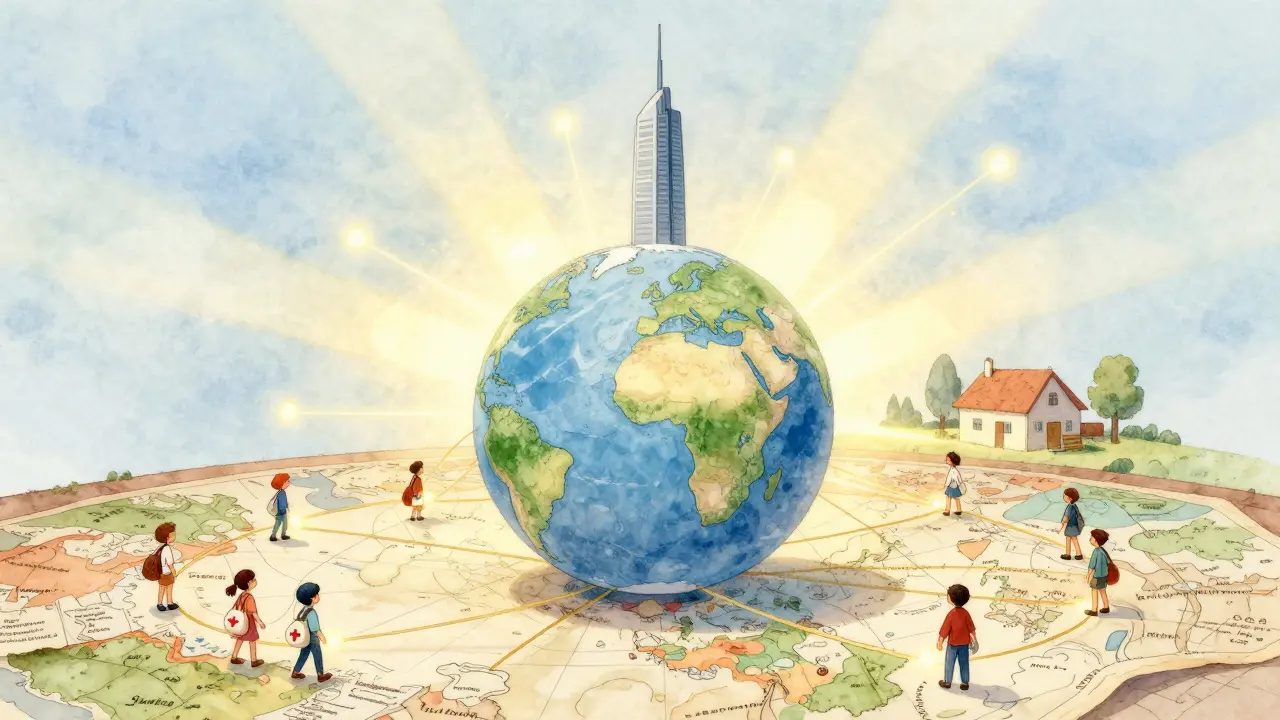
We often hear about how medicines become cheaper once patents expire, but what forces that expiration in the first place? Behind every pill bottle lies a complex web of international treaties that decide who can make it and at what price. These rules aren't just legal footnotes; they determine whether life-saving treatments remain out of reach for millions. Today, we're talking about the Trade-Related Aspects of Intellectual Property Rights (TRIPS), the global framework that dictates patent policy and shapes the market for generic medicines. If you've ever wondered why a cancer drug costs thousands in one country and pennies in another, the answer starts here.
The Origins of TRIPS and Global Standards
To understand today's pharmacy landscape, we have to look back to 1995. Before that year, patent laws were largely local. A country like India could choose to protect manufacturing methods without granting exclusive rights over the product itself, allowing local companies to produce affordable copies of patented drugs. World Trade Organization (WTO) members signed the Marrakesh Agreement, establishing TRIPS, which forced a unified global standard. Suddenly, developing nations had to recognize product patents for a minimum of 20 years, matching the standards set by wealthy nations.
This shift wasn't about charity; it was about economic predictability. Industrialized countries, led by the United States and the European Union, argued that strong intellectual property rights encourage innovation. They claimed that without the promise of high profits during a monopoly period, pharmaceutical companies would stop investing billions in research and development. While this logic makes sense in theory, the practical outcome changed the dynamics of global health overnight. By 2010, 147 out of 151 developing countries had extended patent protection to their markets, closing the loopholes that had previously allowed competition.
How Patents Shifted Generic Availability
The most visible change came to generic medicines. Historically, generic manufacturers produced alternatives once a patent expired or used different processes to create the same result. Under the pre-TRIPS era, many countries accepted process patents but not product patents. This meant a company could buy a machine to make a drug if they figured out a different way to build it than the original inventor. After TRIPS, the protection covered the molecule itself. Even if a manufacturer discovered a cheaper way to synthesize the drug, they couldn't sell it until the patent holder said okay.
Feature
Pre-TRIPS Era
Post-TRIPS Era
Patent Type
Process patents common
Product patents mandatory
Protection Duration
Varies by country
Minimum 20 years
Generic Access
High flexibility
Limited by uniformity
Pricing Impact
Affordability easier
Costs increased significantly
The result was immediate inflation for patented drugs. Studies noted that in some cases, prices jumped well over 200 percent after implementation because the local supply of cheap versions vanished. Patients relying on these medications suddenly faced choices between paying full retail or skipping doses entirely.
Compulsory Licensing: A Safety Valve?
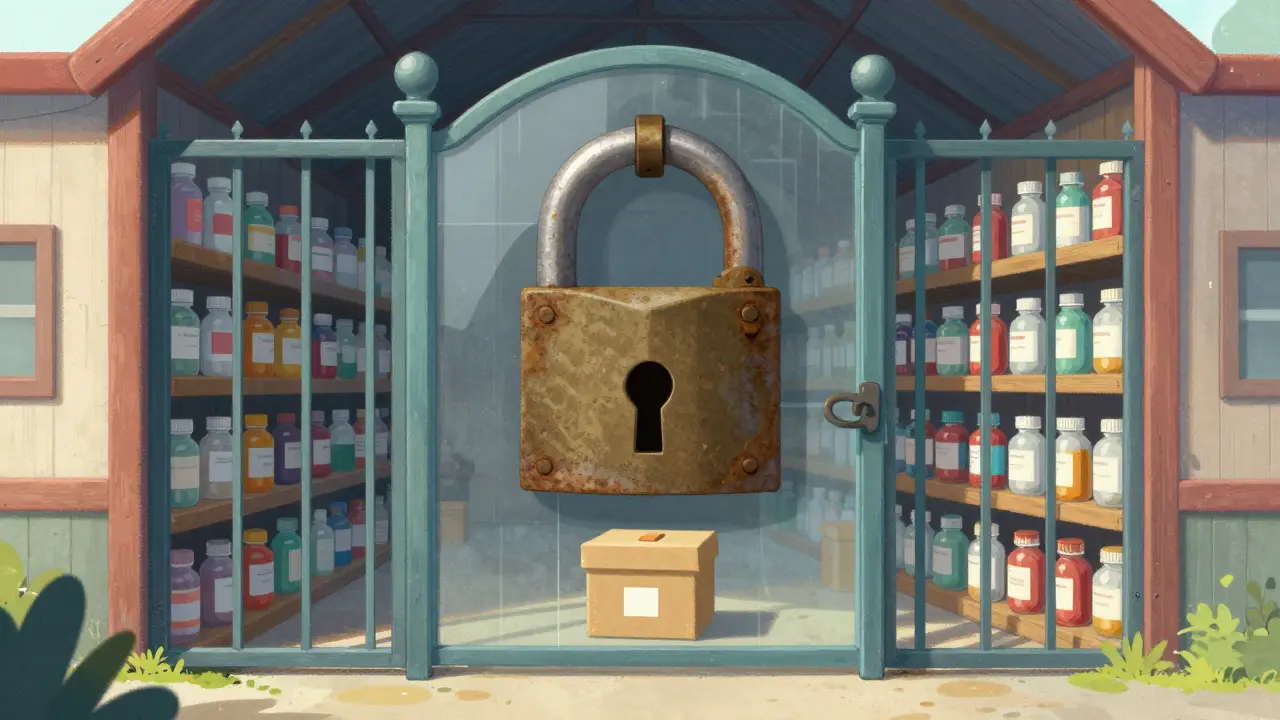
It might seem unfair to lock everyone behind a paywall forever, but policymakers included an emergency exit. Article 31 of the agreement introduced compulsory licensing. This provision allows a government to authorize third parties to produce a patented product without the owner's consent. Imagine a factory being allowed to print copyrighted books because the library needs them for students-that's essentially what this does for medicine during public health crises.
However, the conditions were strict. For a long time, licenses were limited to supplying the domestic market. If Country A issued a license, the generics made there had to stay in Country A. This left nations with poor manufacturing capacity stranded. You can't import a generic version easily without permission from the exporter, creating a logistical nightmare for countries lacking heavy industry. The World Health Organization highlighted this flaw early on, noting that the "domestic market" requirement effectively barred imports for many smaller economies.
The Doha Declaration and Flexibility Attempts
By 2001, the pressure became too great. Governments gathered at the WTO Ministerial Conference in Doha, Qatar, recognizing that the rigid application of IP rules was harming public health. They issued the Doha Declaration, affirming that trade agreements should not prevent countries from protecting their populations. It stated clearly that members could use measures to safeguard public health, including issuing compulsory licenses.
This sounded promising on paper, but reality proved messier. Many countries hesitated to act. Threats of trade sanctions loomed large. In Brazil, the U.S. initially threatened legal action under its Trade Act when the nation began producing generic antiretroviral drugs for AIDS treatment. The lawsuit didn't happen, but the political chill remained. Similarly, South Africa saw 40 pharmaceutical companies sue the government just for passing laws to allow parallel imports of cheaper medicines. The threat alone drained resources and scared many officials away from utilizing available flexibilities.
Data Exclusivity: The Hidden Barrier
Beyond patents themselves, there is a second, often less discussed barrier called data exclusivity. When a new drug launches, the manufacturer submits clinical trial data to regulators to prove it works. Some trade agreements prevent regulatory authorities from using this data to approve a generic version for several years, even after the patent expires.
This adds another 5 to 10 years of monopoly protection. While TRIPS doesn't explicitly mandate this, many modern bilateral trade deals do. These "TRIPS Plus" provisions are stricter than the baseline agreement. For instance, free trade agreements signed by the United States since 2020 often require eight years of data exclusivity in partner nations. This stacks on top of the existing 20-year patent term, potentially keeping prices high for nearly three decades before a generic competitor enters the market.
Real-World Consequences for Public Health
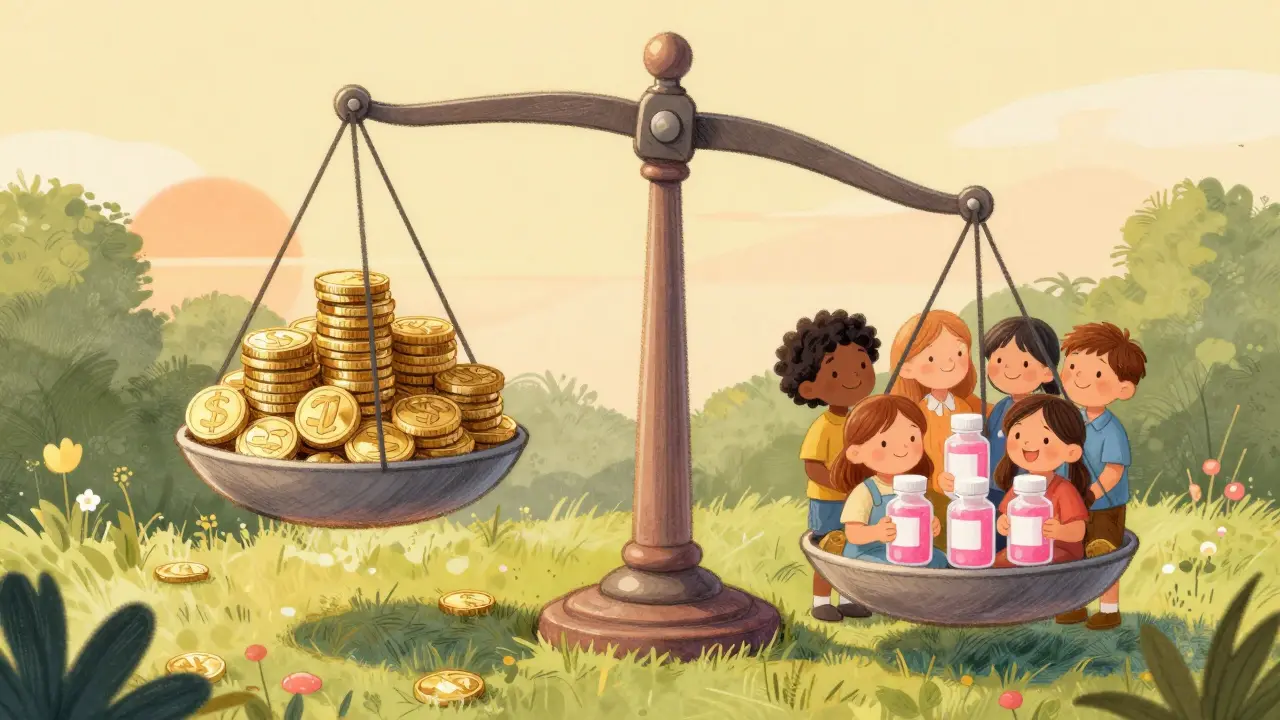
The abstract legal battles translate into real human outcomes. Look at HIV treatment. Between 2000 and 2019, the cost of first-line antiretroviral therapy dropped from $10,000 per patient per year to $75. That drop occurred primarily because countries could bypass patent barriers to secure generics from India and Thailand. Without that ability, millions would still be waiting for unaffordable cures.
Conversely, for newer therapies like Hepatitis C or specific cancers, the cost remains steep. Access to Medicine Foundation reports indicate that 65% of low-income countries face delays in registering generics due to patent linkage provisions. Doctors prescribe expensive brand names because the system hasn't cleared the cheaper alternative yet. This delay isn't accidental; it's built into the timeline designed to maximize return on investment for innovators.
The Pandemic and Future Reforms
The COVID-19 pandemic reignited the debate over intellectual property barriers. In October 2020, India and South Africa proposed waiving TRIPS obligations specifically for pandemic-related technologies. They argued that hoarding vaccines and treatments hindered the global fight against the virus. Over 100 WTO members eventually supported the idea. However, resistance from the EU, Switzerland, and the US delayed action until partial concessions were finally agreed upon in June 2022.
Even with these reforms, the tension remains. Organizations like the Medicines Patent Pool, established in 2010, offer a middle path. They negotiate voluntary licenses from originator companies to allow generic production for specific low-income markets. This has reached 17.4 million patients across various diseases. Yet, critics argue that voluntary pools don't solve the fundamental conflict between profit margins and public accessibility. As we move toward 2026, the focus is shifting toward balancing R&D incentives with the undeniable human need for affordable healthcare.
its crazy how simple laws change lives for patients instead of helping them
I want to highlight something important about data exclusivity! It actually extends protection beyond the patent term! This means even after 20 years you still cant make generics! Regulators cant use the trial data for approval during that window! Many free trade agreements include this clause specifically! The US pushed hard for eight years of this exclusivity! It adds up to thirty years of high prices before competition starts! This isnt mentioned enough in policy discussions! We need to look at bilateral treaties too! It creates hidden barriers for developing nations trying to import meds! The WHO flagged this as a major issue back in the early 2000s! Countries with no labs get stuck waiting forever! Innovation requires balance but current rules favor profit too much! We see delays in registering life saving drugs constantly! Patients suffer while lawyers argue over clauses! Reform needs to address both patents AND data rules! Otherwise we stay stuck in this expensive cycle!
thats soo true everyone i alaways feel like they hide info from us! thank u for breaking it down so well though! makes me want to learn more abt trade deals now
oh sure lets believe the WTO is all about public health 🙄 its all about profit margins and lobbying money 🧐 nobody talks about how the same people write the laws and own the drug company shares 👀 dont trust the narrative bro 👊
lets not jump to conclusions :) but yeah lobbying definitely plays a huge part in everything
This gives me hope that things can change eventually 🌟 We need to keep pushing for transparency everywhere 💪 Health rights matter more than corporate stock prices 🔥 Lets keep the conversation going 🗣️
I agree with the sentiment but we also need to acknowledge why R&D costs are high 💡 Its a complex puzzle with no easy solution yet ⚖️
WE NEED ACTION NOW!!! Everyone read this!!! It's affecting real families!!! The numbers don't lie!!! We havent fixed this sooner which is shocking!!! Change is possible!!! Keep fighting!!! :)
good points! (-:) staying informed helps us all understand the issues better.