
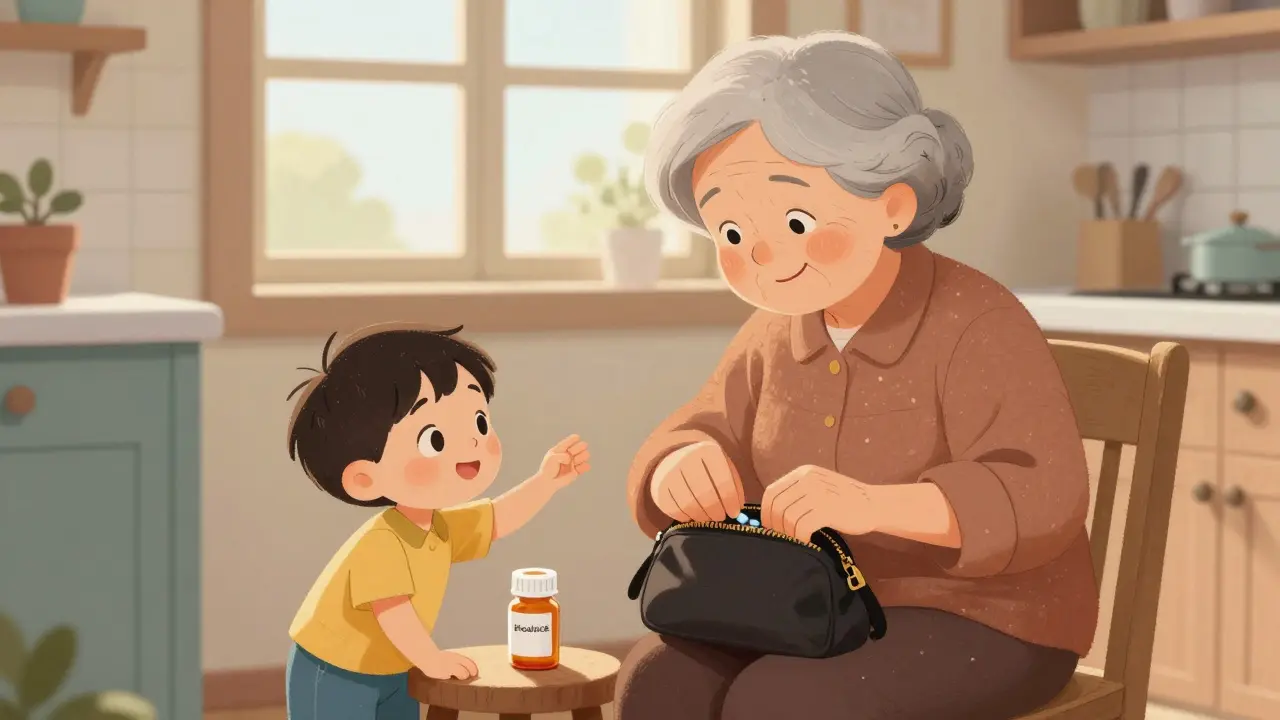
Every year, 58,000 children under age 5 end up in the emergency room because they got into medicine they shouldn’t have. And in more than one-third of those cases-38%-the medicine came from a grandparent’s purse, nightstand, or kitchen counter. This isn’t about negligence. It’s about a gap in awareness. Grandparents love their grandchildren deeply. They want to protect them. But most don’t realize how easily a child can reach a pill bottle, or how dangerous even a single dose can be.
Why Grandparents Are a Critical Part of the Solution
Grandparents aren’t just babysitters. They’re caregivers. Over 7 million grandparents in the U.S. live with their grandchildren. Another 13% provide regular childcare. And nearly 74% of these caregiving grandparents take at least one prescription daily. That’s more than double the rate of parents in their 30s and 40s.
Here’s the problem: medicine doesn’t stay hidden. A bottle of blood pressure pills in a purse. A bottle of pain relievers on the dresser. A weekly pill sorter on the counter. These are common sights in homes where grandparents live or visit. And kids? They’re curious. They climb. They reach. They open.
Studies show 30% of 4-year-olds can open child-resistant caps in under five minutes. Yet 36% of grandparents believe those caps are enough to keep kids safe. That’s a dangerous mismatch. The same study found that 29% of caregiving grandparents transfer medications into non-childproof containers-like pill organizers or small jars-because the original bottles are hard to open. What feels like a helpful change? It’s actually a major risk.
Where Medicines Are Hidden (and Why That’s Dangerous)
Medicines aren’t always stored in obvious places. They’re tucked into:
- Bedside tables (12% of caregiving grandparents keep meds here)
- Handbags and purses (31% keep them accessible)
- Kitchen counters and cabinets (38% store them here)
- Bathroom cabinets (45% store them here)
Each of these spots is a potential hazard. A child climbing onto a stool to reach a purse. A toddler pulling open a drawer while searching for snacks. A curious hand grabbing a bottle labeled “vitamins.”
Compare this to parents: 68% store medications safely. Grandparents? Only 52% do. Why? It’s not laziness. It’s habit. Many grandparents grew up in a time when medicine was kept in a medicine cabinet, and childproofing wasn’t a thing. They don’t realize how much the risks have changed.
What Works: The PROTECT Initiative’s Proven Approach
In 2010, the CDC and the Consumer Healthcare Products Association launched the “Up & Away and Out of Sight” campaign. It’s simple. And it works.
A 2017 NIH study tested a 15-minute educational session with 223 grandparents. After just one session, safe storage jumped from 39% to 78%-and stayed there 50 to 90 days later. Here’s what made the difference:
- Visuals, not lectures. Showing photos of real homes and real medicine storage mistakes.
- Hands-on practice. Letting grandparents open and close child-resistant caps. Only 54% could do it correctly before the session.
- Clear language. Saying “Let’s keep our grandkids safe” instead of “You’re putting them at risk.”
The results were strongest in the grandparents’ own homes. That’s key. Safety isn’t about what happens at the parents’ house. It’s about every place the child visits.
How to Make Medication Storage Safe-Step by Step
If you’re a grandparent, caregiver, or parent helping one, here’s exactly what to do:
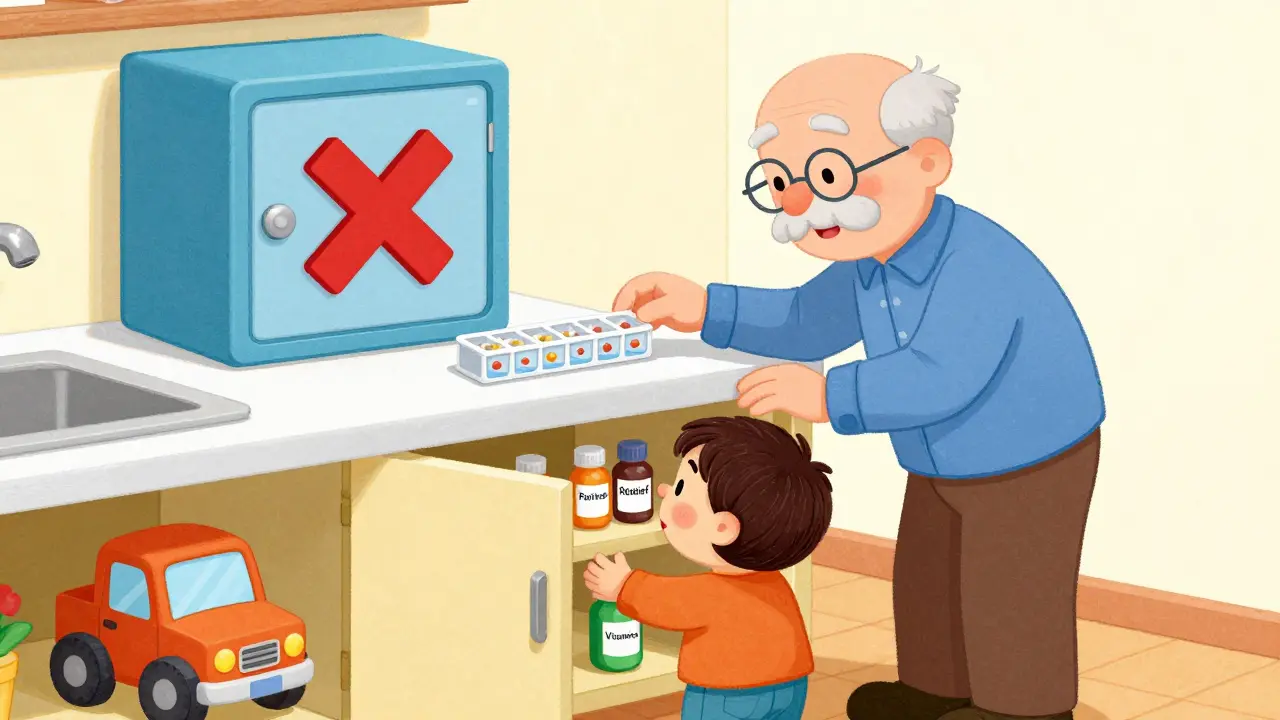
- Keep all medicine in a locked cabinet. Not just any cabinet. One that requires 15+ pounds of force to open. Install a latch if needed. High up. Out of sight. Out of reach.
- Use original containers. Never transfer pills into pill organizers, jars, or envelopes. The labels tell you what it is, how much to take, and when it expires. If the cap is hard to open, ask your pharmacist for an easy-open cap or a secondary bottle.
- Never leave medicine in bags or pockets. Even if you’re only going to the park for an hour. A child can open a purse in seconds.
- Dispose of old medicine properly. Don’t flush it. Don’t throw it in the trash. Take it to a pharmacy drop-off. Most pharmacies offer free disposal. If you can’t get there, mix pills with coffee grounds or cat litter, seal them in a bag, and toss them. This makes them unappealing and hard to use.
- Have the talk with your grandchild. Use simple words: “Medicine is not candy.” “Only adults give medicine.” “If you find medicine, tell an adult right away.”
What Grandparents Say-Real Stories
One grandma on Reddit shared: “My 3-year-old found my blood pressure pills in my purse. I caught him just in time. Now I have a locked box in my closet. I tell him these are ‘Grandma’s special vitamins’-only for grown-ups.”
Another grandpa said: “I tried putting my meds in a lockbox, but my wife said it felt like she was being accused of being careless. We didn’t talk about it for weeks.”
That’s the emotional hurdle. Many grandparents feel judged. But the truth? They’re not being blamed. They’re being helped. And they care deeply. In fact, 87% of grandparents say they’re highly concerned about their grandchild’s safety-higher than most parents.
How Families Can Work Together
This isn’t just a grandparent problem. It’s a family problem. And it’s fixable.
Start with a calm conversation:
- Ask: “Do you know where we keep our meds when the kids visit?”
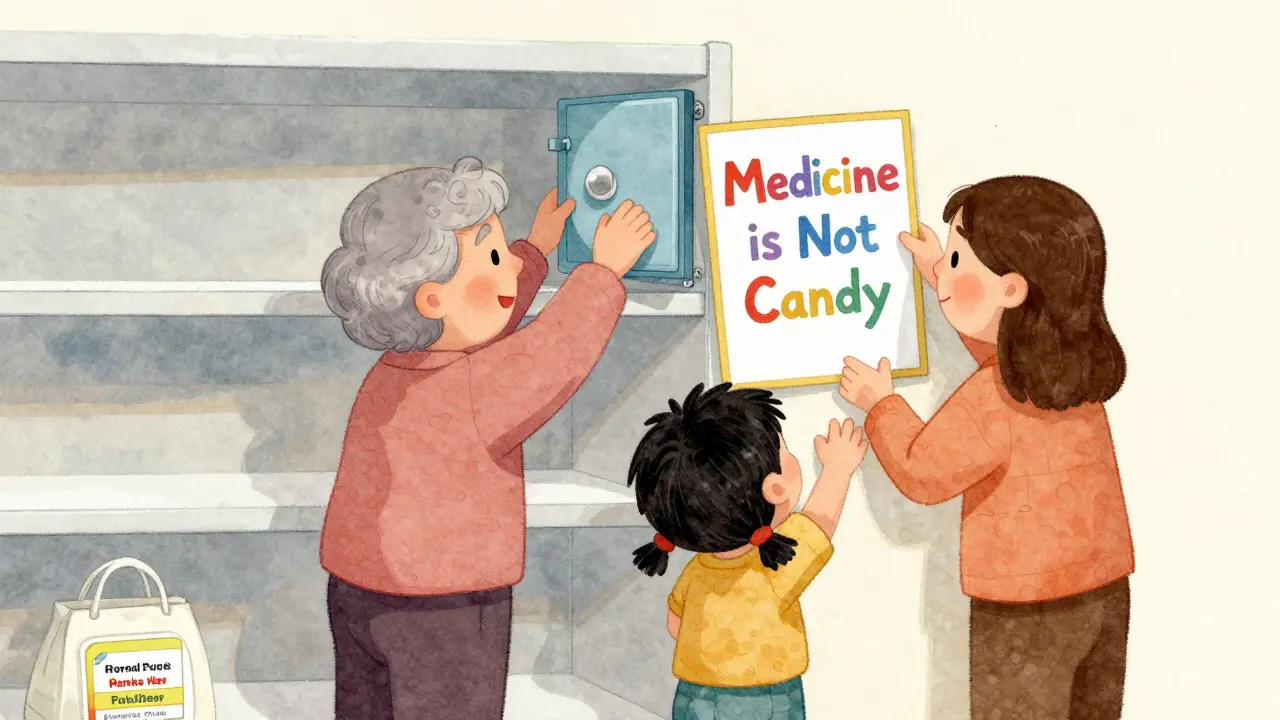
- Offer: “I can send you a free lockbox. Some pharmacies give them out for free.”
- Involve the child: “Let’s make a poster together-‘Medicine is not candy.’”
- Agree on a system: “When the kids come over, we’ll both check the locked box before they arrive.”
Only 38% of families have this kind of clear plan. That’s too low. A simple agreement reduces risk dramatically.
What’s Changing Now-New Tools and Support
In January 2024, the CDC launched the “Grandparent Guardian” digital toolkit. It includes short videos in English, Spanish, and other languages showing how to lock up medicine, open child-resistant caps, and dispose of old pills. Early data shows 85% of viewers watch the whole thing.
Pharmacies are helping too. 78% of major chains now offer free lockboxes to seniors. Some even do quick safety checks when you pick up your prescription. Ask: “Do you have anything for grandparents with visiting kids?”
And there’s more coming. The Safe Storage for Grandkids Act, proposed in Congress, would fund $15 million a year for education and lockbox programs. It’s not law yet-but it shows this issue is getting real attention.
What to Do Right Now
You don’t need a perfect system. You just need a safer one.
- Look around your home. Where are the medicines?
- Find one spot to lock them up-today.
- Call your pharmacy. Ask for a lockbox or easy-open cap.
- Have the talk with your grandchild. Just three simple sentences.
It takes five minutes. But it could save a life.
Why do grandparents often store medicine unsafely?
Many grandparents grew up in a time when medicine safety wasn’t a major concern. They store pills in familiar places-like nightstands, purses, or kitchen counters-because that’s what worked for them. They also don’t realize how quickly kids can open child-resistant caps or reach high shelves. Age-related memory issues and the complexity of managing multiple medications make it harder to stay consistent with safe practices.
Can child-resistant caps really be opened by kids?
Yes. While child-resistant caps are designed to slow down children, they’re not foolproof. Consumer Product Safety Commission testing shows that 30% of 4-year-olds can open them in under five minutes. That’s why storage location matters more than the cap type. Even a child-resistant bottle on a low counter is a risk.
What should I do if my grandchild swallows medicine?
Call Poison Control immediately at 1-800-222-1222. Don’t wait for symptoms. Don’t try to make them vomit. Have the medicine bottle ready when you call-so you can tell them what was taken and how much. Keep this number saved in your phone and posted on your fridge. It’s the fastest way to get help.
Are over-the-counter medicines just as dangerous as prescriptions?
Absolutely. Tylenol, Advil, cough syrup, and even children’s vitamins can be toxic in small amounts. In fact, more than half of pediatric poisonings involve non-prescription drugs. Just because something is sold without a prescription doesn’t mean it’s safe for kids. Treat all medicines the same way: locked up, out of sight, and never left unattended.
How can I talk to my grandparent about medicine safety without offending them?
Focus on teamwork, not blame. Say: “I know you want to keep the kids safe, and I want to help you do that.” Offer solutions: “I found a free lockbox at the pharmacy-want me to bring one by?” Or: “Let’s make a fun poster together so the kids know medicine isn’t candy.” Most grandparents want to do the right thing. They just need support, not criticism.


