
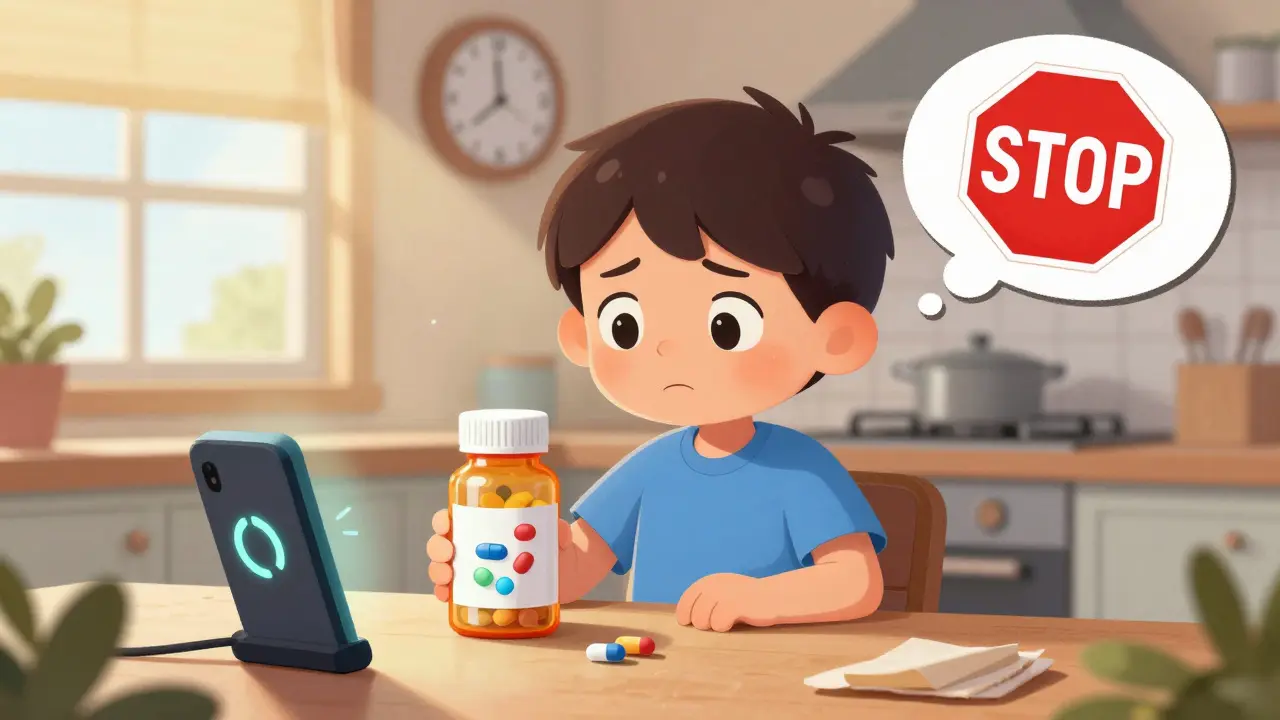
If you open your prescription bottle and the pills look nothing like what you’re used to, stop taking them immediately. Don’t swallow another one. Don’t toss them in the trash. Don’t hand them back to the pharmacy without documenting everything. A wrong medication can cause serious harm - even death - and knowing exactly what to do in those first critical minutes can save your life.
Don’t Take Another Dose - Ever
The first thing you must do is stop. Right now. No exceptions. Whether it’s a pill that looks slightly different, a liquid with a strange color, or a capsule labeled with a name you don’t recognize, if it doesn’t match what your doctor prescribed, it’s not safe. You might think, “Maybe it’s just a different brand,” but brand changes don’t alter the active ingredient enough to make you feel sick. If you’re dizzy, nauseous, or your heart is racing after taking a pill, that’s not a coincidence. It’s a red flag.According to the Institute for Safe Medication Practices, over 1.5 million medication errors happen every year in the U.S. Many of these are dispensing mistakes at the pharmacy - the wrong drug, wrong dose, or even someone else’s prescription. The consequences? Emergency rooms, long-term organ damage, or worse. The clock starts ticking the moment you realize something’s off. Every extra dose increases your risk.
Call Your Doctor Right Away
Don’t wait until your next appointment. Don’t text your doctor and hope they reply. Call them directly. If they’re not available, go to an urgent care center or the ER. Your doctor needs to know immediately because they might need to:- Prescribe a different medication to counteract the effects
- Order blood tests to check for toxicity
- Adjust your treatment plan to prevent complications
- Advise you to go to the emergency room right away
For example, if you were supposed to get blood pressure medicine but got a diabetes drug instead, your blood sugar could crash. If you were taking an antidepressant and got a heart medication, your heart rhythm could go haywire. These aren’t hypotheticals - they happen every day. A 2022 study from the National Coordinating Council for Medication Error Reporting and Prevention found that 26% of all medication-related incidents came from pharmacy dispensing errors. That’s over 1 in 4 mistakes rooted in the pharmacy counter.
Contact the Pharmacy - Speak to the Manager
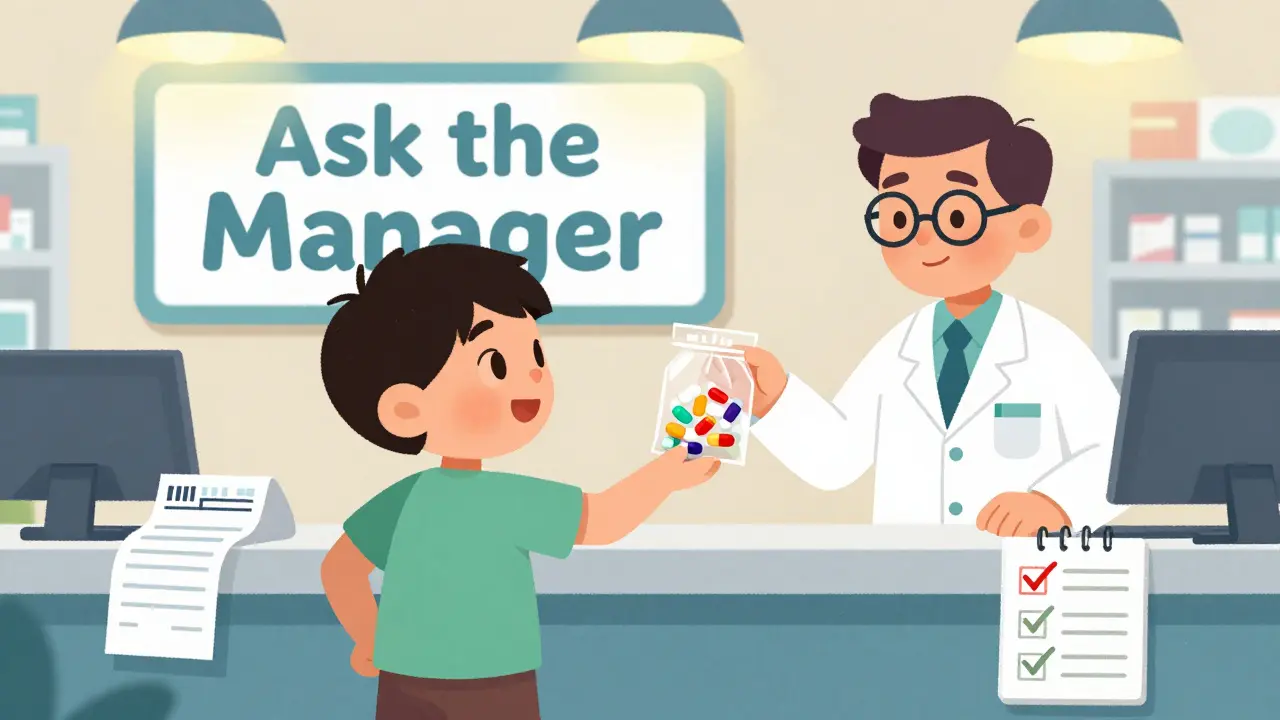
Go back to the pharmacy. Not the tech at the window. Not the clerk who handed you the bag. Ask to speak with the head pharmacist or the manager. Tell them exactly what happened: “I received this medication, but it’s not what my doctor prescribed.” Don’t apologize. Don’t say, “I might be wrong.” Just state the facts.They’re required by law to investigate. And they will - if you give them the evidence. Bring the bottle, the receipt, the original prescription label (if you still have it), and the medication itself. Don’t return the pills. Don’t flush them. Don’t throw them away. Keep them in a sealed bag. These are your proof. If you’re considering legal action later (and you might be), this is the only way to prove what happened.
Document Everything - Write It Down
Write down every detail while it’s fresh in your mind:- The exact time you noticed the mistake
- What you were expecting vs. what you received
- Any symptoms you felt after taking the wrong pill
- Who you spoke to at the pharmacy (name, badge number if possible)
- What they said in response
Take photos. Take videos. Show the label side-by-side with the actual pills. If you have the original prescription from your doctor, photograph that too. According to Matt Law’s 2022 case analysis, 92% of successful pharmacy error claims included photographic evidence. Video recordings increase settlement amounts by 37% on average. You’re not being paranoid - you’re being smart.
Report It - To the Right Places
You have two critical reporting options:- Report to the pharmacy’s corporate office. Most chains have a dedicated patient safety line. Call customer service and ask for the compliance or risk management department.
- Report to the FDA’s MedWatch program. This is the federal system for tracking medication errors. You can file online at fda.gov/medwatch. In 2022 alone, the FDA received over 92,000 medication error reports - 38% from community pharmacies.
Some states also require reporting to local health boards. In Georgia, for example, pharmacies must report errors to both the Georgia Composite Medical Board and the Attorney General’s Consumer Protection Division. Even if your state doesn’t require it, filing a report helps track patterns. If multiple people report the same pharmacy making the same mistake, regulators take notice.
Don’t Talk to Insurance or Pharmacy Lawyers - Without Legal Advice
You might get a call from the pharmacy’s insurance company. They’ll sound friendly. “We’re so sorry this happened. We’d like to make it right.” But don’t sign anything. Don’t give a recorded statement. Don’t accept a quick settlement offer. These offers are usually low - often under $5,000 - and they come with a waiver that prevents you from suing later.According to the American Association for Justice, 70% of pharmacy error cases settle out of court, with average payouts between $50,000 and $500,000. Catastrophic cases - like permanent brain damage or death - have resulted in verdicts over $10 million. You don’t get that kind of money by accepting a quick apology and a gift card.
If you suffered harm, talk to a lawyer who specializes in medical malpractice. Many offer free consultations. They’ll tell you if you have a case, and if so, how much you might recover. Never give a statement to anyone without your lawyer present. Ever.
What Happens to the Pharmacy?
Pharmacies are held to strict standards. If a dispensing error is confirmed, they can face:- Fines from state pharmacy boards
- Loss of license for the pharmacist involved
- Required staff retraining
- Public citations on state inspection reports
Some pharmacies use barcode scanning systems to catch errors before the pill leaves the counter. These systems reduce mistakes by 85%. But only 62% of U.S. pharmacies use them. That means nearly 4 out of 10 pharmacies are still relying on human eyes and memory - which fail.
Trustpilot reviews show that major chains like Walgreens, CVS, and Rite Aid have average ratings below 2.5 stars for prescription accuracy. That’s not an accident. It’s systemic. When pharmacists are rushed, understaffed, or working double shifts, mistakes happen. And the burden falls on you.
How to Prevent This in the Future
You can’t control the pharmacy - but you can protect yourself:- Check every prescription. Compare the pill to the description on the label. Color? Shape? Size? Dosage? If it doesn’t match, ask.
- Ask the pharmacist to explain what it’s for. If they can’t tell you why you’re taking it, that’s a red flag.
- Use one pharmacy. When all your prescriptions are in one system, pharmacists can catch dangerous interactions.
- Ask for printed information. Most pharmacies provide a patient leaflet. Read it. It lists side effects and what to watch for.
Also, keep a list of all your medications - including doses and why you take them - and bring it to every doctor visit. This helps prevent prescribing errors before they reach the pharmacy.
Long-Term Risks You Can’t Ignore
A single wrong pill might seem like a small mistake. But the long-term effects are real. A study in the Journal of the American Medical Association found that patients who experienced a medication error had a 28% higher risk of dying within five years. Cardiovascular errors - like getting the wrong blood pressure or heart rhythm drug - carried the highest risk: 42% increased mortality.The Institute of Medicine estimates preventable medication errors cost the U.S. healthcare system $21 billion a year. Over $8 billion of that comes from community pharmacy errors. That’s not just money. It’s lives. It’s emergency visits. It’s lost workdays. It’s families torn apart by preventable mistakes.
You have rights. You have power. And you have the ability to act - fast - to protect yourself and others.
What should I do immediately after realizing I got the wrong medication?
Stop taking the medication right away. Do not take another dose. Save the pill, the bottle, the receipt, and the prescription label. Call your doctor immediately. If you feel unwell, go to the emergency room. Document everything - time, symptoms, who you spoke to at the pharmacy.
Can I get in trouble for keeping the wrong medication?
No. You are not required to return the medication. In fact, keeping it is critical if you want to prove what happened. Pharmacies and insurance companies may ask you to return it, but do not do so without documenting it first. Take photos and videos of the medication and label. This is your evidence.
How long do I have to file a legal claim for a pharmacy error?
It depends on your state. Most states give you between 1 and 3 years from the date you discovered the error to file a claim. In Georgia, the deadline is 2 years. In California, it’s 3 years. If you think you might have a case, talk to a lawyer as soon as possible - even if you’re not sure. Many offer free consultations.
Why do pharmacies make these mistakes?
Common causes include high workload, understaffing, similar-looking pill names, handwritten prescriptions, and lack of barcode scanning systems. Only 62% of U.S. pharmacies use barcode scanning, which reduces errors by 85%. Many pharmacies are still relying on manual checks - and humans make mistakes.
Should I report the pharmacy to the government?
Yes. Report it to the FDA’s MedWatch program and your state’s pharmacy board. This helps regulators track patterns and enforce safety standards. Over 92,000 medication errors were reported to the FDA in 2022, but experts say less than 15% of all errors are ever reported. Your report could prevent someone else from being harmed.
Just wanted to say this post saved my life last year. I got a bottle that looked totally off, and I almost tossed it like I used to. Then I remembered reading something like this and paused. Called my doc, they confirmed it was wrong, and we caught it before I took a single pill. Seriously, everyone should save this thread.
lol so many steps 😅 i just call the pharmacy and yell at them
It is not hyperbole to say that medication errors represent one of the most insidious threats to public health in modern America. We have entrusted our lives to systems that operate on efficiency over humanity, and when the human element fails - as it inevitably does - the cost is measured in heartbeats, in breaths, in futures cut short. This article does not merely inform; it is a moral imperative written in clinical detail. Thank you.
pharmacies make mistakes because theyre underfunded and overworked but also because the whole system is designed to prioritize profit over safety and we all know it but nobody does anything except maybe report it on fda which takes 6 months to even look at and by then you already got a new script and forgot about it
I’ve been thinking about how much of our health is built on trust - trust in the doctor, trust in the pharmacist, trust that the system won’t slip. But when you realize that trust is a fragile thing, that a misread label or a rushed shift can change everything… it’s terrifying. And yet, the fact that we still go back week after week, hand over our prescriptions, and hope for the best - that’s not ignorance, that’s resilience. We’re not just patients, we’re participants in a broken machine, and this post gives us the tools to push back without losing our minds.
This is gold. I work in healthcare in India and we face similar issues - wrong meds, unclear labels, no documentation. But here’s the thing: if you calmly but firmly ask the pharmacist to walk you through the medication - what it’s for, how it should look, what side effects to expect - they almost always pause and double-check. It’s not about confrontation. It’s about turning a transaction into a conversation. One simple question can prevent disaster.
YES. Check every bottle. Ask questions. No shame. I used to feel dumb asking, but now I say ‘Hey, I’m paranoid - can you confirm this is my blood pressure med?’ and they laugh, then check twice. It’s weird how a little assertiveness turns the whole vibe. You’re not being difficult - you’re being the adult in the room.
have you considered that this whole thing is a government scam to sell more blood pressure meds? i mean think about it - they want you to panic, keep the pills, take photos, call the fda - but what if the ‘wrong’ pill was actually the right one and they just changed the label to make you think you’re in danger? i got my meds from cvs last week and the bottle said ‘lisinopril’ but the pills were blue and round - same as always. what if they’re testing us?
Good info. Just keep the bottle. Call your doc. Don’t panic. You’ve got this.