
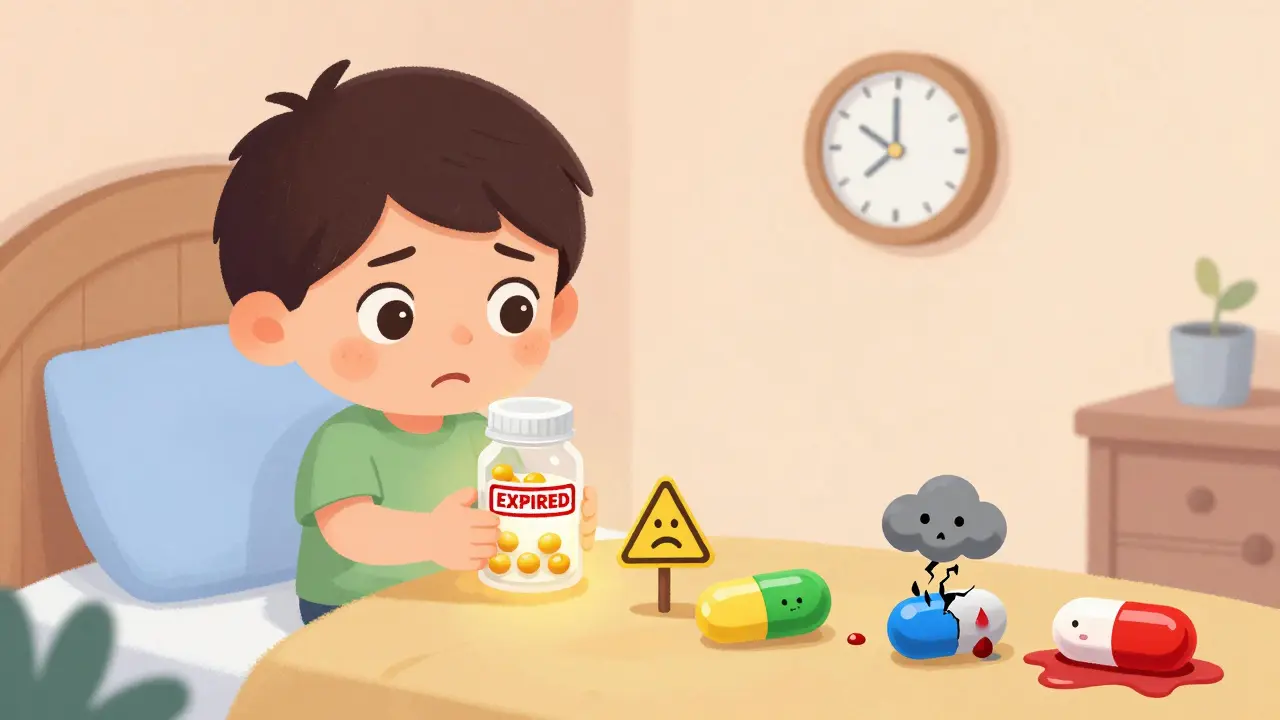
When you see an expiration date on a pill bottle, you might think it’s just a suggestion - maybe the drug is still fine. But for certain medications, that date isn’t just a recommendation. It’s a hard line between life and death. Medications with a narrow therapeutic index (NTI) are among the most dangerous to use after they expire. Even a tiny loss of potency - or a slight increase in toxic byproducts - can send a patient into crisis. This isn’t theoretical. It’s happened. And it can happen again.
What Is a Narrow Therapeutic Index?
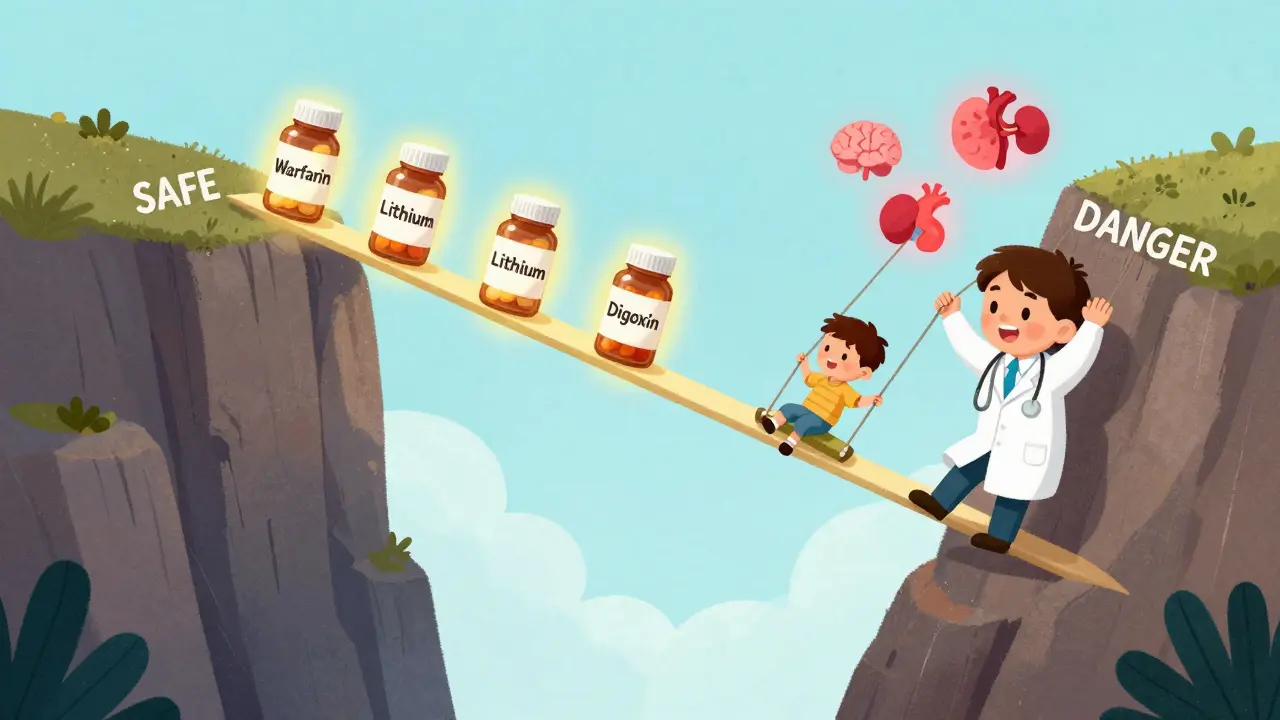
A narrow therapeutic index means there’s almost no room for error. The difference between a dose that works and a dose that kills is razor-thin. For most drugs, the body can handle some variation. But for NTI drugs, a 10% change in concentration can mean the difference between healing and hospitalization.
The U.S. Food and Drug Administration defines NTI drugs as those where small changes in blood levels can lead to serious side effects - like internal bleeding, seizures, kidney failure, or heart rhythm problems. The therapeutic window is so tight that the toxic dose is often just 1.5 to 2 times the effective dose. For comparison, most drugs have a safety margin of 5 to 10 times. NTI drugs don’t have that cushion.
Common NTI medications include:
- Warfarin - used to prevent blood clots
- Lithium - for bipolar disorder
- Digoxin - for heart failure and irregular heartbeat
- Phenytoin - an antiseizure drug
- Carbamazepine - also for seizures and nerve pain
- Levothyroxine - for underactive thyroid
- Cyclosporine - after organ transplants
- Aminoglycosides - antibiotics like gentamicin
These aren’t rare drugs. Millions of people take them. And if any of them are expired, the risk isn’t just higher - it’s unacceptable.
Why Expiration Dates Matter More for NTI Drugs
Expiration dates aren’t arbitrary. They’re based on real stability testing. Manufacturers test how long a drug keeps its full strength under normal storage conditions. For most medications, even after expiration, potency may remain above 90%. But for NTI drugs, that 10% drop isn’t just a number - it’s a trigger.
Take warfarin. Its therapeutic range is an INR (International Normalized Ratio) of 2.0 to 3.0. If a patient’s INR goes above 4.0, they risk dangerous bleeding. If it drops below 1.5, they could develop a stroke or pulmonary embolism. A 10% drop in warfarin potency could push an INR from 2.8 down to 2.2 - enough to stop the drug from working. But a 10% increase? That could spike the INR to 3.5 or higher. No warning. No symptoms until it’s too late.
Digoxin is even more dangerous. Its therapeutic range is 0.5 to 0.9 nanograms per milliliter of blood. Toxicity starts at 1.2. That’s a 33% increase from the top of the safe range. If an expired digoxin tablet degrades and releases more active compound - or if a degradation product forms - a patient could slip into toxicity without any change in dose.
Phenytoin is another example. Its blood concentration must stay between 10 and 20 mcg/mL. Below 10, seizures return. Above 20, patients develop tremors, confusion, or even coma. A small loss of potency might cause breakthrough seizures. A small gain - from degraded material - could cause brain damage.
Studies show that NTI drugs have low within-subject variability - meaning the same person’s body responds very consistently to the same dose. So if a patient has been stable on a specific dose for months, and then switches to an expired version, their body doesn’t adapt. It reacts. And the reaction can be catastrophic.
What Happens When NTI Drugs Expire?
Most drugs don’t turn toxic when they expire. They just lose strength. But NTI drugs are different. Some degrade in unpredictable ways:
- Warfarin can break down into inactive forms - reducing anticoagulant effect
- Lithium tablets may absorb moisture, changing how quickly they dissolve - leading to erratic absorption
- Digoxin can form breakdown products that are more toxic than the original compound
- Phenytoin may become less soluble, so it doesn’t absorb properly - causing sudden drops in blood levels
These aren’t guesses. They’re documented in pharmaceutical stability studies. The FDA requires manufacturers of NTI drugs to use stricter bioequivalence standards. For most drugs, generics must be 80-125% as potent as the brand. For NTI drugs like levothyroxine and phenytoin, the range is 90-111%. That’s a 22% tighter window. Why? Because even a 5% drop in potency can be dangerous.
Now imagine that same 5% drop happens after expiration. A drug that was at 100% potency at expiration may now be at 92%. That’s a 16% deviation from the acceptable bioequivalence range. It’s outside the safety margin. And no one is testing it.
Real-World Consequences
There’s no shortage of cases where expired NTI drugs caused harm. A 2018 study in the Journal of Clinical Pharmacy and Therapeutics reviewed 147 cases of adverse drug events linked to NTI medications. Over 60% involved dose-related toxicity or therapeutic failure. While the study didn’t track expiration, it did show that small changes in concentration - changes that could come from degraded medication - led to hospitalizations, permanent disability, or death.
One case involved a 68-year-old man on warfarin after a mechanical heart valve replacement. He’d been stable for years. His INR hovered at 2.7. Then he switched to a bottle of warfarin that had expired 11 months earlier. His INR dropped to 1.4. Two weeks later, he had a stroke. He survived - but with permanent brain damage.
Another patient, on lithium for bipolar disorder, took a bottle that expired two years prior. She developed tremors, confusion, and vomiting. Her lithium level was 1.8 mEq/L - well into the toxic range. She was hospitalized for five days. Her doctor later found the tablets had absorbed moisture, changing their dissolution rate. The dose she took was higher than expected - not because she took more, but because the drug had changed.
These aren’t outliers. They’re predictable outcomes of ignoring expiration dates on high-risk medications.
What Should You Do?
If you take an NTI medication, here’s what you need to do:
- Never use expired NTI drugs. No exceptions. Even if they look fine.
- Check expiration dates monthly. Set a reminder on your phone. These drugs don’t wait for convenience.
- Store them properly. Keep them in a cool, dry place. Not the bathroom. Not the car. Not the medicine cabinet above the sink.
- Don’t refill early. If your prescription says 30 days, don’t refill at 25. You don’t need to stockpile.
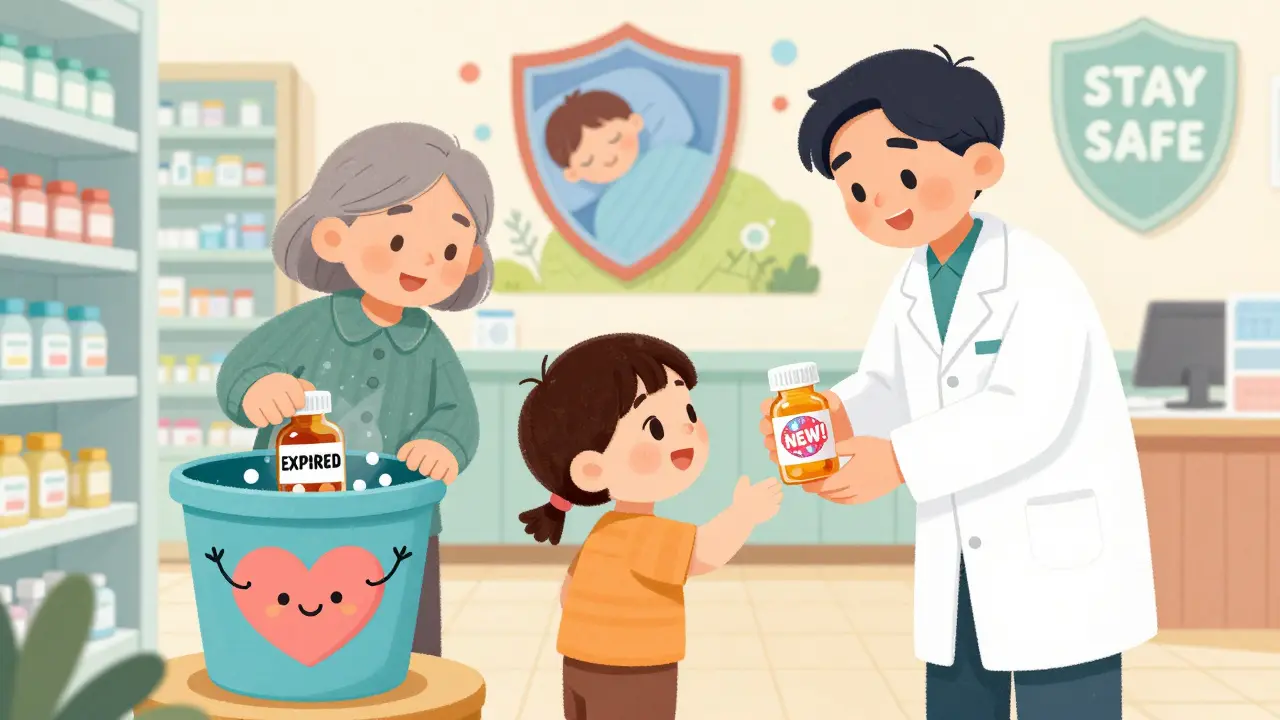
- Ask your pharmacist. If you’re unsure, ask if your medication is on the NTI list. Most pharmacists know.
- Don’t share. Even if someone else has the same diagnosis, their dose is different. NTI drugs are not interchangeable.
Healthcare providers should treat all NTI drugs as high-alert medications. That means double-checking prescriptions, verifying expiration dates before dispensing, and educating patients. The Institute for Safe Medication Practices recommends independent double-checks for NTI drugs - especially when switching brands or refilling after expiration.
Why Doesn’t the FDA Say This More Clearly?
The FDA doesn’t have a public warning about expired NTI drugs. Why? Because they haven’t studied it. There’s no large-scale clinical trial on the effects of expired NTI medications. It’s unethical to run one. You can’t test whether an expired digoxin tablet will kill someone. But the evidence is there - in the pharmacology, in the bioequivalence standards, in the case reports.
The FDA requires tighter manufacturing controls for NTI drugs. They know the risk. But they haven’t translated that into public guidance. That’s a gap. And it’s dangerous.
Some pharmacy boards - like North Carolina’s - have issued guidelines warning that expired NTI drugs may have "erratic absorption" and "formulation-dependent bioavailability." But most states don’t. Patients are left to guess.
Bottom Line
For most drugs, using them a few months past expiration might be low risk. For NTI drugs, it’s not a gamble. It’s a gamble with your life. A 5% loss of potency isn’t just a number - it’s a stroke waiting to happen. A 10% increase isn’t just a side effect - it’s a trip to the ICU.
If you take warfarin, lithium, digoxin, phenytoin, or any other NTI medication, treat the expiration date like a stop sign. Don’t drive through it. Don’t creep past it. Stop. And get a new prescription.
Your body doesn’t adapt to degraded drugs. It reacts. And sometimes, it’s too late before you know it.
That's it. No drama. Just do it.