
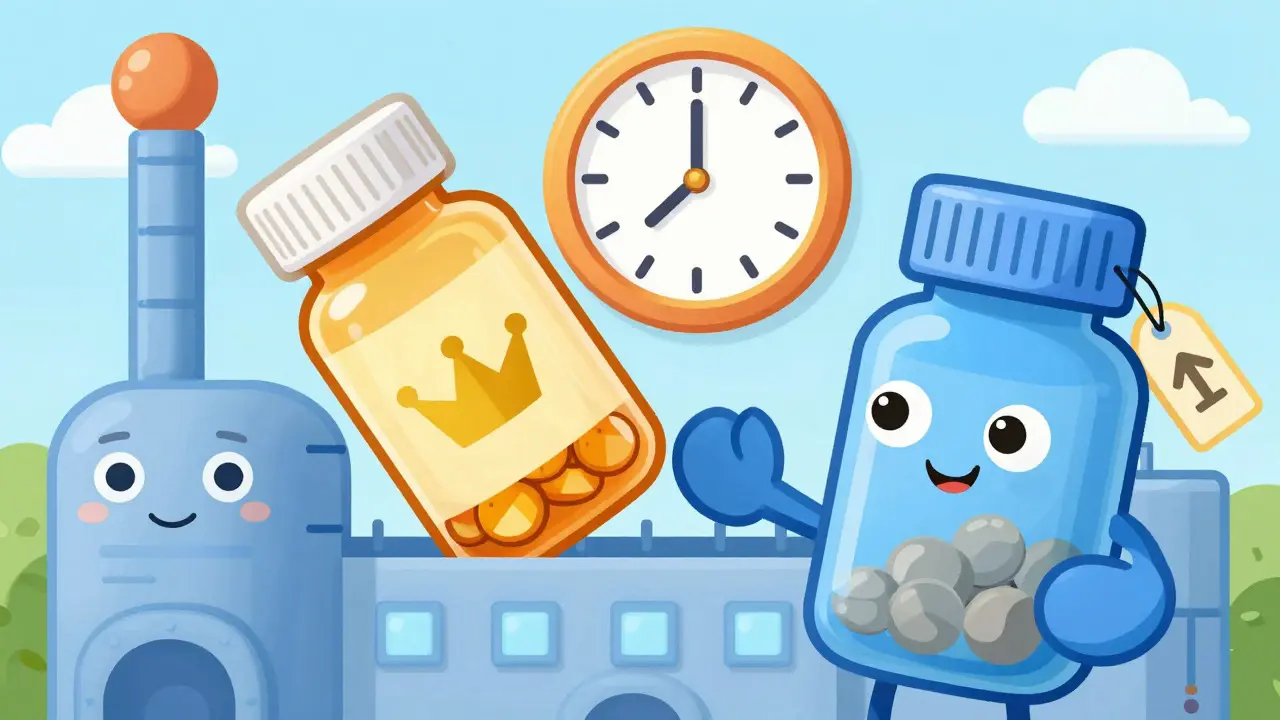
Imagine a blockbuster drug losing its patent protection. Suddenly, the market opens up for cheaper copies, and revenue often plummets by 80-90% in just one year. It’s a terrifying scenario for any pharmaceutical giant. But there is a clever loophole that allows brand companies to keep their foot in the door. They launch authorized generics, which are their own drugs sold without the brand label, at generic prices. This isn't just about saving money; it's a calculated move to protect market share, confuse competitors, and keep patients loyal. Understanding this strategy reveals how pharma giants play the long game when patents expire.
The Core Concept: What Is an Authorized Generic?
An authorized generic is identical to the brand-name drug in both active and inactive ingredients. The only differences are the labeling, color, or markings on the pill. Unlike traditional generics, which must go through a separate approval process called the Abbreviated New Drug Application (ANDA), authorized generics operate under the original brand's New Drug Application (NDA). This means they don’t need new FDA approval for bioequivalence because they *are* the original formulation. The brand manufacturer simply notifies the FDA and starts selling the same product under a different name, usually at a lower price point.
This regulatory shortcut is crucial. Traditional generics take 18-24 months to get approved. Authorized generics can hit the shelves almost immediately after a decision is made. For a company facing imminent patent expiration, speed is everything. By launching an authorized generic, the brand ensures that at least one version of their exact formulation remains available, preserving clinical outcomes while capturing the price-sensitive segment of the market.
Defending Against the Patent Cliff
The primary reason brands launch authorized generics is defense. When a patent expires, the first generic competitor typically enjoys a 180-day exclusivity period under the Hatch-Waxman Act. During this window, that single generic maker has a temporary monopoly, allowing them to charge higher prices than other generics but still less than the brand. It’s a lucrative position for the generic maker, but a painful one for the brand owner.
By launching an authorized generic during this 180-day window, the brand company directly competes with the exclusive generic maker. Data from Health Affairs (2022) shows that in markets with this exclusivity period, about 70% of authorized generics launched before or during this window. The Federal Trade Commission’s 2011 report confirmed that this practice significantly lowered prices during this critical period. For the brand, this limits the financial windfall for the generic competitor. If the generic maker can’t make as much profit during their exclusive period, they may be less aggressive in future markets, or the brand retains a slice of the revenue that would otherwise vanish completely.
Market Segmentation and Price Discrimination
Beyond defense, authorized generics allow for sophisticated market segmentation. Not all patients or payers are willing to switch to a generic from a competitor. Some doctors prefer the specific formulation of the brand they know, and some insurance plans have preferred drug lists that favor certain manufacturers. An authorized generic lets the brand cater to these segments without cannibalizing its premium-priced brand entirely.
Think of it as two-tier pricing. The brand stays high-priced for those who want the name recognition or specific payer contracts. The authorized generic captures the price-sensitive customers who would otherwise defect to a third-party generic. Instead of losing 100% of the market to generics, the manufacturer retains a portion through this dual-channel approach. For example, Greenstone Pharmaceuticals, a subsidiary of Pfizer, used this strategy with celecoxib (the authorized generic of Celebrex) to maintain presence in the COX-2 inhibitor market after the brand faced competition.
Strategic Timing and Competitive Dynamics
Timing is the art of authorized generics. Historically, between 2010 and 2019, researchers identified 854 authorized generic launches in the U.S., peaking in 2014. In markets where traditional generic competition had already begun, approximately 75% of authorized generics launched after the fact. However, the trend is shifting. Recent analysis suggests brands are becoming more proactive, sometimes launching authorized generics even before generic competition materializes. This preemptive strike aims to lock in distribution channels and patient loyalty before rivals can establish themselves.
Some manufacturers also use differentiated packaging or distribution channels. For instance, offering the authorized generic exclusively through mail-order pharmacies or specific retail chains prevents direct price comparisons with the brand product on the same shelf. This subtle separation helps maintain the perceived value of the brand while quietly harvesting the volume from the generic tier.
Consumer Acceptance and Clinical Continuity
You might wonder if patients actually accept this. Surprisingly, yes. A Roper Public Affairs & Media study from 2005 found that over 80% of Americans wanted the option of authorized generic prescription drugs. Why? Because they trust the formulation. Traditional generics can contain different inactive ingredients, which occasionally lead to slight variations in absorption or side effects, particularly for drugs with narrow therapeutic indices. Authorized generics eliminate this risk. Patients stay on the exact chemical profile they’ve been using, just at a lower cost. This continuity is a massive strategic advantage for brand owners, as it reduces the friction of switching and keeps the physician-patient relationship intact.
Financial Impact and Revenue Preservation
The numbers speak for themselves. While specific revenue figures for individual authorized generics aren't always public, the logic is clear. If a drug generates $1 billion in annual brand sales, losing the patent could wipe out most of that income. However, if the manufacturer captures even 15-20% of the subsequent generic market-which might represent 60-70% of the original brand's volume-they preserve $100-150 million in annual revenue. That’s not trivial cash flow. It keeps manufacturing plants running, maintains workforce stability, and funds research for the next pipeline of drugs.
Companies like Impax Laboratories (now part of Amneal Pharmaceuticals) have built entire business models around this strategy. They understand that the post-patent phase isn't the end of a product's life; it's a transition. Authorized generics smooth that transition, turning a cliff into a slope.
| Feature | Brand Drug | Traditional Generic | Authorized Generic |
|---|---|---|---|
| Manufacturer | Innovator Company | Third-Party Company | Innovator Company |
| Formulation | Original | Equivalent Active Ingredients | Identical to Brand |
| Regulatory Pathway | NDA | ANDA | NDA (Notification) |
| Time to Market | Long (R&D + Approval) | 18-24 Months | Rapid (Days/Weeks) |
| Pricing | Premium | Low | Generic-Level |
| Labeling | Brand Name | Generic Name | Generic Name (Different Label) |
The Future: Biosimilars and Beyond
As the pharmaceutical landscape evolves, the concept of authorized generics is expanding. With biologics facing their own patent expirations, analysts predict the rise of "authorized biosimilars." Although the FDA hasn't fully defined this pathway yet, brand companies are likely to adapt the same strategy. They will produce their own biosimilar versions to compete with third-party entrants, maintaining control over the market transition. The FTC continues to monitor these practices, ensuring they don't stifle competition, but the evidence so far suggests net consumer benefits through lower prices and preserved access to trusted formulations.
Frequently Asked Questions
Are authorized generics exactly the same as the brand drug?
Yes. They contain the same active and inactive ingredients as the brand drug. The only differences are the packaging, labeling, and possibly the color or shape of the pill. The formulation itself is identical.
Do I need a new prescription for an authorized generic?
Usually, no. Since it operates under the same NDA, pharmacists can often substitute it for the brand drug if allowed by your insurance plan or doctor's instructions, similar to how they handle traditional generics, though policies vary.
Why would a brand company sell its own drug at a lower price?
To prevent total loss of market share. It is better to earn a smaller margin on a larger volume of sales through the authorized generic channel than to lose those customers entirely to a competitor's generic.
Is an authorized generic cheaper than a traditional generic?
Not necessarily. Prices depend on competition. Sometimes authorized generics are priced slightly higher than the cheapest traditional generics because there is less competition, but they are generally much cheaper than the brand name.
Can any company launch an authorized generic?
Only the original brand manufacturer or a company licensed by them can launch an authorized generic, because it relies on the original New Drug Application (NDA).