

When you pick up a prescription, you might not realize that the pill in your hand could be a completely different brand than what your doctor wrote on the script. That’s because of generic substitution laws - rules that let pharmacists swap brand-name drugs for cheaper generic versions. But here’s the catch: these rules aren’t the same everywhere. In one state, a pharmacist might be required to switch the drug without asking. In another, they can’t even touch it without your written permission. The system is a patchwork of 51 different sets of rules - one for each state and Washington, D.C. - and it’s confusing for patients, pharmacists, and even doctors.
What Exactly Is Generic Substitution?
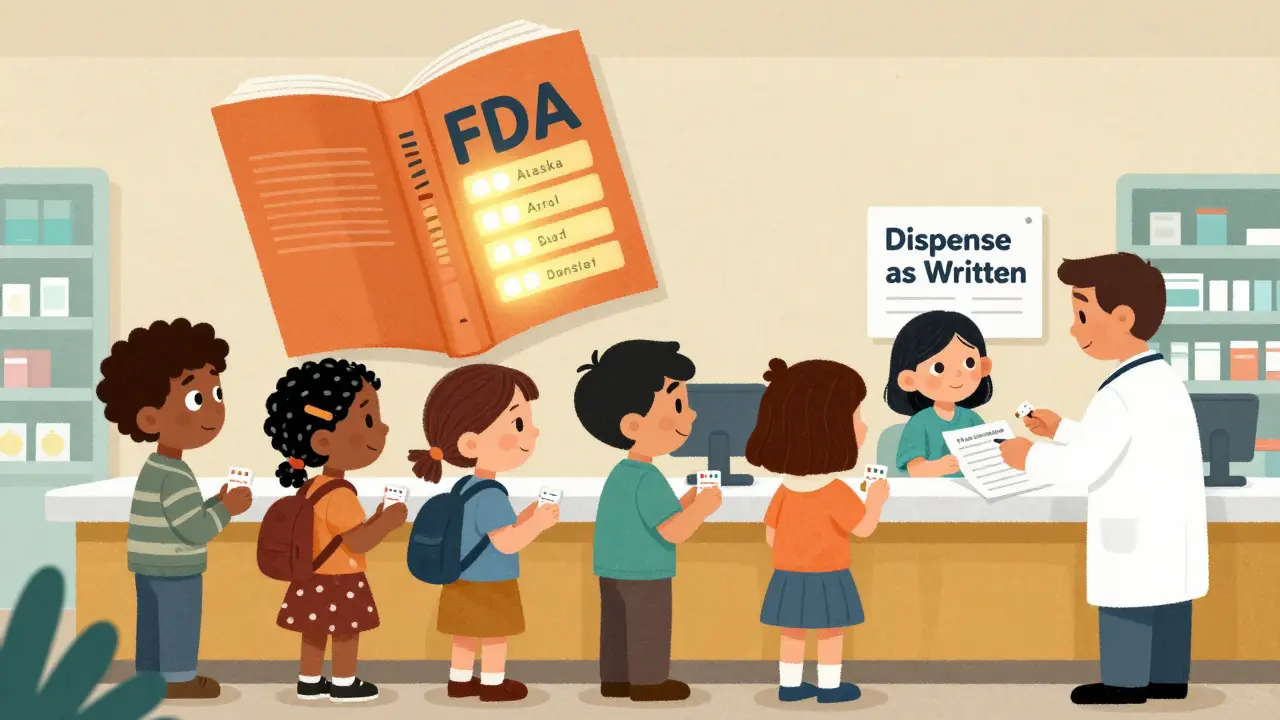
Generic drugs contain the same active ingredients, dosage, and strength as their brand-name counterparts. They’re just cheaper because they don’t need to repeat expensive clinical trials. The FDA approves them as therapeutically equivalent using its FDA Orange Book a public database that rates drugs by therapeutic equivalence, used by pharmacists and regulators to determine which generics can be substituted. But even if the FDA says two drugs are interchangeable, state laws decide whether a pharmacist can actually make the swap.
Think of it this way: your doctor prescribes "Lipitor." The pharmacy has "atorvastatin" - the generic version - in stock. Can they give you that instead? In some states, yes, automatically. In others, they have to call you first. And in a few, they’re legally barred from switching at all - especially for drugs like warfarin or seizure medications where tiny differences in absorption can cause big problems.
States That Require Substitution
There are 19 states - including California, New York, and Texas - where pharmacists must substitute a generic drug if it’s available and the prescription doesn’t say "Do Not Substitute." These are called "mandatory substitution" states. The idea is simple: if the generic is safe and approved, save money by default.
These states assume that patients benefit from lower costs unless they object. But even here, there are exceptions. For example, if the drug has a narrow therapeutic index - meaning the difference between a safe dose and a dangerous one is tiny - substitution may still be blocked. Drugs like levothyroxine (for thyroid), warfarin (a blood thinner), and certain anti-seizure medications often fall into this category. Kentucky, for instance, keeps a formal list of drugs that can’t be swapped without prescriber approval.
States That Allow - But Don’t Require - Substitution
Thirty-one states and Washington, D.C., let pharmacists substitute generics, but they don’t force them to. In these places, the decision is up to the pharmacist, the patient, or sometimes the prescriber. This gives more control to patients, but it also creates delays. Pharmacists might not offer the generic unless asked, and patients often don’t know to ask.
Some of these states add extra layers. Alaska, Delaware, Maine, and New Hampshire require pharmacies to post signs telling customers substitution is possible. It sounds helpful - until you realize most people walk past the sign without reading it. A 2022 study found that only 17% of patients in these states even remembered seeing the notice.
Patient Consent: The Big Divide
One of the biggest differences between states is whether they require patient consent before substitution.
Seven states - Connecticut, Hawaii, Maine, Maryland, New Hampshire, Vermont, and West Virginia - plus Washington, D.C., require you to give explicit permission before a pharmacist swaps your drug. That means you might be handed a form to sign, or the pharmacist has to verbally confirm you’re okay with the change.
Hawaii goes even further: it bans substitution of anti-seizure drugs unless both the doctor and the patient agree. This is because even small changes in blood levels of drugs like phenytoin can trigger seizures. The American Epilepsy Society supports this approach.
Meanwhile, 31 states and D.C. require pharmacists to notify you after substitution - usually by labeling the prescription bottle or giving you a handout. But that’s not the same as consent. Many patients don’t realize they’ve been switched until they notice a different pill shape or color.
Liability and Legal Risk
Pharmacists are caught in the middle. They’re trained to follow the law, but the rules vary so much that they’re constantly second-guessing themselves.
In 24 states - including Alabama, Arizona, Illinois, Massachusetts, Missouri, Nebraska, New Mexico, Oregon, and Rhode Island - pharmacists have no legal protection if something goes wrong after a substitution. That means if a patient has an adverse reaction, the pharmacist could be sued, even if they followed every state rule.
This fear has real consequences. A 2022 survey by the Medicare Rights Center found that pharmacists in these states were more likely to call the prescribing doctor for approval - even when the law didn’t require it - just to avoid liability. That adds hours to daily workloads and delays prescriptions.
Biologics and Biosimilars: A New Frontier
Biologic drugs - like Humira or Enbrel - are complex, expensive medications used for conditions like rheumatoid arthritis, psoriasis, and Crohn’s disease. Their cheaper versions are called biosimilars. But unlike regular generics, biosimilars aren’t exact copies. They’re "similar enough" to be approved, but not identical.
Forty-five states treat biosimilars differently than regular generics. Many require extra steps: prescriber approval, patient notification, or even a separate prescription. Six states - Florida, Indiana, Massachusetts, New Jersey, Pennsylvania, and Tennessee - make substitution of biosimilars optional, even if they’re FDA-approved as interchangeable.
And here’s the kicker: 48 states and D.C. require pharmacists to notify the prescribing doctor within 2 to 7 days after substituting a biosimilar. But many doctors don’t get those notices - or don’t check them. A 2022 survey by the National Psoriasis Foundation found that 42% of patients didn’t know their biologic had been switched.

Why This Patchwork Exists
There’s no federal law that standardizes substitution. The FDA sets safety standards, but states control pharmacy practice. That’s because pharmacists are licensed by state boards, and each state has its own priorities.
Some states focus on cost savings. Others prioritize patient control. A few, like Kentucky and Hawaii, are especially cautious because of past incidents - like patients having seizures after a generic seizure drug was swapped without consent.
The result? A system that’s inefficient. A pharmacist working in Arizona and Nevada has to learn two different sets of rules. A Walgreens employee in a border town like El Paso or Buffalo spends hours every week checking which state’s law applies to each prescription.
What’s Changing in 2026?
The confusion is starting to change. Twelve states introduced bills in 2023 to create a "Harmonization Act" - a voluntary agreement to align substitution rules across borders. While it’s not federal, it could make things easier for pharmacies with multiple locations.
The FDA also updated its Orange Book in 2022 to include new "interchangeability" ratings for complex generics. That triggered 18 states to review their laws. And research shows results: states that simplified their rules between 2018 and 2022 saw generic use jump by 6.8% on average - and over 11% in states that removed consent requirements.
Still, experts warn that without broader reform, the system will keep costing the U.S. healthcare system billions. The Congressional Budget Office estimates that inconsistent laws lead to $4.7 billion in unnecessary brand-name drug use each year - money that could be saved if substitution were more predictable.
What You Should Do
- Always check your prescription label. If the drug name or pill shape changed, ask why.
- If you take drugs with a narrow therapeutic index - like warfarin, levothyroxine, or seizure meds - ask your doctor to write "Dispense as Written" on the prescription.
- Know your state’s rules. If you live near a state border, find out whether your pharmacy follows your home state’s laws or the pharmacy’s.
- Don’t assume substitution means savings. Some biosimilars still carry high prices.
- Ask if your insurance has a preferred generic. Many Medicaid and Medicare plans push for substitution automatically.
Generic drugs are safe, effective, and save billions. But the rules around them shouldn’t feel like a guessing game. Whether you’re paying out of pocket or through insurance, you deserve to know what’s in your medicine - and who gets to decide when it changes.
Can a pharmacist substitute my brand-name drug without telling me?
In 31 states and Washington, D.C., pharmacists are required to notify you after substitution - usually on the prescription label or with a handout. But in 7 states plus D.C., they must get your explicit consent before swapping. In mandatory substitution states, they can switch without asking - but you still have the right to refuse the generic when you pick up the prescription.
Are generic drugs really as safe as brand-name ones?
Yes. The FDA requires generics to have the same active ingredient, strength, dosage form, and route of administration as the brand. They must also meet the same strict manufacturing standards. The only differences are in inactive ingredients - like dyes or fillers - which rarely affect how the drug works. For most people, generics are just as safe and effective.
Why can’t I switch my seizure medication to a generic?
For drugs with a narrow therapeutic index - like phenytoin, carbamazepine, or valproate - even tiny differences in how the body absorbs the drug can lead to breakthrough seizures or toxic side effects. Some states, including Hawaii and Kentucky, ban substitution for these drugs unless both the prescriber and patient agree. The American Epilepsy Society supports these restrictions to avoid serious health risks.
Do biosimilars work the same as the original biologic drugs?
FDA-approved interchangeable biosimilars are designed to have no clinically meaningful differences from the original biologic. But because biologics are made from living cells - not chemicals - they’re more complex than traditional generics. Some patients report different side effects or reduced effectiveness after switching. That’s why many states require notification to the prescriber and, in some cases, patient consent.
How do I find out what substitution laws apply in my state?
The National Association of Boards of Pharmacy (NABP) offers a free, interactive map on their website that shows current substitution rules for every state and D.C. You can also ask your pharmacist - they’re required to know the rules in their state. If you take a high-risk medication, ask your doctor to write "Dispense as Written" on your prescription to prevent substitution.
If you’re on a medication where small changes matter - like blood thinners, thyroid pills, or seizure drugs - don’t wait to ask questions. Your safety isn’t a state-by-state lottery. Know your rights, know your drugs, and speak up.
Generic substitution hinges on therapeutic equivalence as defined by the FDA Orange Book’s AB ratings, but state-level variations introduce regulatory friction that undermines pharmacoeconomic efficiency. The absence of federal preemption creates a compliance nightmare for multi-state pharmacy chains, especially when navigating narrow therapeutic index (NTI) exceptions. For instance, levothyroxine and warfarin require bioequivalence within 85–115% AUC and Cmax thresholds - yet some states mandate prescriber override even when FDA deems interchangeability valid. This isn’t patient safety - it’s administrative arbitrage.
I’ve worked in community pharmacy for 14 years, and this patchwork system is a nightmare. We have patients who come in with prescriptions from out-of-state providers and we have to cross-reference three different databases just to know if we can substitute. And don’t get me started on biosimilars - the documentation burden alone adds 20 minutes per script. We’re not just pharmacists anymore; we’re compliance officers. If we had one national standard, we could actually focus on patient counseling instead of paperwork.
Honestly? I think this whole system is kind of a mess, but I’m glad someone’s talking about it 😅
Pharmacists are doing their best with insane rules, and patients are just trying to get their meds without getting confused. Maybe we don’t need federal control, but a basic minimum standard for notification + consent would help so much. Also, can we PLEASE make those pharmacy signs bigger? I’ve walked past them 100 times and never read one 😅
Oh, so now we’re treating pharmacists like babysitters? Let me guess - next they’ll make us sign a waiver before taking aspirin? This is pure regulatory overreach wrapped in ‘patient safety’ glitter. The FDA already says generics are equivalent. If you’re too dumb to notice your pill changed color, maybe you shouldn’t be managing your own meds. I’ve been on generics for 12 years. No seizures. No strokes. No ‘bioequivalence drama.’ This whole state-by-state circus is just a lobbyist-funded scam to keep Big Pharma’s profits intact.
It is, indeed, a matter of considerable concern that the jurisprudential framework governing pharmaceutical substitution remains fragmented across the United States. The absence of a uniform statutory regime undermines the coherence of public health policy and introduces inefficiencies into the dispensing process. One might posit that a federal standard - perhaps modeled on the Uniform Pharmacy Practice Act - would serve to harmonize these divergent approaches and ensure equitable access to cost-effective therapeutics.
Thank you for breaking this down so clearly! 🙌 I’m so glad you mentioned the NTI drugs - I didn’t realize how dangerous even tiny changes can be for thyroid or seizure meds. I’ve been on levothyroxine for years and always ask for the same brand - but now I know I can write "Dispense as Written" on my script! Also, that NABP map is a lifesaver. I’m sharing it with my mom who’s on warfarin. You’re doing God’s work here 💙
Let’s be real - most patients don’t care about pharmacokinetics. They just want the cheapest pill. The fact that 48 states require physician notification for biosimilars proves we’re over-engineering this. If you’re so worried about variability, why not just ban generics entirely? Or better yet - why not make patients pay full price for brand-name drugs if they insist on them? The system isn’t broken - it’s just being exploited by bureaucrats who think they’re protecting people while actually slowing down care. If you can’t handle a pill change, maybe you’re not ready for modern medicine.
I’m not saying I’m better than anyone else, but I’ve always believed that if a drug is changed without your explicit consent, it’s a violation of bodily autonomy. I don’t care if it’s ‘FDA-approved’ - my body is not a lab for state experiments. I’ve had anxiety attacks after being switched without warning. This isn’t about money. It’s about trust. And right now, the system is eroding it.
YESSSSS to the NABP map!! 🙌 I just used it last week when my sister moved from Texas to Florida - we thought she’d have to get a new script for her seizure med, but turns out Florida allows substitution unless the doc says otherwise. I showed her the map, we called her pharmacist, and boom - no disruption. Also, if you’re on a narrow therapeutic index drug, ASK FOR "DISPENSE AS WRITTEN" - it’s your RIGHT. Don’t be shy. Pharmacists don’t bite (usually 😜). And yes, biosimilars are tricky - but they’re NOT scams. They’re science. Just ask your doc to explain the difference. You got this 💪❤️