
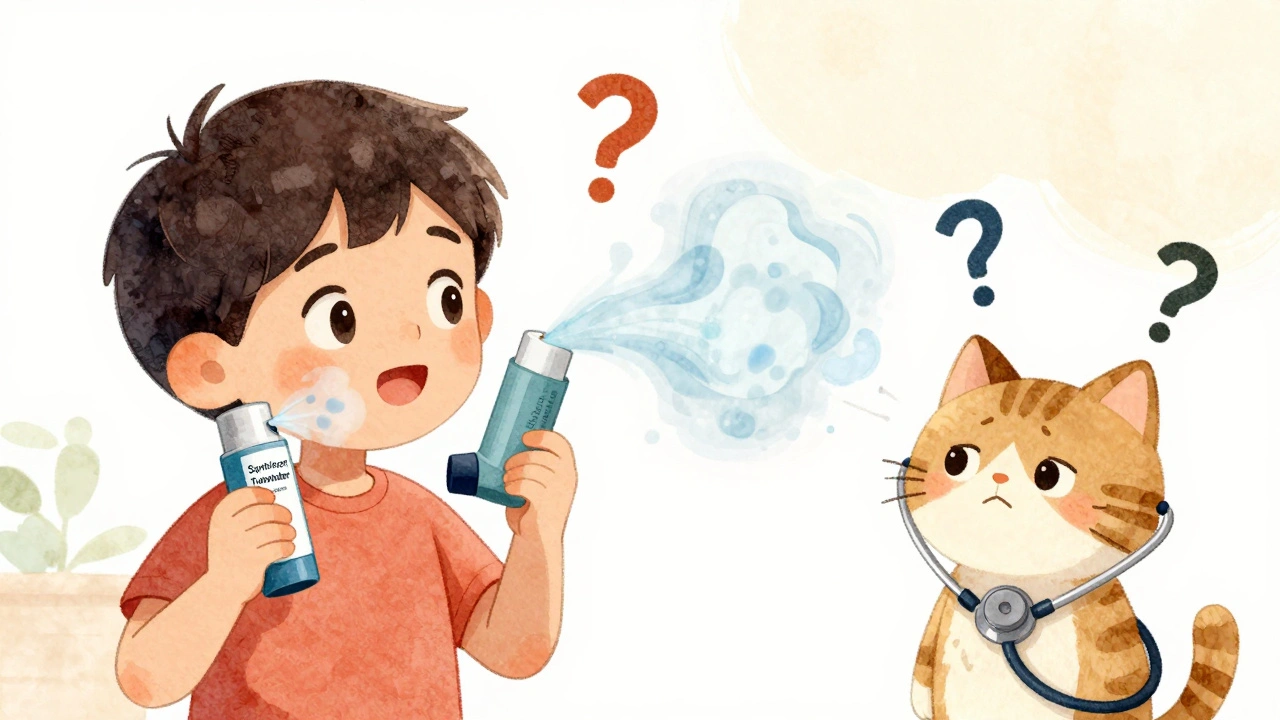
When you're managing asthma or COPD, your inhaler isn't just a tool-it's your lifeline. You know how to use it. You’ve practiced the breath, the hold, the timing. So when your pharmacy switches your Symbicort or Advair to a generic version without warning, it’s not just a change in price-it’s a change in how you breathe.
Why Generic Inhalers Aren’t Like Generic Pills
If you’ve ever switched from a brand-name pill to a generic, you know the drill: same active ingredient, lower cost, same effect. But with respiratory combination inhalers, that logic falls apart. These devices deliver two drugs-usually a corticosteroid and a long-acting beta agonist-through a mechanical system that’s just as important as the medicine inside. The problem? Generic inhalers often come in different devices. A generic version of Symbicort might look similar, but it could be a Spiromax instead of a Turbohaler. One twists to load. The other slides. One needs a slow, deep breath. The other demands a sharp, forceful inhale. If you don’t know the difference, you’re not getting the full dose. You’re just breathing air. A 2020 study found that 76% of patients switched from a Turbuhaler to a Spiromax without training used the device incorrectly. That’s not a small number. That’s three out of four people not getting the medicine they need.The Device Is Part of the Drug
The FDA says generic inhalers are interchangeable if they deliver the same amount of medicine to the lungs. Sounds fair. But here’s the catch: different devices deposit medicine differently. Studies show lung deposition can vary by 25-40% between inhaler types-even when the active ingredients are identical. The European Medicines Agency (EMA) gets it. Their 2022 guidelines require proof of therapeutic equivalence through pharmacokinetic studies, pharmacodynamic tests, and sometimes even clinical outcomes. The U.S. FDA? Their 2019 guidance says patients should be able to use a generic without extra training. That’s where things go wrong. Real-world data backs up the concern. A 2021 study in the Journal of Aerosol Medicine found that patients switched from Symbicort Turbohaler to generic Spiromax without instruction had a 22% increase in asthma attacks within six months. That’s not a minor uptick. That’s people ending up in the ER.What Patients Are Saying
Look at the reviews. On Drugs.com, Symbicort Turbohaler has a 6.2 out of 10 rating. The generic Spiromax? 4.8. The complaints are consistent: "Harder to use," "Feels less effective," "Didn’t know I had to breathe harder." One patient wrote in the Pharmaceutical Journal: "I didn’t realize I needed to breathe in harder. My asthma got so bad I ended up in the hospital." Reddit threads like r/asthma are full of similar stories. Out of 82 people who shared their experience after being switched to a generic inhaler, 68 reported worse symptoms. That’s 83%. Many said they weren’t warned. No one showed them how to use the new device. They just got a different inhaler and assumed it worked the same. A 2022 survey by Asthma UK found that 57% of patients felt confused after a switch. One in three had visited the emergency room within three months. That’s not just discomfort. That’s preventable crisis.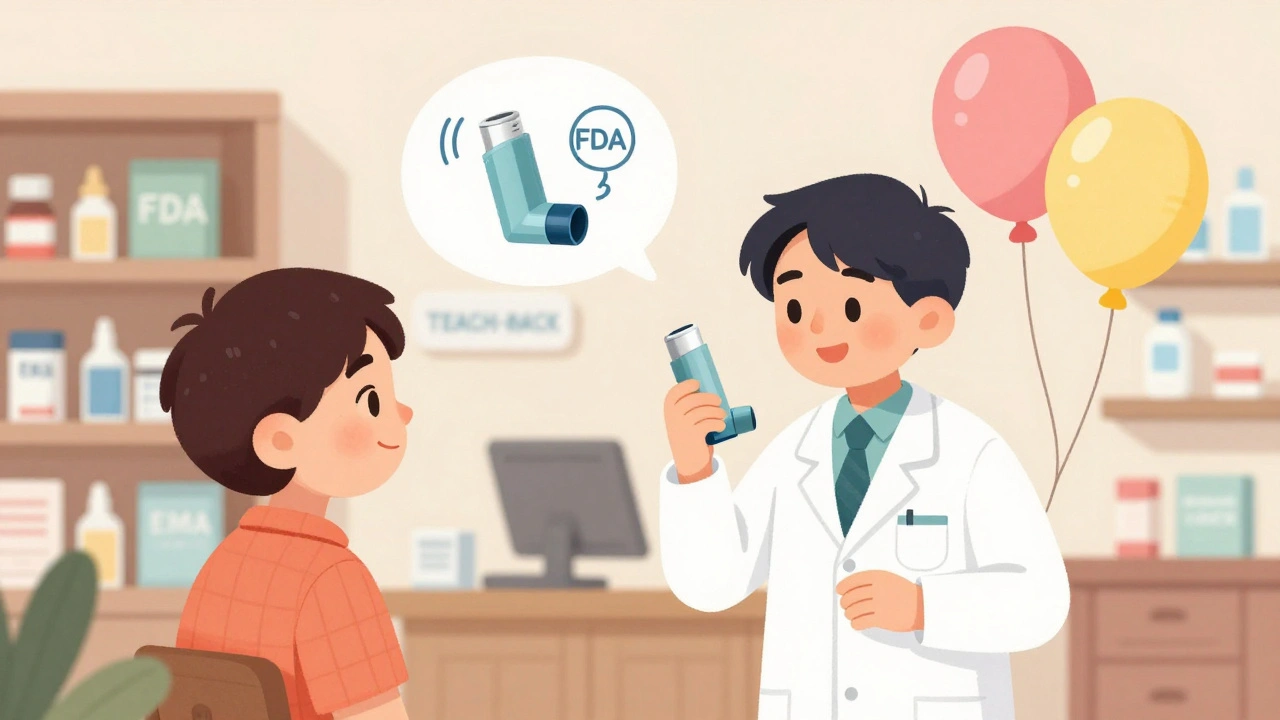
Doctors and Pharmacists Are Caught in the Middle
Most doctors don’t know the difference between inhaler devices. They prescribe by name, but they don’t train on mechanics. Pharmacists are supposed to counsel patients-but only 28% of U.S. community pharmacies consistently do it for inhalers, according to the American Pharmacists Association. Why? Time. Most say they simply don’t have enough time in the day. Training a pharmacist to demonstrate correct technique for both Turbuhaler and Spiromax takes an average of 12.7 minutes. That’s longer than most insurance visits. And even then, 43% of pharmacists couldn’t show the right technique themselves at first. The good news? When you teach patients properly, they get better. The AARC recommends the "teach-back" method: ask the patient to show you how they use it. If they can do it right on the spot, their technique retention jumps from 35% to 82%.Global Differences, Global Risks
Countries handle this differently-and the results show it. In Norway, 62% of respiratory inhalers are generic. In France, it’s 22%. Why? Because France requires doctors to prescribe by brand name and device. No substitution without consent. In Germany, pharmacists must give 15 minutes of in-person counseling for first-time inhaler users. In the U.S.? No federal mandate. Just a recommendation. The European Respiratory Society now recommends prescribing inhalers by brand name to prevent substitution errors. GINA’s 2023 guidelines say the same: "Device familiarity and correct technique should be prioritized over generic substitution." The cost savings look good on paper. But the American Thoracic Society found that automatic substitution without counseling increases the risk of treatment failure by 37%. And a 2023 IMS Health report says inappropriate substitution costs U.S. healthcare systems $1.2 billion a year in avoidable ER visits and hospital stays.
What You Should Do
If you use a combination inhaler, here’s what to do now:- Know your device. Learn how yours works. If you’re not sure, ask your doctor or pharmacist to show you.
- Ask before switching. If your pharmacy says they’re giving you a generic, ask: "Is it the same device?" If it’s not, ask for the original.
- Don’t assume. Even if the medicine name is the same, the device might not be. Don’t trust that it works the same way.
- Use the teach-back method. When you get a new inhaler, ask your provider: "Can you watch me use it?" Then do it. If you mess up, they fix it right there.
- Track your symptoms. If you feel worse after a switch, don’t wait. Call your doctor. Your breathing shouldn’t get harder because of a pharmacy decision.
Just wanted to say THANK YOU for posting this. 🙏 I got switched to a generic last year and didn’t realize my technique was off until I started wheezing again. My nurse taught me the teach-back method and it changed everything. You’re not overreacting-you’re surviving. 💪❤️
lol so the fda is just letting pharma companies swap our lifesavers like trading cards? 🤡 next theyll say your insulin pump is 'interchangeable' with a syringe and a rubber band. i saw a video of a guy using a spiromax like a vape. he thought you just puff it. nope. its a weaponized inhaler. 😭
everyone’s panicking but the math is simple. cheaper drug + no training = more ER visits. more ER visits = more money for hospitals. who’s getting paid? not you. not me. the system wins. again. 🤷♂️
Stop assuming your pharmacist knows how to use these devices. I asked mine to show me how to use my new generic-and she fumbled the Spiromax. Twice. I had to pull up a YouTube video on my phone and say, 'No, this is how it actually works.' If they can’t demonstrate it, they shouldn’t be handing it out. Period.
Let’s be clear: the FDA’s 2019 guidance was a catastrophic failure of regulatory imagination. Pharmacokinetic equivalence ≠ clinical equivalence. You can’t reduce a mechanical delivery system to a chemical assay. This isn’t bioequivalence-it’s bio-ignorance. And now we’re witnessing the epidemiological fallout. The European model isn’t just better-it’s ethically non-negotiable.
It’s not about generics. It’s about autonomy. If I’m handed a new tool to keep me alive, I deserve to know how it works. Not a pamphlet. Not a 30-second demo. A real, hands-on, patient-centered training. This isn’t a cost-saving measure-it’s a violation of informed consent. We’re not cattle being switched to a new feedlot. We’re people who breathe.
my mom got switched last month and she cried because she thought she was dying. turns out she was just breathing wrong. i showed her the video from the asthma uk site. she’s been fine since. just… talk to people. don’t just hand them a box and say ‘you’re good’.
THIS. IS. NON-NEGOTIABLE. 🚨 I used to be a respiratory therapist. I’ve seen people collapse because they thought the new inhaler was the same. One guy thought he was supposed to spray it into his mouth like a spray tan. He didn’t inhale at all. He spent three days in the ICU. This isn’t a 'minor inconvenience.' This is a silent epidemic. If you’re switching, demand a demo. Demand it. Now.
Oh please. The real conspiracy? That we’ve been brainwashed into thinking 'generic' means 'equal.' Wake up. The pharmaceutical-industrial complex doesn’t want you to know that the device is the drug. They want you to believe it’s just a pill. They’ve been doing this since the 90s. It’s not incompetence-it’s design. And now your lungs are the collateral.
I’m not a doctor, but I’ve been on three different inhalers in five years. The only time my peak flow improved was when someone sat with me and watched me use it. Not once did a pharmacist ask me to demonstrate. Not once. If you’re not being taught, you’re being set up to fail.
Let’s not romanticize patient advocacy. The systemic failure here is not anecdotal-it’s structural. The GDUFA III funding allocation is a performative gesture. Without mandatory device-specific training protocols codified into CMS reimbursement guidelines, we’re merely rearranging deck chairs on the Titanic. The 1.2B annual cost? That’s the price of institutionalized negligence.
I’m a nurse and I used to think this wasn’t my problem. Then I saw a 72-year-old woman use her new generic inhaler by shaking it like a soda can. She had no idea. I spent 15 minutes with her. She cried. We did teach-back. She’s been stable for 8 months. This isn’t about cost. It’s about dignity. Please, if you’re switching-ask for help. You’re not being annoying. You’re being smart.