
When you pick up a prescription at the pharmacy and see a generic label, you might assume it’s just a cheaper copy. But here’s the truth: generic drugs aren’t copies-they’re exact matches in how they work, just built differently. The FDA requires them to deliver the same active ingredient, in the same strength, at the same speed, and with the same effect as the brand-name drug. And yet, they cost 80-85% less. How? It all comes down to a tightly controlled, highly scientific manufacturing process that’s been refined over 40 years.
Where It Starts: Reverse Engineering the Original
The journey of a generic drug doesn’t begin in a lab with a blank slate. It starts with the brand-name drug itself-the one that’s been on the market for years. This is called the Reference Listed Drug (RLD). Manufacturers don’t just guess what’s in it. They take apart the original pill, capsule, or injection and analyze every component: the active ingredient, the fillers, the coatings, even the shape. They use advanced tools like mass spectrometry and chromatography to map out the exact chemical structure and how it behaves in the body. This step is critical. A generic drug can’t just contain the same active ingredient-it has to release it the same way. For example, if the brand-name drug is designed to release its medicine slowly over 12 hours, the generic must do the same. If it releases too fast, you could get side effects. Too slow, and it won’t work. That’s why manufacturers spend months studying the RLD before they even touch a single raw material.The Blueprint: Quality by Design (QbD)
Once they understand the original, manufacturers follow a framework called Quality by Design (QbD), developed by global health regulators and used by every major generic drug maker today. QbD isn’t about testing the final product to see if it’s good enough. It’s about building quality into every step from the start. They identify three key factors:- Critical Quality Attributes (CQAs): What features of the drug affect safety or effectiveness? (e.g., how fast it dissolves, how stable it is over time)
- Critical Material Attributes (CMAs): What properties of the raw ingredients matter? (e.g., particle size of lactose, purity of the active ingredient)
- Critical Process Parameters (CPPs): What conditions during manufacturing change the outcome? (e.g., temperature, pressure, mixing time)
The Seven Stages of Manufacturing
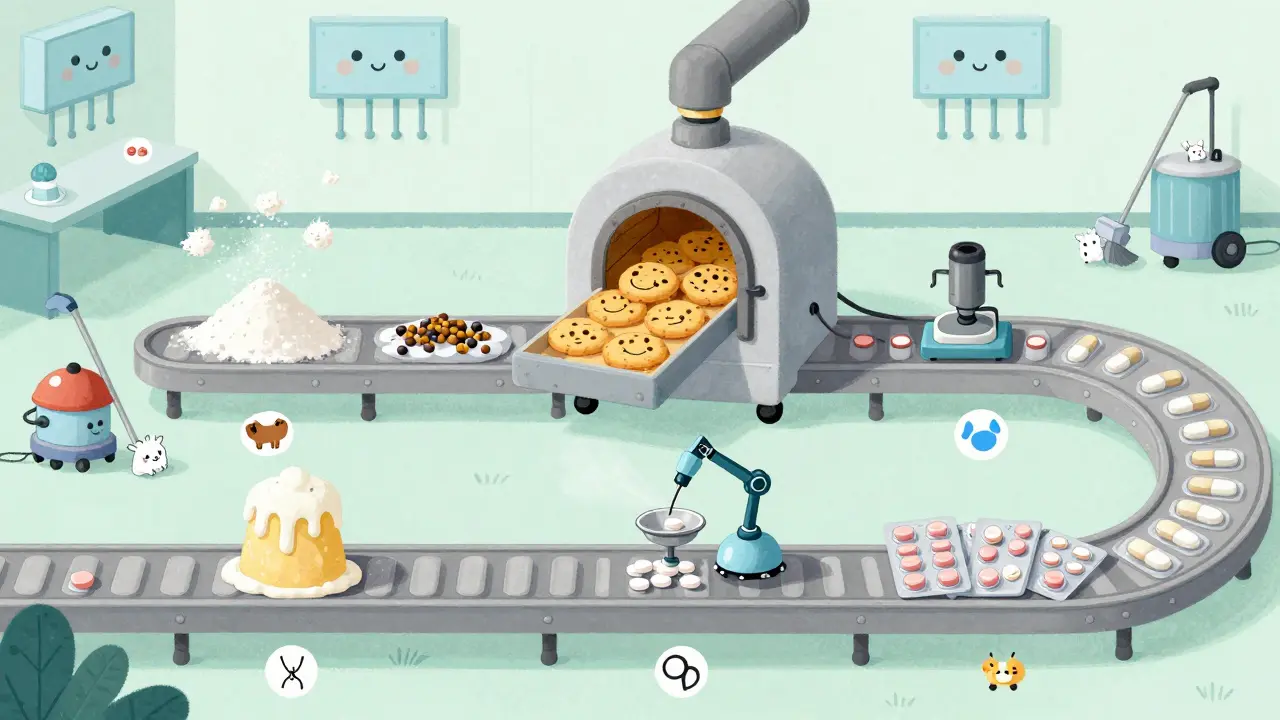
Once the blueprint is set, production begins. Here’s how a typical generic tablet is made:- Formulation: The active pharmaceutical ingredient (API) is mixed with inactive ingredients (excipients) like starch, cellulose, or magnesium stearate. These help the tablet hold together, dissolve properly, or mask a bitter taste.
- Mixing and Granulation: The powder blend is turned into granules-tiny clumps that flow better and compress evenly. This is done with a binder and a small amount of liquid, then dried.
- Drying: The wet granules are dried in large ovens at controlled temperatures. Too much moisture? The tablet might crumble. Too little? It won’t bind right.
- Compression and Encapsulation: For tablets, the dried granules are pressed into shape using high-pressure machines. For capsules, the powder is filled into gelatin or vegetarian shells.
- Coating: Many tablets get a thin coating. It can protect the drug from stomach acid, control release timing, or make it easier to swallow. The coating must be uniform-no cracks, no uneven spots.
- Quality Control: At every stage, samples are pulled for testing. Each batch is checked for weight, hardness, dissolution rate, purity, and potency. Dissolution testing is especially important: if a tablet doesn’t release 80-125% of its drug within a set time compared to the brand-name version, it’s rejected.
- Packaging and Labeling: The finished product is sealed in blister packs or bottles with tamper-evident seals. Labels must list the generic name, strength, manufacturer, and expiration date-no brand names, no logos that mimic the original.
The Rules: CGMP and Clean Rooms
Manufacturing can’t happen just anywhere. Facilities must follow Current Good Manufacturing Practices (CGMP), enforced by the FDA. These aren’t suggestions-they’re legal requirements. Cleanrooms are classified by air purity. For filling sterile injectables, you need an ISO Class 5 environment-cleaner than an operating room. For tablet production, Class 7 or 8 is typical. Temperature is kept between 20-25°C. Humidity stays at 45-65%. Dust, mold, and even human skin flakes are controlled. Tablet weight must be within ±5% for pills under 130mg, or ±7.5% for heavier ones. Dissolution tests must match the brand-name drug within the 80-125% range. One batch failing? The whole lot gets destroyed.The Approval Path: The ANDA Process
Before a generic drug hits shelves, it must be approved by the FDA through the Abbreviated New Drug Application (ANDA). Unlike brand-name drugs-which require 10-15 years and over $2 billion in clinical trials-generics skip most of that. The ANDA process has five steps:- Submission: The manufacturer files the ANDA, which includes all the data on formulation, manufacturing, and testing.
- Bioequivalence Testing: 24-36 healthy volunteers take both the generic and the brand-name drug. Blood samples are taken over time to measure how much drug enters the bloodstream (Cmax) and how long it stays (AUC). The generic must fall within 80-125% of the brand’s values.
- Facility Inspection: The FDA sends inspectors to the manufacturing site. They check records, observe processes, and verify that everything matches what was submitted.
- Labeling Approval: The generic’s label must be identical in wording, warnings, and instructions-except for the manufacturer’s name.
- Post-Approval Monitoring: Even after approval, the FDA continues to monitor complaints, adverse events, and random inspections.
Why Some Generics Are Harder Than Others
Not all generic drugs are created equal. Simple pills-like metformin or lisinopril-are easy to replicate. But complex products? That’s where things get tough. Take a topical cream like Clobetasol Propionate. It’s not just about the chemical. The texture, how it spreads on the skin, how deeply it penetrates-all of that matters. One manufacturer spent seven years and $47 million just to match the original. Even then, they had to run dozens of clinical tests because traditional lab tests couldn’t predict real-world performance. Same with extended-release pills, nasal sprays, or injectables. These require advanced engineering. The FDA now has a Complex Generic Products Initiative with 127 specific guidances to help manufacturers navigate these challenges.
Real-World Challenges
Even with all the rules, things go wrong. In 2021, Teva recalled 14 generic products after an FDA inspection found CGMP violations at its Puerto Rico plant. Problems like unclean equipment, missing documentation, and unvalidated processes led to batches that might not have worked as intended. On the flip side, Mylan’s generic version of Sovaldi-a $84,000 brand-name hepatitis C drug-cut the cost to $28,000 without a single report of reduced effectiveness. That’s the power of good manufacturing. One pharmacist on Reddit shared a common issue: “A slight change in lactose particle size from our supplier threw off our tablet hardness. We had to re-formulate the whole batch.” That’s why manufacturers test every incoming raw material. One bad batch of filler can ruin thousands of pills.The Bigger Picture
Generic drugs make up 90% of all prescriptions filled in the U.S. They’ve saved over $1.7 trillion in the last decade. But the system is under pressure. Over 78% of the active ingredients in U.S. generics come from just two countries: China and India. That raises questions about supply chain stability. Meanwhile, the FDA is pushing for innovation. Continuous manufacturing-where drugs are made in one unbroken flow instead of batch-by-batch-is now approved for 17 generic facilities. It’s faster, uses less energy, and reduces errors. Pfizer’s pilot program cut visual inspection errors by 40% using AI. And while price competition drives some manufacturers out of the market, others are focusing on complex generics where profit margins stay higher. With over $75 billion in branded drugs set to lose patent protection by 2027, the demand for generics isn’t slowing down.What You Should Know
If you’re prescribed a generic drug:- It’s not a “lesser” version-it’s an identical one.
- It’s tested just as rigorously as the brand-name drug.
- It must work the same way in your body.
- Changes in appearance (color, shape) are normal and don’t affect performance.
Are generic drugs as safe as brand-name drugs?
Yes. The FDA requires generic drugs to meet the same safety, strength, quality, and performance standards as brand-name drugs. They use the same active ingredients and must prove bioequivalence before approval. Millions of people take generics every day without issue.
Why do generic drugs look different from brand-name drugs?
U.S. trademark law prevents generics from looking exactly like brand-name drugs. That means color, shape, size, and flavor can differ. But the active ingredient, dosage, and how it works in your body must be identical. These differences are purely cosmetic and have no effect on safety or effectiveness.
Can a generic drug fail to work for me?
It’s extremely rare, but possible. Some patients report differences when switching between different generic manufacturers, especially with drugs that have a narrow therapeutic index (like blood thinners or seizure meds). This isn’t because the generic is inferior-it’s because tiny variations in how the drug is absorbed can matter in sensitive cases. If you notice a change, talk to your doctor or pharmacist about sticking with the same generic brand.
How long does it take to make a generic drug?
From start to finish, it usually takes 3-4 years and $5-10 million. This includes reverse-engineering the original, developing the formulation, running bioequivalence studies, and getting FDA approval. For complex drugs like inhalers or topical creams, it can take 7+ years and cost tens of millions.
Why are some generic drugs cheaper than others?
Price differences come from competition, manufacturing costs, and market demand. Simple generics like atorvastatin have dozens of manufacturers, so prices drop sharply. Complex generics have fewer competitors, so prices stay higher. Also, some manufacturers have lower overhead, use more efficient processes, or source cheaper raw materials-all of which affect the final price.
Really appreciate this breakdown. I work in a clinic and see patients worry about generics all the time. The fact that they’re held to the same FDA standards as brand-name drugs is wild when you think about it. Most people think it’s just a cheaper knockoff, but nope-it’s science, not magic. The QbD process alone is mind-blowing. They’re not just copying, they’re reverse-engineering with precision.
Also, the part about lactose particle size throwing off tablet hardness? That’s such a tiny detail that makes a huge difference. Makes me respect pharmacists even more.
Okay, so let me get this straight-you’re telling me that some guy in a lab in Hyderabad is sitting there with a mass spectrometer, analyzing the exact molecular dance of a 12-hour extended-release pill that costs $500, and then he builds an identical one for $5? That’s not just innovation, that’s a middle finger to corporate greed. And the FDA? They’re not just rubber-stamping-they’re watching every single batch like a hawk. I’ve seen people rant about generics being ‘inferior,’ but I’ve got a cousin on warfarin who switched from brand to generic and didn’t even notice. Zero side effects. Zero. Meanwhile, the pharma execs are sipping champagne in their Malibu mansions while the rest of us are just trying to survive. This system? It’s working. It’s just not designed for them. It’s designed for us.
so like… i read this whole thing and im like wow but wait-what about the 2021 teva recall? like… if they can mess up THAT badly then how can we trust ANY generic? i mean, unclean equipment? missing docs? are we just rolling the dice every time we fill a prescription? also, why do they use so many weird chemicals like magnesium stearate? sounds like poison. i think we need more transparency. like, put the whole manufacturing process on youtube. live stream. i wanna see it.
Oh wow. So this is what happens when you let the government regulate anything. Let me guess-this whole ‘Quality by Design’ nonsense is just another way for bureaucrats to feel important while real manufacturers get crushed under red tape. And don’t get me started on bioequivalence testing with 36 healthy volunteers. That’s not science-that’s a placebo ritual. Meanwhile, in China, they’re making real medicine without all this theater. You think this is cheap? Try living in a country where you can buy a year’s supply of metformin for $5. No FDA. No inspections. Just results. This whole system is a scam designed to keep prices high under the guise of safety. You’re not protecting patients-you’re protecting profits. And you wonder why people are leaving the U.S. for medication.
OMG this is so cool!! 🤯 I had NO idea generics went through this much science 😍 Like, I thought they just slapped a label on a pill and called it a day. But nooo-they’re basically detectives solving the original drug’s secrets! And the clean rooms?? ISO Class 5?? That’s like a space lab!! 💫 Also, the fact that one bad batch of lactose can ruin thousands of pills? Wild. We need more people to know this. I’m sharing this with my mom who’s on 5 generics and thinks they’re ‘fake meds.’ Thanks for the education!! 🙌❤️
Interesting stuff. I’ve worked in pharmaceutical logistics across Asia and North America, and what’s not said here is how much of this process depends on raw material supply chains that are barely monitored. India and China produce 78% of the APIs used in U.S. generics, but the quality control there? It’s a mixed bag. I’ve seen labs where the same equipment is used for three different drugs with no cleaning protocol. The FDA sends inspectors, sure-but they’re stretched thin, and audits are scheduled weeks in advance. The real test is in the random, unannounced inspections, and those are rare. The system works on paper, but on the ground? It’s a house of cards held together by goodwill and hope. And don’t even get me started on how packaging standards vary between countries. A pill that passes in Ohio might fail in Oregon because of humidity differences in storage. It’s not just manufacturing-it’s a global game of Jenga.
Why should we trust any drug made in India or China? These countries have no moral compass. They care about profit, not people. The FDA thinks they’re protecting us, but they’re just letting foreign factories cut corners. I’ve seen videos-workers without gloves, dirty water, rats in the facility. And you say this is ‘scientific’? This is not science. This is exploitation. The real solution? Ban foreign manufacturing. Make generics in America. Or stop pretending we’re getting safe medicine. Millions of Americans are taking pills that were made by people who don’t even wash their hands. This isn’t healthcare. This is colonialism with a prescription label.
Wow. So after reading this, I now realize the FDA isn’t just a regulatory body-they’re the only thing standing between me and a 1980s pharmaceutical Wild West. And yet, people still complain about generics looking different. Honey, if you’re worried about the color of your pill, maybe you’re the problem. Also, ‘My doctor said the brand is better’-no, they didn’t. They just didn’t bother to explain the science. I’m starting a support group for people who take generics and actually understand them. We’ll call it ‘Pill Literacy Warriors.’ I’ll bring cookies. 🍪
so like… i just found out my generic adderall is made in india and now i’m scared to take it 😭