
Cold & Allergy Medication Safety Checker
This tool helps you check for dangerous interactions between cold/flu medications and other drugs. Always consult a healthcare professional for personalized advice.
Select Your Medications
Enter your medications and conditions to check for interactions
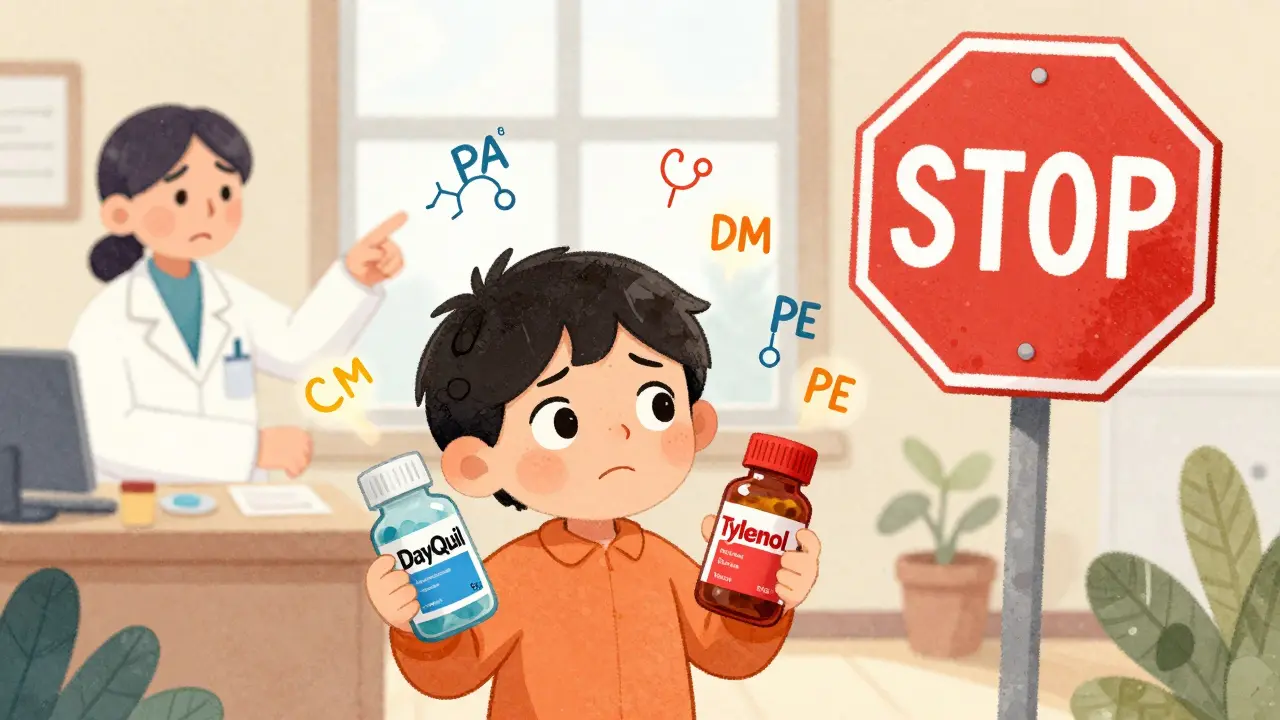
Every winter, millions of people reach for a bottle of cold medicine thinking they’re doing the right thing. They want to feel better fast-no more runny nose, no more headache, no more cough that keeps them up all night. But here’s the thing: many of those bottles contain more than one drug. And mixing them without knowing what’s inside can land you in the emergency room.
Why Combination Medications Are Risky
You’ve seen them on the shelf: DayQuil, NyQuil, Tylenol Sinus, Advil Cold & Sinus. These products promise relief from everything at once: congestion, cough, fever, sore throat, runny nose. That sounds convenient, right? But convenience comes with a hidden cost. Most of these combination cold and allergy meds contain 2 to 4 active ingredients. Common ones include:- Acetaminophen (also called APAP) for pain and fever
- Pseudoephedrine or phenylephrine to clear nasal congestion
- Dextromethorphan (often labeled DM) to suppress cough
- Chlorpheniramine or diphenhydramine to reduce sneezing and runny nose
Phenylephrine vs. Pseudoephedrine: What’s the Real Difference?
You’ve probably noticed that some cold meds now say “phenylephrine” instead of “pseudoephedrine.” That’s because pseudoephedrine is kept behind the pharmacy counter due to its use in making methamphetamine. But here’s the catch: research shows phenylephrine doesn’t work well as a decongestant at standard doses. A 2022 FDA advisory panel reviewed 11 clinical trials and found that 10mg of oral phenylephrine is no more effective than a placebo. Yet it’s still in nearly half of all OTC cold products. Why? Because it’s cheaper and easier to stock than pseudoephedrine. But even if it doesn’t work well, phenylephrine still affects your body. When combined with acetaminophen, studies show it can spike your blood levels by up to 400%. That means even a normal dose can cause dizziness, rapid heartbeat, or dangerously high blood pressure-especially if you already have heart issues or take blood pressure meds. Pseudoephedrine, on the other hand, works better. It reduces nasal congestion in about 65% of users compared to 45% for phenylephrine. But it also raises systolic blood pressure by 8-12 mmHg and increases heart rate by 5-8 beats per minute. If you have uncontrolled hypertension (systolic over 180 or diastolic over 110), you should avoid it entirely.The Hidden Danger: Dextromethorphan and Antidepressants
Dextromethorphan (DM) is a cough suppressant found in many nighttime cold formulas. It’s generally safe when taken alone. But if you’re on an SSRI like sertraline (Zoloft), fluoxetine (Prozac), or an SNRI like venlafaxine (Effexor), combining it with DM can trigger something called serotonin syndrome. Serotonin syndrome isn’t rare-it’s underreported. Symptoms include agitation, confusion, rapid heart rate, high blood pressure, sweating, tremors, and muscle rigidity. In severe cases, it can be fatal. A 2017 study in the Journal of Clinical Psychiatry found that people taking SSRIs who also used dextromethorphan had a 300% higher risk of developing serotonin syndrome. That’s not a small chance. It’s a serious, life-threatening interaction that many people don’t even know about. And it’s not just prescription antidepressants. Some herbal supplements like St. John’s Wort or even certain migraine meds can do the same thing. If you’re on any medication for mood, anxiety, or pain, check with a pharmacist before taking a cough syrup with DM.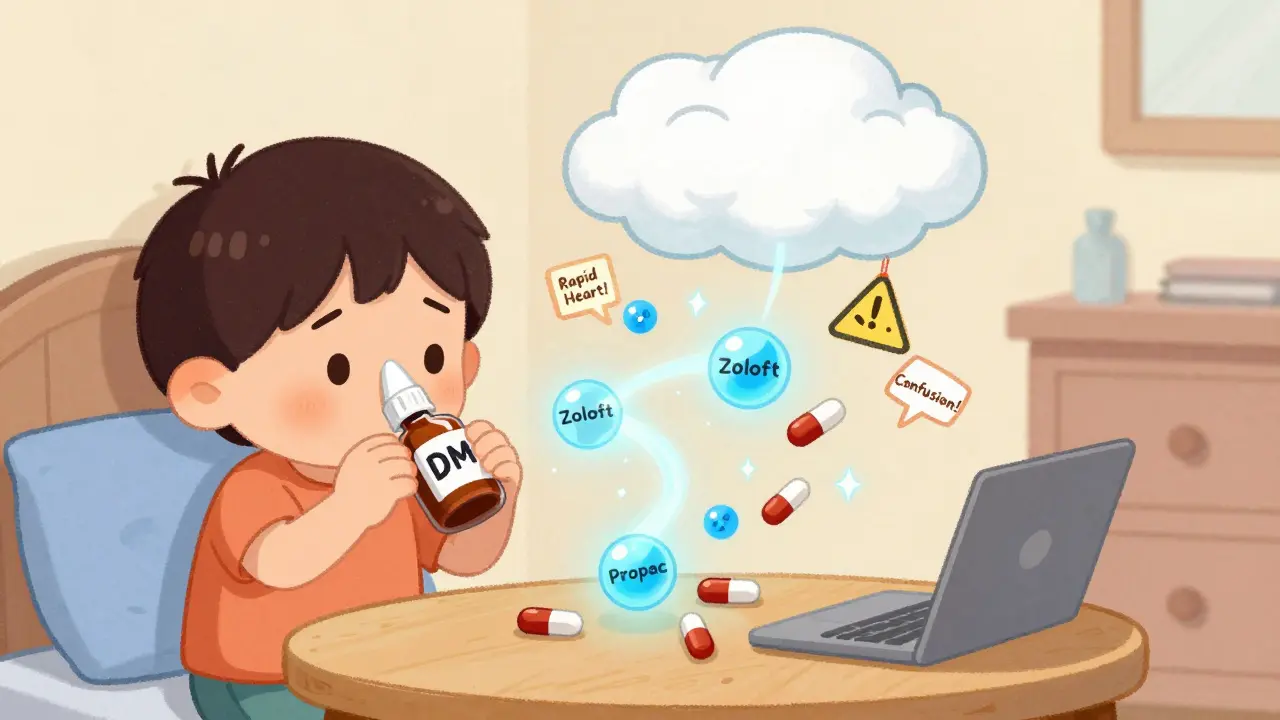
What You’re Not Reading on the Label
Drug labels are getting better, but they’re still confusing. The FDA now requires clearer labeling, but you still have to know what you’re looking for. Here’s what the abbreviations really mean:- APAP = Acetaminophen
- DM = Dextromethorphan
- PE = Phenylephrine
- PSE = Pseudoephedrine
- CHLOR or DIPH = Chlorpheniramine or Diphenhydramine
Real Stories, Real Consequences
On Reddit, a thread titled “Accidentally doubled up on acetaminophen-what now?” had over 80 comments. One person wrote: “I took NyQuil for my cold, then took Tylenol for my headache. I didn’t realize they were the same thing. Woke up vomiting, went to the ER. Liver enzymes were through the roof.” Another case from Walgreens: “Took two different cold meds thinking they were different-ended up in ER with high blood pressure.” That’s not an outlier. Emergency departments see dozens of these cases every winter. A 2022 Consumer Reports survey found that 41% of people don’t check all the ingredients on cold medicine labels. They pick the one with the best packaging or the lowest price, assuming it’s safe. And it’s not just adults. Teens are increasingly misusing dextromethorphan for its hallucinogenic effects. When combined with other meds, the risk of overdose skyrockets.How to Stay Safe
You don’t have to avoid cold meds entirely. But you do need to be smarter about them. Follow this simple 3-step rule:- Read every label-not just the front. Look at the “Active Ingredients” section. Write them down if you need to.
- Check for duplicates. If you’re taking two products, make sure they don’t have the same active ingredient. Don’t rely on brand names-check the chemicals.
- Ask a pharmacist. If you’re on any prescription meds, have a chronic condition, or are pregnant, don’t guess. Walk into a pharmacy and ask: “Is this safe with my other meds?”

What’s Changing in 2025?
The FDA is cracking down. By December 2024, all combination cold and allergy products must have high-contrast labels and bold warnings about duplicate ingredients. They’re also reviewing whether phenylephrine should be removed from the market entirely. Manufacturers are already adapting. Johnson & Johnson (Tylenol) and Procter & Gamble (Vicks) are testing new formulas using caffeine and guaifenesin instead of phenylephrine. These might be safer and more effective. But until then, you’re the last line of defense. No regulator, no pharmacist, no app can replace your own awareness.When to Skip OTC Meds Altogether
Some people should avoid combination cold meds entirely:- If you have high blood pressure, heart disease, or thyroid problems-skip pseudoephedrine and phenylephrine
- If you take antidepressants, migraine meds, or Parkinson’s drugs-avoid dextromethorphan
- If you drink alcohol regularly-acetaminophen becomes even more toxic
- If you’re over 65-your liver and kidneys process drugs slower. Lower doses are safer
Bro, I took NyQuil and Advil last winter because I thought they were "different"-woke up puking at 3 AM. Liver enzymes through the roof. Don’t be me. Read the damn label. APAP is acetaminophen. Stop being lazy.
Life’s funny, no? We want to fix everything with a pill… but the real medicine is still rest, honey in tea, and silence. 🌿 Maybe we’re not sick-we’re just tired of pretending we’re not.
While the sentiment expressed herein is broadly laudable, the pedagogical approach lacks sufficient scholarly rigor. The reliance on anecdotal Reddit testimonials as primary evidence constitutes a significant methodological flaw. Furthermore, the conflation of pharmacokinetic data with consumer behavior is not adequately contextualized within peer-reviewed literature.
So basically we’re all just dumbasses who can’t read a label? Cool. I’m just glad I’m not the only one who’s been this dumb. Also, I took DayQuil and then took a Tylenol for my headache because I thought "Day" meant "no acetaminophen." Spoiler: it did not. I’m fine now. Probably.
Just checked my medicine cabinet. Three bottles with APAP. Oops.
Phenylephrine doesn’t work? Shocking. Next you’ll tell me that the FDA is run by people who’ve never had a cold. 🤡
They’re putting phenylephrine in everything because they’re tracking us. Big Pharma + Big Brother. You think they care if you die? They’re making billions off your confusion. 🚨💊
Let’s be real-this isn’t about labels. It’s about the fact that we’ve outsourced our biology to corporations who profit from our ignorance. Dextromethorphan + SSRIs? That’s not an interaction-it’s a corporate homicide waiting to happen. Wake up. Read the fine print. Or don’t. I’m not your mom.
I’ve been using saline spray and honey for my cough for years. It’s not glamorous, but I’ve never ended up in the ER. Just… thought I’d share.
Y’all are overthinking this. I take whatever’s on sale. I’m 32, I’m fine. If you’re scared of medicine, maybe you shouldn’t be alive. 😎
Why are we even talking about this? In India we just drink ginger tea and chill. All this western medicine is just a scam to sell pills. Why do you need 4 drugs for a cold? Simple is better. You guys are too soft
USA always making drama out of nothing. In Nigeria we just take one pill and go to work. If you get sick from medicine then you were weak to begin with. No need for all this reading labels nonsense
Okay so I just Googled "APAP" and now I’m terrified. I’ve been taking this stuff for years and I didn’t know it was acetaminophen?? I think I’m gonna die?? I’m sweating. I’m shaking. I think my liver is crying. Someone please tell me I’m not going to die??
Y’all act like this is news. Honey, I’ve been yelling about this since 2018. People take NyQuil like it’s candy. I once saw a guy take three different cold meds and then drink a Red Bull. He looked like a robot who forgot to shut off. We’re not just dumb-we’re performative dumb.
As a Canadian, I can confirm: the phenylephrine debacle is a uniquely American tragedy. Over here, pseudoephedrine is still available behind the counter, and we actually have pharmacists who give a damn. Meanwhile, you guys are out here treating your sinus congestion like a TikTok trend. 🇨🇦💔