
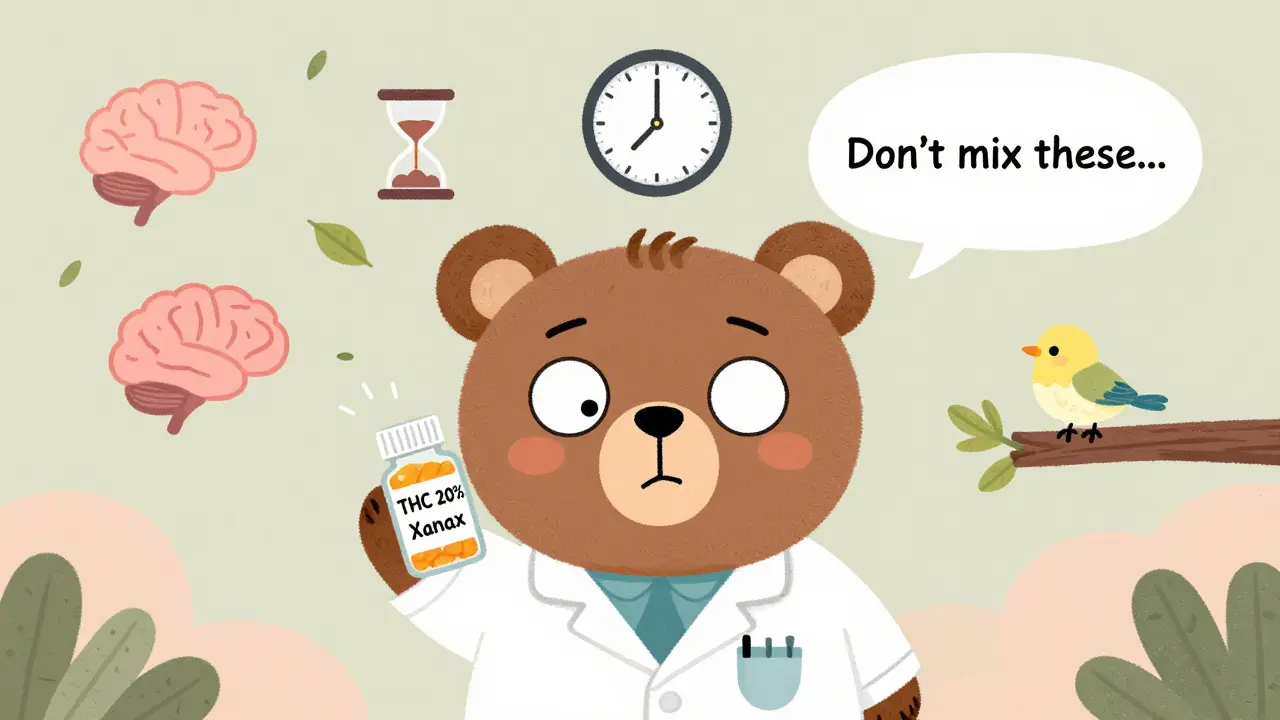
CNS Depressant Combination Risk Calculator
Assess Your Combination Risk
This tool estimates your risk level based on THC concentration, depressant type, and age. The National Academies recommend avoiding combinations when risk exceeds 7 points.
Risk Level: Low
Medical Guidance
Combining cannabis with prescription CNS depressants like benzodiazepines, opioids, or barbiturates isn’t just risky-it’s dangerous in ways many people don’t realize. You might think, "I’ve smoked before and taken Xanax, nothing happened." But that’s luck, not safety. The truth is, when cannabis meets other brain-slowing drugs, the effects don’t just add up-they multiply. And that’s when breathing slows too much, memory vanishes, or you wake up on the bathroom floor with no idea how you got there.
How Cannabis Acts Like a CNS Depressant
Cannabis isn’t just a "relaxant." It’s a central nervous system depressant. That means it directly slows down brain activity, just like alcohol, Valium, or opioids. The main culprit is THC, especially at concentrations above 10%. THC binds to CB1 receptors in the brain, triggering sedation, muscle relaxation, and drowsiness. It also messes with short-term memory, reaction time, and your ability to focus-exactly like benzodiazepines do. A 2020 study in The British Journal of Psychiatry found that even small doses of THC (5-10 mg) cause measurable impairments in cognitive tasks, especially those requiring divided attention. These aren’t minor side effects. They’re the same kind of deficits seen in people under the influence of alcohol.And here’s the catch: cannabis doesn’t just mimic these drugs-it works alongside them. While benzodiazepines boost GABA (the brain’s main calming neurotransmitter), THC affects the endocannabinoid system. Both pathways end up suppressing brain activity. When they overlap, the result isn’t 1 + 1 = 2. It’s more like 1 + 1 = 3.5. That’s called synergistic sedation. And it’s why people end up in emergency rooms.
The Real Danger: Slowed Breathing and Overdose Risk
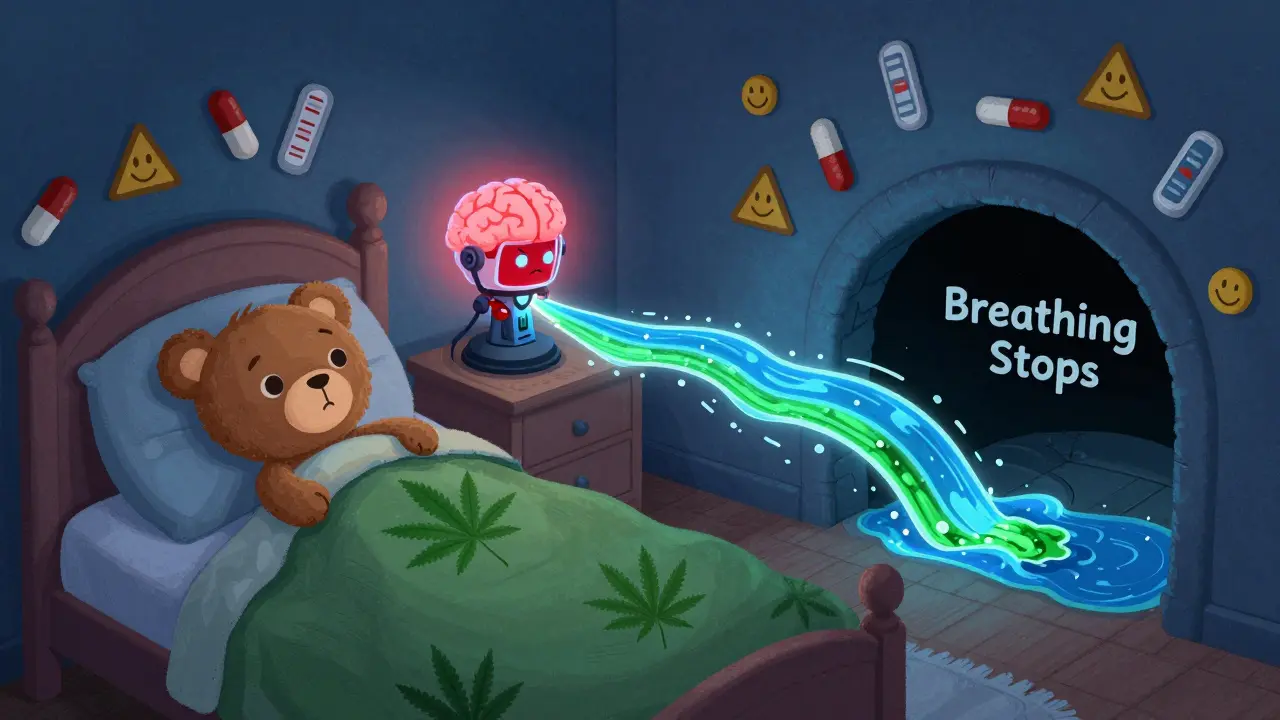
The most terrifying consequence of mixing cannabis with CNS depressants isn’t just feeling sleepy. It’s respiratory depression-your breathing slows to dangerous levels, sometimes stopping entirely. This is especially true when cannabis is combined with opioids. Both drugs suppress the brainstem’s drive to breathe, but through different biological pathways. That means the body has no backup system when both are active. The risk isn’t theoretical. A 2020 study in the Journal of Clinical Medicine found that patients using both cannabis and benzodiazepines had a 3.2 times higher chance of an emergency room visit than those using benzodiazepines alone. Sixty-seven percent of those visits involved breathing problems.Real cases back this up. One Reddit user, u/AnxietyWarrior, described waking up on the bathroom floor after taking a tiny dose of Xanax and a single hit of 20% THC flower. His oxygen levels dropped to 82%-a life-threatening level. The Substance Abuse and Mental Health Services Administration (SAMHSA) recorded over 7,800 emergency visits in 2022 involving cannabis and benzodiazepines alone. That’s a 42% jump since 2019. These aren’t isolated incidents. They’re a growing public health trend.
Who’s Most at Risk?
Older adults are especially vulnerable. Many are prescribed opioids for chronic pain and benzodiazepines for anxiety or insomnia. If they start using medical cannabis-often without telling their doctor-they’re walking into a perfect storm. A 2021 study from the University of Colorado found that 38.7% of medical cannabis patients were also taking prescription CNS depressants. Nearly a quarter of them had experienced episodes of extreme sedation so severe they needed medical help.Age isn’t the only factor. High-THC products make things worse. Edibles are riskier than smoked cannabis because the effects are delayed. Someone might take more thinking it’s not working, only to get hit with a massive, prolonged sedative effect hours later. And if they’ve already taken a sleeping pill? The combination can be fatal.
Even recreational users aren’t safe. A 2023 survey of 1,247 medical cannabis patients found that 22.4% had experienced an episode of excessive drowsiness, memory blackouts, or trouble waking up after combining cannabis with another depressant. These aren’t "bad trips." They’re physiological reactions caused by drug interactions.
What Experts Are Saying
Leading medical organizations are sounding the alarm. The American Society of Anesthesiologists says cannabis use within 72 hours of surgery requires close monitoring because anesthetics are CNS depressants. One study found that cannabis users needed 20-25% more propofol to reach the same sedation level as non-users-but had 37% more breathing problems during recovery.The American Academy of Neurology warns that combining cannabis with benzodiazepines creates unpredictable effects on brain chemistry. Dr. Igor Grant from UC San Diego called this one of the most under-recognized risks in modern medicine. The FDA, CDC, and European Medicines Agency all now require warning labels on prescription depressants about cannabis interactions. The message is clear: this isn’t speculation. It’s documented, measurable, and life-threatening.
Can You Use Them Together Safely?
Some patients do use both under strict medical supervision. A 2022 case series from the University of Colorado Anschutz Medical Campus showed that 15 chronic pain patients successfully reduced their opioid doses by nearly half by adding low-dose THC (2.5-5 mg). No serious events occurred. But notice the conditions: low THC, medical oversight, no other depressants, and careful monitoring.That’s not the same as self-medicating. The American Medical Association recommends that doctors screen every patient for cannabis use before prescribing benzodiazepines or opioids. The CDC advises dose adjustments and enhanced monitoring if both are used. The American Society of Health-System Pharmacists created a risk tool: assign points for THC concentration (1-5), depressant type (benzodiazepines = 3, opioids = 4, barbiturates = 5), and age over 65 (2 points). A score above 7 means high risk-time to reconsider the combination.
Some evidence suggests CBD-dominant products (with less than 0.3% THC) may pose lower interaction risks. A 2022 JAMA Internal Medicine trial found no significant interaction between high-CBD oil and alprazolam. But that doesn’t mean all CBD products are safe. Many contain hidden THC. And CBD alone can still cause drowsiness.
What Should You Do?
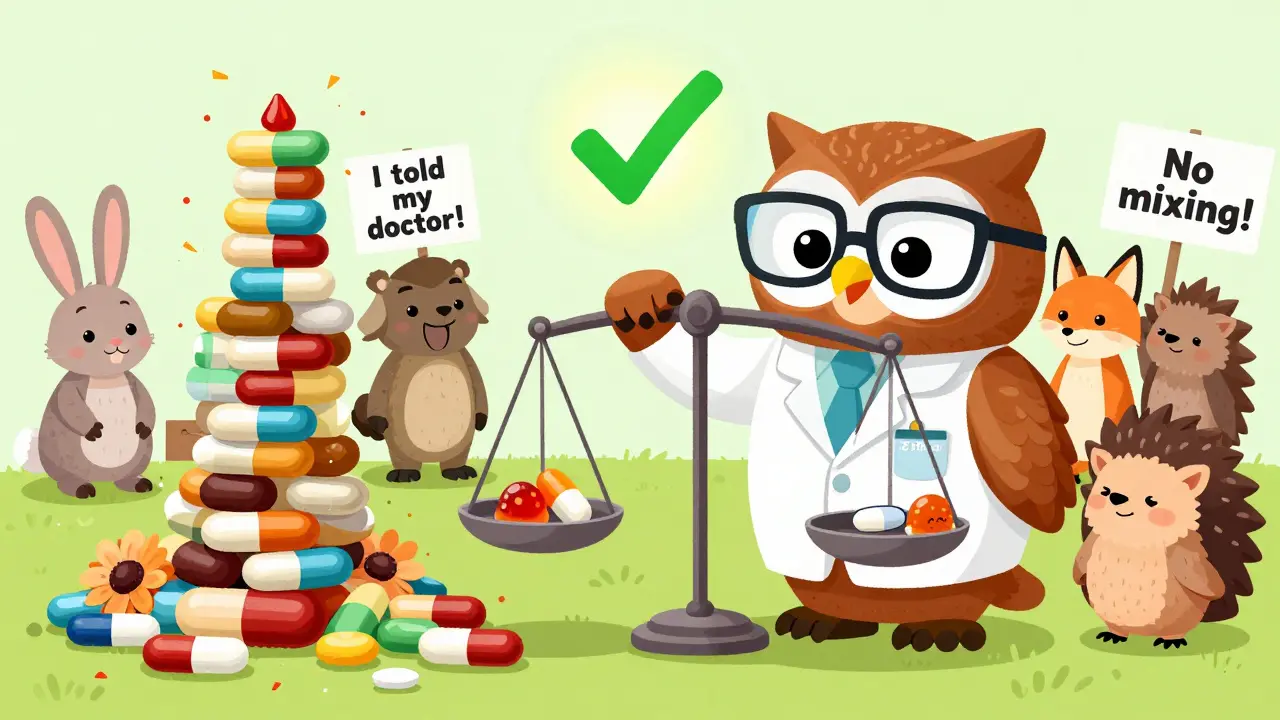
If you’re using cannabis and a CNS depressant, here’s what you need to know:- Don’t combine them without talking to your doctor. Even if you feel fine, your body might not be.
- Avoid high-THC products. Anything over 15% THC dramatically increases risk.
- Don’t use edibles with depressants. The delayed onset makes dosing unpredictable.
- Stagger doses by at least 4 hours. This isn’t foolproof, but it reduces peak overlap.
- Watch for warning signs. Extreme drowsiness, confusion, slurred speech, or difficulty breathing mean stop immediately and seek help.
- Never drive or operate machinery. Impairment from this combo lasts longer than you think-up to 12 hours.
Some people swear they feel better combining cannabis with their anxiety meds. But feeling relaxed isn’t the same as being safe. The goal isn’t to feel calm-it’s to stay alive.
What’s Changing?
Regulations are catching up. California now requires physicians to complete a 2-hour training on cannabis-depressant interactions before certifying patients. Since 2022, high-risk combinations have dropped by 28%. The National Institutes of Health has increased funding for interaction research to over $140 million in 2023. The National Academies are pushing for standardized risk scores and safe THC thresholds. By 2025, the American College of Physicians wants all states with medical cannabis programs to require interaction screening.This isn’t about banning cannabis. It’s about using it responsibly. The science is clear: mixing it with CNS depressants is a silent threat. And if you’re doing it, you’re playing Russian roulette with your breathing.
Can cannabis and Xanax be safely used together?
No, combining cannabis with Xanax (alprazolam) is not safe. Both are CNS depressants that slow brain activity and breathing. When used together, they create a synergistic effect-meaning the combined sedation is stronger than either drug alone. This significantly increases the risk of respiratory depression, extreme drowsiness, memory blackouts, and accidental overdose. Emergency room visits involving this combination have risen 42% since 2019. Even small doses can cause dangerous side effects. Always consult a doctor before mixing any cannabis product with benzodiazepines.
Does CBD interact with CNS depressants the same way as THC?
CBD appears to have a lower risk of dangerous interactions compared to THC. A 2022 double-blind trial in JAMA Internal Medicine found no significant pharmacokinetic interaction between high-CBD cannabis oil (150 mg CBD, less than 0.3% THC) and alprazolam. However, CBD can still cause drowsiness and fatigue on its own. While it doesn’t amplify respiratory depression like THC does, combining CBD with other depressants isn’t risk-free. Always disclose CBD use to your doctor, especially if you’re taking sleep aids, anti-anxiety meds, or painkillers.
Why are edibles riskier than smoked cannabis with depressants?
Edibles take longer to kick in-usually 30 to 90 minutes, with peak effects at 2 to 3 hours. This delay tricks people into thinking the dose didn’t work, so they take more. By the time the full effect hits, it can overlap with the peak of a depressant like an opioid or benzodiazepine. This creates a powerful, prolonged sedative surge that can shut down breathing. Smoked cannabis peaks within 30 minutes and wears off faster, giving the body more time to recover. Edibles turn a risky combination into a potentially deadly one.
Can cannabis help reduce opioid use safely?
Yes, under strict medical supervision. A 2022 case series showed that 15 chronic pain patients reduced their opioid doses by nearly half by adding low-dose THC (2.5-5 mg) to their regimen. Crucially, they avoided other CNS depressants, used medical-grade cannabis, and were closely monitored. This isn’t a green light to self-medicate. The success depended on controlled dosing, no alcohol or benzodiazepines, and ongoing clinical oversight. Attempting this without professional guidance is dangerous.
What should I do if I’ve already mixed cannabis with a depressant?
If you’ve combined them and feel extremely drowsy, confused, or have trouble breathing, seek medical help immediately. Even if you feel fine, tell your doctor. They need to know to adjust your medications and monitor you for delayed reactions. Don’t wait for symptoms to worsen. Keep a record of what you took, how much, and when. This information can save your life if you end up in the ER. Going forward, avoid mixing unless under direct supervision by a physician who understands drug interactions.
Are there any safe THC levels when using CNS depressants?
There is no universally safe THC level when combined with CNS depressants. Even low doses (2.5-5 mg) can be risky, especially in older adults or those with existing respiratory conditions. The National Institute on Drug Abuse advises avoiding products over 15% THC entirely if you’re using depressants. The safest approach is to avoid mixing them altogether. If you must use both, start with the lowest possible dose of each, wait at least 4 hours between doses, and never use edibles. But the only truly safe option is to avoid the combination.


