

Medication Fat Absorption Checker
Check if Your Medication Needs Fat
Many medications work better when taken with fatty foods. Enter your medication name to see if it benefits from fat.
How This Works
Fatty foods trigger bile release which helps absorb fat-soluble medications. About 70% of new drugs are poorly water-soluble and benefit from this effect.
When you take a pill with a high-fat meal, you’re not just eating - you’re activating a hidden system in your body that can make your medicine work better. This isn’t a myth or old wives’ tale. It’s science. And it’s changing how thousands of people take life-saving drugs every day.
The Food Effect: Why Fat Matters
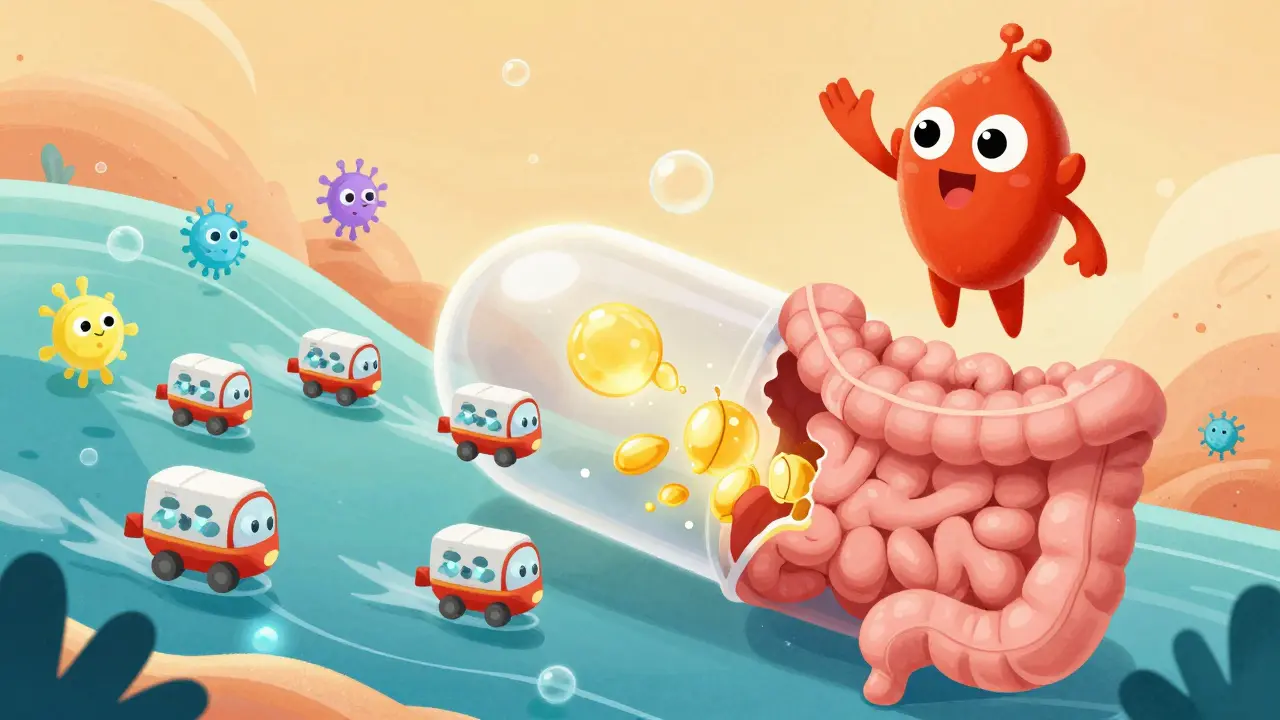
Many medications, especially those used for cholesterol, transplants, and fungal infections, don’t dissolve well in water. That’s a problem because your body absorbs drugs through your gut fluid - and if the drug can’t dissolve, it can’t be absorbed. About 70% of new drugs fall into this category, according to the Biopharmaceutics Classification System. These are called BCS Class II and IV drugs. They’re potent, but stubborn. Here’s where fat comes in. Eating fatty foods triggers your body to release bile and digestive enzymes. Bile acts like a detergent, breaking down fat into tiny droplets. These droplets trap fat-soluble drug molecules, keeping them suspended in your gut so they can be absorbed. Without fat, many of these drugs pass right through you - useless. Studies show this isn’t minor. For drugs like cyclosporine (used after organ transplants), taking it with a high-fat meal can boost absorption by 20-30%. For fenofibrate (a cholesterol drug), lipid-based versions absorb 31% better than older versions. And for itraconazole (an antifungal), the lipid-based oral solution delivers 2.8 times more drug into your bloodstream than the capsule - even on an empty stomach.How Lipid-Based Formulations Work
Pharmaceutical companies didn’t just wait for people to eat steak before taking their pills. They built the food effect into the medicine itself. Lipid-based drug delivery systems are specially designed formulations that mimic what happens when you eat fat. These aren’t just pills with added oil. They’re complex systems, often made of:- Medium-chain triglycerides (MCTs) - oils from coconut or palm kernel that digest faster than regular fats
- Surfactants - like Tween 80 or Cremophor EL - that help mix oil and water
- Cosolvents - like Transcutol HP - that keep the drug dissolved until it reaches the right spot
When Fat Helps - and When It Doesn’t
Not all drugs benefit from fat. In fact, some are ruined by it. Good candidates:- Cholesterol-lowering drugs (fenofibrate, atorvastatin)
- Immunosuppressants (cyclosporine, tacrolimus)
- Antifungals (itraconazole, posaconazole)
- Antivirals (ritonavir, lopinavir)
- Cancer drugs (everolimus, sirolimus)
- Bisphosphonates (like alendronate for osteoporosis) - need an empty stomach and acidic environment to dissolve
- Antibiotics like tetracycline - bind to calcium in dairy, blocking absorption
- Thyroid hormones (levothyroxine) - absorption drops sharply with high-fat meals
Real Patient Experiences
Behind every drug formula are real people. On Reddit’s r/pharmacy community, users share how switching to lipid-based versions changed their lives. One transplant patient wrote: “I used to have to eat a full breakfast every morning just to make my cyclosporine work. Now I take Neoral anytime. No more food tracking. No more nausea.” Another said: “I was on three doses of old fenofibrate a day. My stomach was always upset. Switched to Tricor - once a day, no side effects. I actually remember to take it now.” But it’s not all good news. The cost difference is stark. Generic itraconazole capsules cost around $300 for a month’s supply. The lipid-based Sporanox oral solution? Over $1,200. Many patients can’t afford it. Insurance often blocks it unless you’ve tried the cheaper version first - even if it didn’t work.Why This Matters for Your Health
If you’re on a medication that’s supposed to be taken with food, don’t assume it’s just to avoid stomach upset. It might be the only way the drug works. A 2022 study found that 87% of patients on lipid-based fenofibrate reported fewer stomach issues than those on the older version. That’s not coincidence. Better absorption means lower doses. Lower doses mean fewer side effects. Fewer side effects mean better compliance. Better compliance means fewer hospital visits. For patients with digestive disorders - Crohn’s, cystic fibrosis, post-bariatric surgery - fat digestion is impaired. That makes lipid-based drugs less predictable. One doctor in Minnesota told me: “I’ve seen patients on cyclosporine whose levels drop to dangerous levels after gastric bypass. Their bodies just don’t make enough bile anymore.” That’s why future versions are being designed to adapt. MIT researchers recently tested a “smart lipid capsule” that senses pH and enzyme levels in the gut and releases the drug only when conditions are right. It’s still experimental, but it points to a future where your medicine adjusts to your body - not the other way around.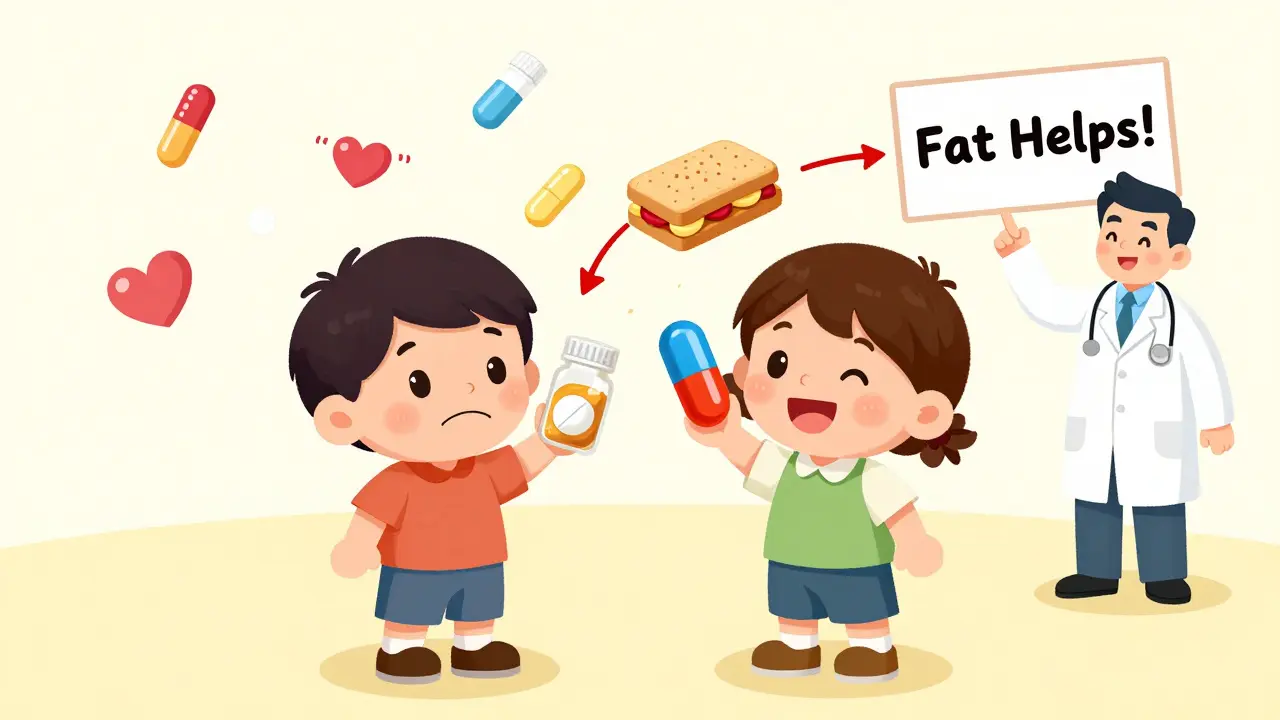
What You Should Do
If you take any of these drugs:- Check the label. Does it say “take with food” or “take with a high-fat meal”? Don’t skip it.
- Don’t substitute generic versions without asking your pharmacist. The lipid-based version might be the only one that works.
- If you’re having side effects or your drug doesn’t seem to be working, ask if a lipid-based version exists.
- Don’t take lipid-based drugs with low-fat or fat-free meals - you’re defeating the purpose.
The Future Is Lipid-Enhanced
The market for lipid-based drug delivery is growing fast - projected to hit $9.2 billion by 2028. Why? Because the problem isn’t going away. Nearly three out of four new drugs still struggle with solubility. Traditional pills won’t fix that. Lipid-based systems are more complex to make. They cost more. They need special packaging. But they work where nothing else does. And for patients who need them - the ones who’ve tried everything else - they’re not a luxury. They’re a lifeline. The next time you take a pill with a glass of milk or a spoonful of peanut butter, remember: you’re not just eating. You’re helping your medicine do its job.Do all lipid-based medications need to be taken with food?
No. Many lipid-based formulations are designed to work regardless of food intake because they contain their own fat and emulsifiers. For example, Neoral (cyclosporine) and Tricor (fenofibrate) can be taken without a high-fat meal. But always check your prescription label - some still require food to ensure consistent absorption.
Can I take my lipid-based drug with a low-fat meal?
It depends on the drug. If the formulation is self-emulsifying (like most modern lipid systems), a small amount of fat - even from a snack - is usually enough. But if you’re on an older version that relies on dietary fat for absorption, a low-fat meal may reduce effectiveness. When in doubt, follow your doctor’s instructions or ask your pharmacist.
Why are lipid-based drugs so expensive?
They’re more complex to manufacture. The ingredients (like MCTs and specialized surfactants) cost more, the production process requires strict controls, and the packaging (often softgel capsules) is more expensive than tablets. Plus, these drugs are often protected by patents longer than generics. A single month’s supply can cost 3-4 times more than the original version.
Are lipid-based medications safe for long-term use?
Yes. Drugs like cyclosporine and fenofibrate in lipid-based forms have been used safely for over 20 years. The lipid components (like medium-chain triglycerides) are generally recognized as safe by the FDA and are found in many foods. The main concern is cost and access - not safety.
Can I switch from a regular pill to a lipid-based version on my own?
No. Even though both versions may contain the same active ingredient, the way they’re absorbed can be very different. Switching without medical supervision can lead to underdosing or overdosing. Always consult your doctor or pharmacist before changing formulations.
What if I have trouble digesting fat?
If you have conditions like cystic fibrosis, pancreatic insufficiency, or have had gastric surgery, your body may not produce enough bile or enzymes to activate lipid-based drugs properly. In these cases, the drug might not work as expected. Tell your doctor - they may need to adjust your dose or consider alternative delivery methods.
I literally took my cyclosporine with a bagel and cream cheese this morning and felt weirdly proud 😄 Like, I’m not just surviving transplant life-I’m optimizing it. My doc said I’m one of the few who actually follow the fat rule. Keep doing the weird food stuff, y’all.
OMG this is such a game-changer. I used to hate taking my fenofibrate because I’d get stomach cramps all day-now I just grab a spoon of peanut butter and boom, no issues. I actually remember to take it now. Why isn’t this common knowledge?!! My grandma still takes hers with tea like it’s medicine from 1987 😅
It is deeply concerning that pharmaceutical innovation is being measured not by therapeutic efficacy alone, but by the ability to exploit physiological mechanisms for profit. The deliberate design of drugs to require dietary fat-thereby conditioning patients to consume more calories-is not science; it is a subtle form of dietary coercion. One must question the ethics of such formulations when they disproportionately burden low-income populations.
Correction: It’s not ‘70% of new drugs’-it’s 70% of new molecular entities classified as BCS Class II or IV. Also, ‘lipid-based delivery systems’ aren’t ‘complex systems’-they’re emulsions. Precision matters. And no, you don’t need to eat steak. A teaspoon of olive oil works. Stop sensationalizing.
Big Pharma knows you're too lazy to eat fat so they made the pill do it for you... but wait-why are they hiding this from the FDA? They're secretly turning us into fat-eating zombies so we need MORE drugs to fix the damage. I saw a guy on YouTube say the same thing. They're using MCT oil to mess with your gut biome. It's all connected. Check the patent dates. 2019. Right after the pandemic. Coincidence? I think not.