
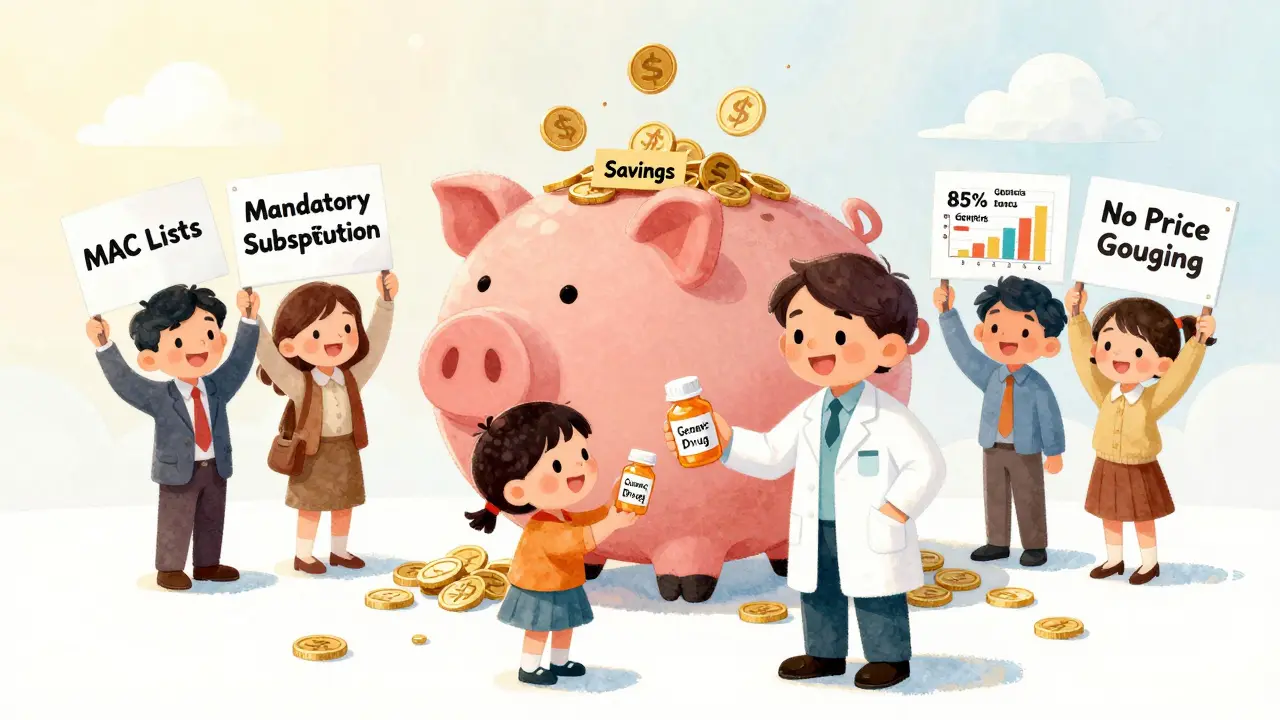
Medicaid spends billions on prescription drugs every year, but here’s the surprising part: generic drugs make up 85% of all Medicaid prescriptions, yet they only account for about 16% of total drug spending. That’s the power of generics. States aren’t just relying on them-they’re actively redesigning how they pay for them to keep costs down without cutting access. This isn’t theoretical. It’s happening right now, in real time, across all 50 states and D.C.
How Medicaid Gets Its Generic Drug Discounts
The federal Medicaid Drug Rebate Program (MDRP) is the backbone of this system. Created in 1990, it forces drugmakers to give states a discount every time a generic drug is filled under Medicaid. For generics, that discount is fixed at 13% of the Average Manufacturer Price (AMP), or the difference between AMP and the lowest price the company charges anyone else-whichever is bigger. It’s automatic. No negotiation. No exceptions.
That’s why states don’t spend as much on generics even though they’re prescribed more often. In 2021, Medicaid paid out $57.3 billion total for drugs. Of that, only $9.1 billion went to generics, even though 84.7% of all prescriptions were for generic versions. That’s not luck. It’s policy.
But here’s the catch: the MDRP doesn’t let states go further. Unlike brand-name drugs, where states can negotiate extra rebates, generic rebates are locked in by federal law. So if a drugmaker suddenly jacks up the price of a 10-year-old generic pill, Medicaid has to pay more-unless the state steps in.
What States Are Doing Beyond Federal Rules
That’s where state-level strategies kick in. Forty-two states now use Maximum Allowable Cost (MAC) lists. These are price caps. If a pharmacy tries to bill Medicaid for a generic drug above the MAC, the state won’t pay the full amount. Instead, they pay the MAC price, and the pharmacy eats the difference.
Thirty-one of those states update their MAC lists every quarter or more often. But here’s the problem: 68% still update monthly or less. That means if a drug’s price drops suddenly-say, from $50 to $30 because a new manufacturer enters the market-some pharmacies might still be getting paid $50 for weeks. Meanwhile, patients might get denied coverage if the MAC is set too high and the pharmacy can’t afford to sell it at the lower price.
States also use mandatory generic substitution. In 49 states, pharmacists are required to swap a brand-name drug for a generic unless the doctor says no. That’s not just common sense-it saves money. A 2024 survey found that states with strong substitution rules saw up to 12% lower net drug spending.
Then there’s therapeutic interchange. If a patient needs a drug for high blood pressure, and there are three equally effective generics, the state can steer them toward the cheapest one. Twenty-eight states have formal programs for this. It’s not about limiting options-it’s about smart choices.
Cracking Down on Price Gouging
One of the most aggressive moves states are making? Targeting price spikes on old, off-patent generics. Maryland passed a law in 2020 that makes it illegal for manufacturers to raise prices on generic drugs without new clinical data or legitimate cost increases. If they do, the state can investigate and impose penalties.
That law came after a single generic antibiotic jumped from $20 to $1,200 in less than a year. No new research. No new formulation. Just greed. Maryland didn’t wait for Congress. They acted.
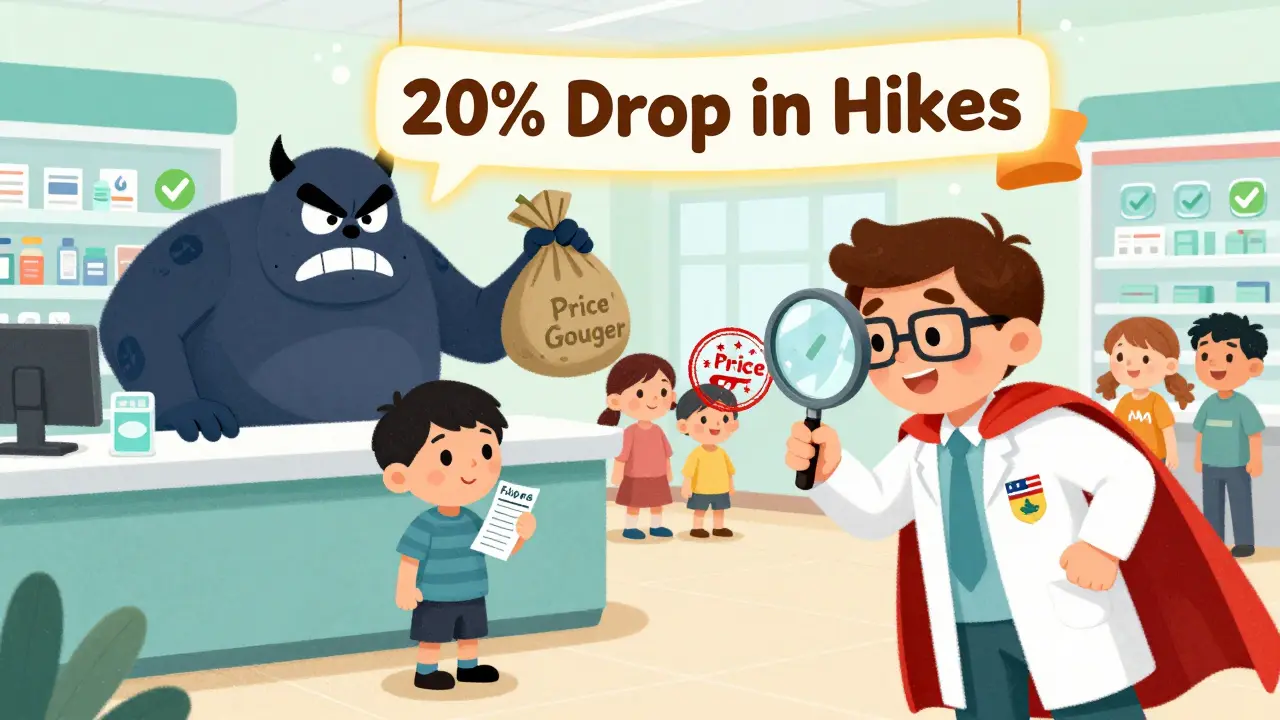
Since then, six more states-California, Colorado, Nevada, Oregon, New York, and Connecticut-have followed suit. These laws are still new, but early data shows a 20% drop in unjustified price hikes in states that enforce them.
Pharmacy Benefit Managers and the Hidden Middleman
Behind the scenes, Pharmacy Benefit Managers (PBMs) are playing a bigger role than most people realize. Thirty-three states hire PBMs like OptumRx, Magellan, or Conduent to handle their pharmacy claims. These companies negotiate discounts, set reimbursement rates, and process claims.
But here’s the issue: PBMs often don’t pass along the full discount they get from drugmakers. A pharmacy might pay $10 for a pill, the PBM negotiates it down to $7, but Medicaid pays $12. The extra $5? That’s the PBM’s profit. It’s called spread pricing.
Twenty-seven states have responded by requiring PBMs to disclose their true acquisition costs. Nineteen of them now require PBMs to show exactly how much they paid for each generic drug. That transparency is forcing PBMs to stop hiding markups. In states that implemented this rule, generic drug reimbursements dropped by 8-11% within six months.
The Supply Chain Crisis and What States Are Doing
One in five Medicaid beneficiaries experienced a shortage of a critical generic drug in 2023. The average shortage lasted over four months. Why? Because 65% of generic injectables are made by just three companies. If one factory shuts down, hundreds of drugs vanish.
Twelve states introduced legislation in 2024 to build emergency stockpiles of high-demand generics. Oregon and Washington teamed up to create a multi-state purchasing pool, buying 47 high-volume generics in bulk to lock in lower prices and guarantee supply. Texas is setting up a state-run warehouse for essential injectables. New Hampshire created a risk pool to cover shortages without breaking the budget.
These aren’t long-term fixes, but they’re buying time. The National Academy for State Health Policy predicts 22 states will have formal stockpiling programs by 2026.
The Big Trade-Off: Cost vs. Access
Every policy has a downside. MAC lists help save money, but if they’re too low, pharmacies stop carrying certain generics because they lose money on each sale. A 2024 survey of 1,200 independent pharmacies found that 74% had claims denied or delayed because their state’s MAC list didn’t match current prices.
Some states are caught in a loop: they lower the MAC to save money, then see patients go without medication because no pharmacy can afford to stock it. So they raise it. Then drugmakers raise prices again. It’s a cycle.
Experts warn that pushing too hard on price controls could backfire. The Congressional Budget Office estimates aggressive state policies could reduce generic spending by 5-8% annually-but if manufacturers quit the market because profits vanish, Medicaid could end up paying even more for brand-name substitutes.
What’s Next? GLP-1 Drugs and the Future of Medicaid Spending
While states are focused on generics, a new threat is rising: GLP-1 medications. These drugs, like Ozempic and Wegovy, are being used for obesity and diabetes. A single year’s supply can cost $12,000. Thirteen states already cover them under Medicaid-but only with strict prior authorization.
That’s a preview of what’s coming. If federal rules change to require Medicaid to cover these drugs for all eligible patients, the Congressional Budget Office estimates that could cost state programs an extra $1.2 billion a year.
States are already preparing. They’re building new formularies, testing step therapy protocols, and studying how to apply MAC-style controls to these drugs. The same tools that worked for generics-substitution, therapeutic interchange, MAC lists-are being adapted for these new high-cost medications.
Bottom Line: Smart, Not Just Cheap
States aren’t trying to slash Medicaid drug spending at any cost. They’re trying to make it sustainable. They’re using data, transparency, and collaboration to outmaneuver price gouging, supply chain gaps, and hidden markups. The tools are there: MAC lists, mandatory substitution, PBM oversight, stockpiling, and anti-price-gouging laws.
The challenge isn’t finding solutions. It’s balancing them. Save too much, and patients lose access. Save too little, and the system breaks. The best states are the ones that watch the data, listen to pharmacists, and adjust fast. That’s how you control costs without sacrificing care.