
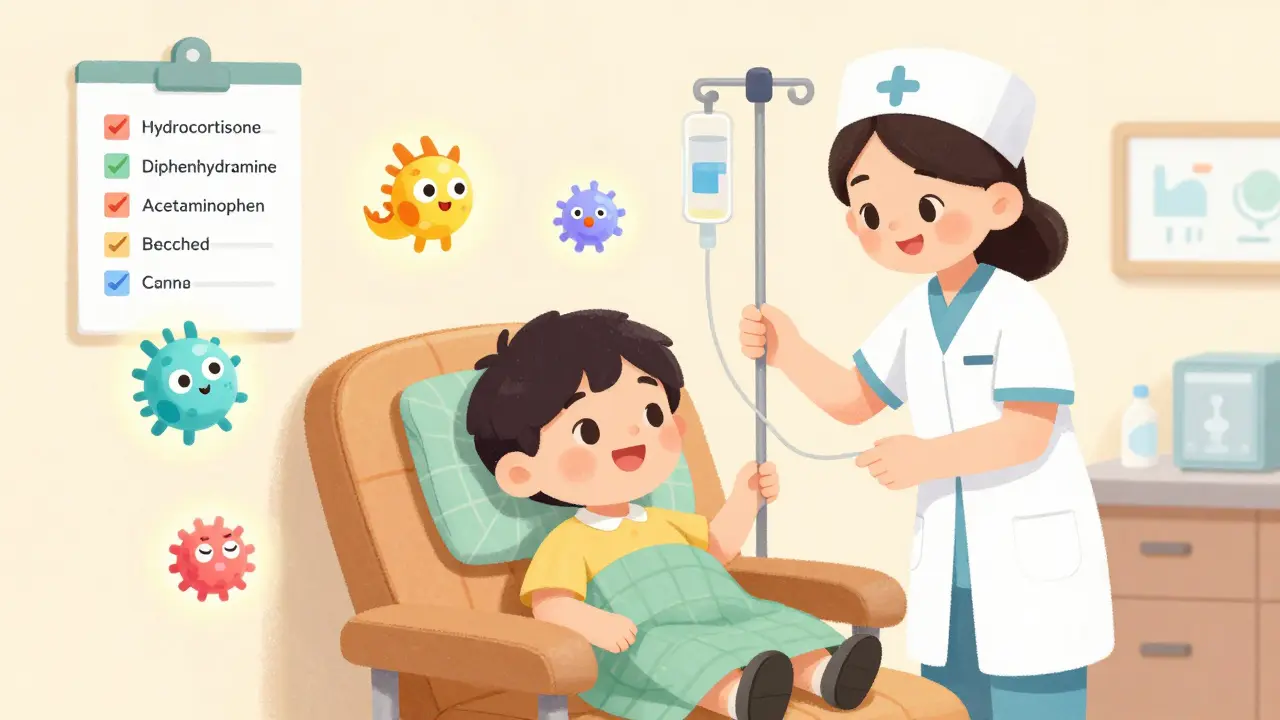
Biologic Infusion Emergency Response Guide
Emergency Response Guide
This interactive guide helps you quickly identify your reaction severity and follow appropriate emergency steps based on the Common Terminology Criteria for Adverse Events (CTCAE v5.0).
Important: Always stop the infusion immediately if you experience any symptoms of an infusion reaction.
Emergency Response Steps
Step 1: Stop the infusion immediately
Do not wait for symptoms to subside. This is the first and most critical step.
Step 2: Position the patient
Lay the patient flat on their back with their legs elevated. This helps maintain blood flow to the heart and brain.
Step 3: Activate emergency response
Call for medical help immediately. Even mild reactions can escalate rapidly.
Step 4: Administer epinephrine (if needed)
For Grade 2 or higher reactions:
Epinephrine dose: 0.00 mg
Dose range: 0.01 mg/kg (max 0.5 mg)
Step 5: Treat symptoms
For breathing trouble:
Nebulized adrenaline 5 mg in 3 mL saline can open airways in under 5 minutes.
For moderate reactions:
Administer methylprednisolone 125 mg IV and diphenhydramine 50 mg IV.
Step 6: Monitor and test
Check serum tryptase level at 30-120 minutes after reaction onset.
A tryptase level > 11.4 µg/L, plus 20% of baseline plus 2 µg/L, confirms anaphylaxis.
Reaction Severity Guide
Grade 1: Mild
Flushing or small rash. No treatment needed.
Grade 2: Moderate
Fever over 100.4°F (38°C), nausea, or mild breathing trouble. Requires medical help.
Grade 3: Severe
Low blood pressure, wheezing, or oxygen needs. Requires hospitalization.
Grade 4: Life-threatening
Cardiac arrest, respiratory failure. Death can occur if not treated immediately.
When you’re receiving a biologic therapy-whether it’s for rheumatoid arthritis, Crohn’s disease, or cancer-you’re trusting a powerful drug to change your life. But for 1 in 3 patients, that treatment comes with a scary twist: an infusion reaction. These aren’t just mild discomforts. They can mean sudden fever, chills, trouble breathing, or even a drop in blood pressure. And if you don’t know what to do, it can turn dangerous fast.
What Exactly Is a Biologic Infusion Reaction?
Biologic therapies are made from living cells, often monoclonal antibodies or fusion proteins. Unlike traditional pills, they’re given through an IV or under the skin. Because they’re so targeted, they work wonders-but your immune system doesn’t always recognize them as friendly. That’s when reactions happen.
There are three main types:
- Immediate hypersensitivity reactions (within 1-2 hours): Think itching, hives, flushing, or swelling. These can be IgE-mediated, like a food allergy, or triggered by other immune pathways.
- Cytokine release syndrome (minutes to hours): Fever, chills, low blood pressure, and muscle rigors. Common with drugs like rituximab or tocilizumab. It’s not an allergy-it’s your immune system overreacting by flooding your body with signaling proteins.
- Delayed reactions (24-72 hours later): Rash, joint pain, or flu-like symptoms. Often mistaken for a cold or virus.
The Common Terminology Criteria for Adverse Events (CTCAE v5.0) grades these from 1 to 4:
- Grade 1: Mild-flushing or a small rash. No treatment needed.
- Grade 2: Moderate-fever over 100.4°F, nausea, or mild breathing trouble. Needs medical help.
- Grade 3: Severe-low blood pressure, wheezing, or oxygen needs. Requires hospitalization.
- Grade 4: Life-threatening-cardiac arrest, respiratory failure. Death can occur if not treated immediately.
And here’s the kicker: 38% of patients stop their biologic therapy because of these reactions. That’s not just inconvenient-it can mean losing control of their disease.
How to Prevent Reactions Before They Start
Prevention isn’t guesswork. It’s a science-backed checklist.
Standard premedication protocol (used in 90% of U.S. cancer centers):
- Hydrocortisone 200 mg IV or methylprednisolone 125 mg IV given 30 minutes before infusion. This reduces immune activation by 47% compared to no steroid, according to the INFLECT trial.
- Diphenhydramine 50 mg IV or cetirizine 10 mg orally given 1 hour before. Cetirizine works just as well as diphenhydramine-but causes 78% less drowsiness.
- Acetaminophen 1,000 mg orally 1 hour before. Helps with fever and chills.
There’s another layer: hydration. The NIH recommends giving 100 cc/h of normal saline during the first 11 steps of infusion, then ramping up to 250 cc/h for the final step. This simple move cuts cytokine release syndrome risk by 63%.
And timing matters. Patients who get infusions every 8 weeks instead of every 12 weeks develop fewer anti-drug antibodies-lowering reaction risk by 32%. That’s not a coincidence. Consistency trains your immune system to tolerate the drug.
But here’s the catch: steroids can hide early warning signs. A 2020 study found that 18.7% of patients had their first signs of anaphylaxis masked by premedication. That’s why monitoring isn’t optional. You need to watch for changes-every single time.
When a Reaction Happens: Emergency Steps You Can’t Skip
If you feel a flush, a chill, or your chest tightens during an infusion-stop the drip immediately.
Here’s what the team should do, step by step:
- Stop the infusion. Don’t wait. Don’t hope it passes.
- Position the patient. Lay them flat, legs raised. This helps blood flow to the heart and brain.
- Call for help. Activate emergency response. Even mild reactions can escalate fast.
- Give adrenaline (epinephrine) if needed. For Grade 2 or higher reactions, give 0.01 mg/kg IM (max 0.5 mg) into the outer thigh. Repeat every 5 minutes if symptoms persist. This is the #1 lifesaver in anaphylaxis.
- For breathing trouble: Nebulized adrenaline 5 mg in 3 mL saline can open airways in under 5 minutes.
- For moderate reactions: Give methylprednisolone 125 mg IV and diphenhydramine 50 mg IV.
- Check serum tryptase. Draw blood at exactly 30-120 minutes after the reaction. A level above 11.4 µg/L, plus 20% of your baseline plus 2 µg/L, confirms anaphylaxis.
Don’t skip the tryptase test. It’s the only objective way to prove this was a true allergic reaction-not just a side effect. That matters for future treatment decisions.
Desensitization: Can You Still Get the Drug After a Reaction?
Yes-and it’s more common than you think.
Desensitization is a controlled, gradual way to reintroduce the drug after a reaction. It’s not for everyone, but for patients with no alternatives (like those with rheumatoid arthritis who don’t respond to other drugs), it’s a lifeline.
The standard protocol is the 12-step, 3-bag method:
- Start at 0.1 mL/min with 1% of the full dose.
- Double the rate every 15-20 minutes.
- Use three bags: 1%, 10%, and 100% of the total dose.
- Complete the process in 4-6 hours.
Success rates? 97% for rituximab, 95% for trastuzumab, 89% for infliximab. And even when reactions happen during desensitization, 92% are mild and manageable.
But here’s the reality: it’s not easy. You need trained staff, monitoring equipment, and a full emergency kit on hand. Only 42% of rheumatology clinics follow standardized protocols. That’s risky.
And some drugs? They’re trickier. Tocilizumab (an anti-IL-6 drug) causes cytokine release syndrome in 8.7% of desensitization attempts-more than triple the rate for TNF inhibitors.
Which Biologics Are Most Likely to Cause Reactions?
Not all biologics are created equal. Here’s how they stack up:
| Biologic | Reaction Rate | Most Common Reaction Type |
|---|---|---|
| Rituximab | 30-80% | Cytokine release syndrome (first infusion) |
| Trastuzumab | 30-40% | Immediate hypersensitivity |
| Cetuximab | 20-25% | IgE-mediated anaphylaxis (in patients with prior meat allergy) |
| Infliximab | 10-20% | Immediate hypersensitivity |
| Adalimumab | 5-10% | Immediate hypersensitivity |
| Etanercept | 2-5% | Mild flushing or headache |
| Tocilizumab | 15-25% | Cytokine release syndrome |
And here’s something surprising: cetuximab reactions are linked to pre-existing IgE antibodies to alpha-gal, a sugar found in red meat. Patients who’ve had tick bites or eaten a lot of beef are at higher risk. That’s why some centers screen for it before starting treatment.

What’s New in 2026?
Things are changing fast.
In 2024, the FDA approved the first standardized desensitization kit: BioShield®. It includes pre-measured dilutions and step-by-step cards for 12 common biologics. No more manual mixing errors.
The NIH’s DESERVE trial is testing a new 8-step protocol with real-time IL-6 monitoring. Early results? 98.2% success rate. That’s huge.
And now, there’s an AI tool called BioReaction Score™. It predicts your risk of a reaction using your genetics (HLA-DRA*0102 status), baseline IL-6 levels, and even past antibiotic reactions. It’s 87.4% accurate. Soon, your doctor might use this before your first infusion to tailor your premeds.
When to Quit: The Hard Decision
Not every reaction means you can try again.
If you’ve had a Grade 4 reaction-like cardiac arrest, severe hypotension, or respiratory failure-you should not restart the drug. The ASCO guideline says there’s a 22% chance it happens again, and it could be fatal.
That’s why documentation matters. Every reaction needs to be logged: time, symptoms, vital signs, meds given, and tryptase results. That record protects you and guides future care.
The International Hypersensitivity Drug Desensitization Registry has tracked over 2,100 procedures across 47 centers. The success rate? 94.3%. That’s not luck. It’s protocol.
Bottom Line: Know the Plan Before You Start
Biologics save lives. But they come with risks you can’t ignore.
You need to know:
- What your specific drug is likely to do
- What premeds you’ll get and why
- What symptoms mean trouble
- What happens if you react
- Whether desensitization is an option
Don’t wait for a reaction to learn this stuff. Ask your care team before your first infusion. Get the protocol in writing. Know who to call if something goes wrong.
Because when it comes to biologic therapy, preparation isn’t optional. It’s the difference between staying on treatment-and losing it forever.
Can you have a biologic infusion reaction even if you’ve had them before without issues?
Yes. Reactions can develop over time, even after multiple safe infusions. Your immune system can start making anti-drug antibodies, especially if doses are spaced too far apart. That’s why consistent timing (like every 8 weeks instead of 12) lowers risk. Also, some reactions are delayed-appearing hours or days later-so don’t assume you’re safe just because the first few infusions were fine.
Are steroid premeds always necessary for biologics?
Not always, but they’re recommended for most IV biologics, especially those with known high reaction rates like rituximab or infliximab. For subcutaneous biologics like adalimumab or etanercept, premeds are less common unless you’ve had a prior reaction. However, skipping steroids can increase your chance of developing antibodies to the drug, which may reduce its effectiveness over time. Always follow your provider’s protocol-it’s based on your drug, your history, and your risk.
What’s the difference between an infusion reaction and an allergic reaction?
Allergic reactions are a subset of infusion reactions. True allergies involve IgE antibodies and often cause hives, swelling, or anaphylaxis. But many infusion reactions are not IgE-mediated-they’re cytokine-driven or caused by complement activation. That’s why you can have a severe reaction without a positive skin test. The key is symptom timing and type, not just the label. Tryptase testing helps tell the difference.
Can you desensitize to any biologic?
Most, but not all. Desensitization works well for monoclonal antibodies like rituximab, trastuzumab, and infliximab. It’s less reliable for drugs that cause severe cytokine release, like tocilizumab or some CAR-T therapies. Also, if you’ve had a Grade 4 reaction, desensitization is generally not recommended. The decision depends on your specific drug, your reaction history, and whether you have alternative treatments.
How long should you be monitored after an infusion?
You should be monitored for at least 1 hour after the infusion ends. For high-risk drugs like rituximab or cetuximab, 2-4 hours is standard. Delayed reactions can start up to 72 hours later, so you need to know the signs: fever, rash, joint pain, or fatigue. If you’re at home and feel unwell after an infusion, contact your care team immediately. Don’t wait until the next day.
Is there a blood test to predict if I’ll have a reaction?
Not yet for routine use, but new tools are emerging. The BioReaction Score™ algorithm uses genetic markers (like HLA-DRA*0102), baseline IL-6 levels, and past allergic history to predict risk with 87.4% accuracy. It’s not widely available yet, but it’s being rolled out in major cancer centers. For now, your best predictor is your own history-especially if you’ve had a reaction before or have a known allergy to red meat (linked to cetuximab reactions).
Just had my third rituximab infusion last week - no issues this time! I swear the premeds and slow drip made all the difference. My nurse even upped my saline rate, and I didn’t feel a thing. Seriously, don’t skip the hydration step - it’s not just busywork.
Also, I used to get super drowsy from diphenhydramine, but switching to cetirizine? Game changer. No more napping for three hours after treatment.
My mom had a Grade 3 reaction on her first infliximab. They stopped it, gave her epinephrine, and she cried for an hour. But after desensitization? She’s been on it for two years now. No more joint pain. No more hospital visits. It saved her life.
OMG I had this happen to me and I was like WAIT WHY IS MY BODY ON FIRE?? Like I was just trying to get better and now I’m dying?? Like why do they even make this stuff??
It is, indeed, profoundly concerning - and frankly, ethically indefensible - that so many patients are left uninformed about the very real, statistically significant risks associated with biologic infusions. The medical community’s reliance on standardized protocols, while commendable in theory, often masks a systemic failure to personalize care. Tryptase testing? Mandatory. Premedication? Non-negotiable. And yet - how many clinics still skip it? How many patients are told, ‘It’s probably fine’ - when ‘fine’ is a euphemism for ‘you might die’?
Let us not forget: this is not merely ‘side effect management.’ This is immunological warfare - and the patient is the battlefield. If your provider won’t give you the full protocol in writing - find a new one. Your life is not a gamble.
biologics r just fancy placebos with side effects. why do we even use them? my cousin got sick after one and now he cant work. the system is broken.
👏 This is the kind of detailed, life-saving information that should be shared far and wide. Whether you’re a patient, a caregiver, or a clinician - this post is a masterclass in responsible care. The BioShield® kit? Brilliant. The AI predictor? Revolutionary. And the desensitization success rates? Hope in action.
Remember: knowledge isn’t power - it’s protection. Share this. Bookmark it. Print it. And never, ever assume ‘it won’t happen to me.’ 💪❤️
I used to think I was just ‘sick’ after my infusions - fatigue, achy joints, weird rash. Turns out? Delayed reaction. I didn’t connect the dots until I started tracking my symptoms in a journal. Now I know: if I feel off 24 hours after, I call my nurse before I even get out of bed. No more ‘it’ll pass.’
And honestly? The tryptase test saved me. My doctor thought it was a virus. Lab results said: anaphylaxis. I’m still on the drug - but now I’m prepped. No more guessing.
yo i got the same reaction as the guy in the article and they just gave me benadryl and said ‘you’ll be fine’ but i felt like i was gonna die lmao. now i just take my own meds before i go. they dont even ask if i want em.
There’s something so deeply human about this whole process - the fear, the uncertainty, the quiet courage it takes to walk into that infusion chair knowing your body might rebel. But what I find most beautiful is how science has responded - not with fear, but with precision. The 12-step desensitization protocol? It’s like teaching your immune system to speak a new language. And the AI tool? It’s not just predictive - it’s personal. It sees you not as a statistic, but as a person with a unique genetic fingerprint, a history of antibiotics, a past with tick bites. That’s not just medicine - that’s respect. That’s care. And honestly? After everything I’ve been through, that’s the only thing that keeps me coming back.
Don’t let anyone tell you that biologics are ‘too risky.’ They’re not. What’s risky is not knowing. What’s dangerous is silence. Speak up. Ask for the protocol. Demand the tryptase test. You deserve nothing less than to be seen, heard, and protected - every single time.
Why are we letting foreign drug companies control our healthcare? This is why America needs to make its own biologics. Stop outsourcing life-saving meds to labs in India and China. We’re letting our own people suffer because we’re too lazy to build it here.
Thank you for this comprehensive breakdown. I’m a clinical pharmacist and I’ve seen too many patients discontinue therapy due to fear of reactions - often because they were never properly educated. Your inclusion of the CTCAE grading, desensitization protocols, and emerging tools like BioReaction Score™ is invaluable. I’m sharing this with our infusion center team tomorrow. This is exactly the kind of resource we need to standardize education across institutions.
Wait - you said cetirizine causes 78% less drowsiness? I’m switching. I’ve been taking diphenhydramine for two years and I’m basically a zombie after every infusion. Also, I didn’t know about the 8-week vs 12-week timing thing. My next dose is due in 10 days - guess I’m moving it up.