
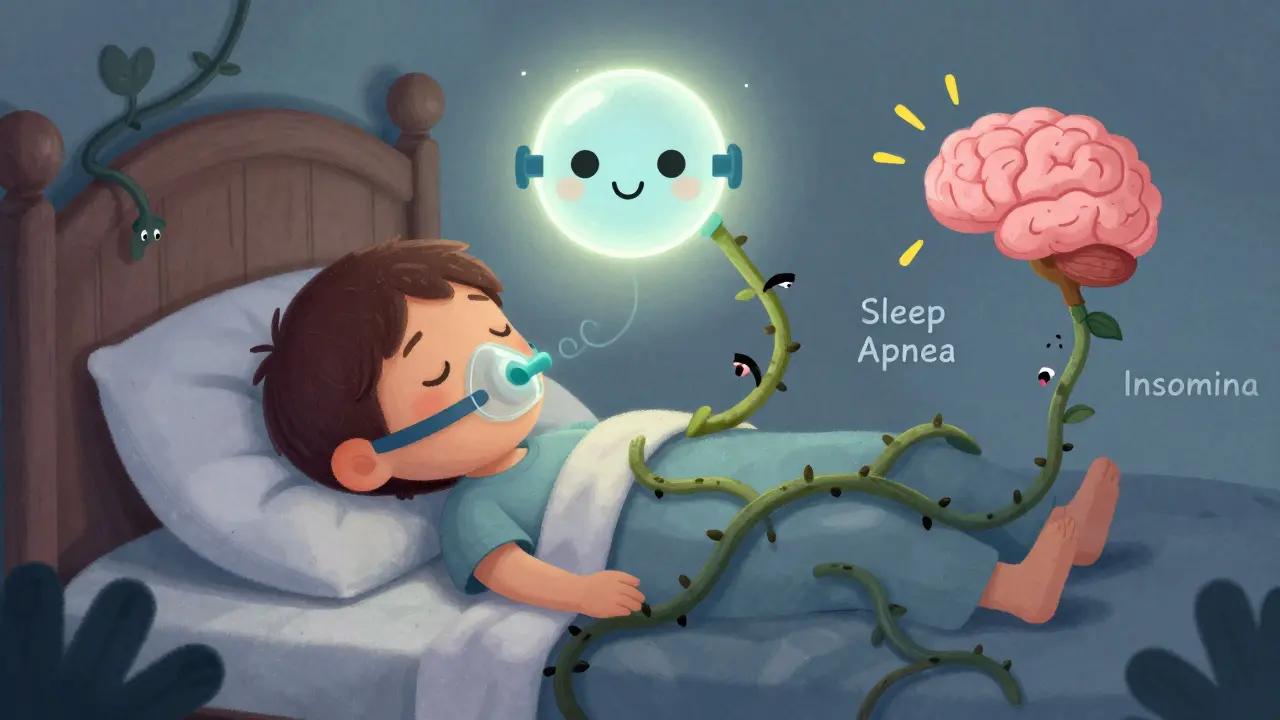
What Is COMISA, and Why Does It Matter?
COMISA stands for Comorbid Insomnia and Sleep Apnea. It’s not just having trouble sleeping and breathing at night - it’s when both conditions feed off each other, making sleep worse than either one alone. About 4 in 10 people diagnosed with sleep apnea also have clinical insomnia, and most doctors miss it. They treat one problem, then wonder why the patient still feels exhausted. That’s because treating just sleep apnea with a CPAP machine doesn’t fix the brain’s habit of staying wired at night. And treating just insomnia with sleep meds doesn’t stop the breathing pauses that wake you up every few minutes.
COMISA isn’t a rare edge case. It’s the hidden majority. In fact, if you’ve been on CPAP for months and still can’t fall asleep or stay asleep, you might have COMISA. Studies show that 39% to 58% of people with sleep apnea also struggle with insomnia. Yet, only 12% of patients have access to providers who know how to treat both at once. Most sleep clinics still treat them separately - and that’s why so many people give up on CPAP after just a few weeks.
Why CPAP Alone Often Fails in COMISA
CPAP is the gold standard for sleep apnea. When used correctly, it works 85-90% of the time. But in COMISA patients, adherence drops to just 42.7%. Why? Because CPAP doesn’t fix insomnia - it can make it worse.
Think about it: you’re trying to sleep, but the mask feels tight, the air pressure feels unnatural, and the machine hums loudly. You start associating your bed with frustration, not rest. That’s classic insomnia conditioning. One study found that 27% of COMISA patients develop worse insomnia after starting CPAP because of mask discomfort and nighttime awakenings caused by pressure changes. Even worse, the brain starts resisting sleep, fearing the discomfort that comes with it.
Patients on Reddit’s r/sleepapnea community report this constantly. Common complaints? “I can’t fall asleep with the mask on.” “The air keeps me awake.” “I take it off because I’m too stressed.” These aren’t laziness or noncompliance - they’re symptoms of untreated insomnia tangled with OSA.
The Only Treatment That Actually Works for COMISA
There’s one approach that consistently outperforms all others: combining Cognitive Behavioral Therapy for Insomnia (CBT-I) with CPAP therapy from day one. Not after. Not later. Together.
CBT-I isn’t just “sleep hygiene.” It’s a structured, evidence-based program that rewires how your brain thinks about sleep. It includes stimulus control (only using your bed for sleep), sleep restriction (limiting time in bed to match actual sleep), and cognitive restructuring (challenging thoughts like “I’ll never sleep again”).
When paired with CPAP, CBT-I doesn’t just help you sleep better - it helps you stick with CPAP. A 2020 randomized trial showed that patients who got CBT-I alongside CPAP increased their nightly usage by 1.2 hours on average. That’s not a small gain - it’s the difference between barely surviving the night and actually feeling rested.
The results? 63% of COMISA patients achieved remission of insomnia symptoms with combined treatment. Only 29% did with CPAP alone. That’s a 117% improvement.
How COMISA Is Diagnosed (And Why Most Doctors Miss It)
Standard sleep studies (polysomnography) catch sleep apnea easily. But they often miss insomnia - especially if you’re lying awake for hours before falling asleep, or waking up multiple times without realizing it.
Diagnosing COMISA requires two things:
- A sleep study showing an Apnea-Hypopnea Index (AHI) of 5 or higher - meaning at least 5 breathing pauses per hour.
- A score of 15 or higher on the Insomnia Severity Index (ISI), a 7-question tool that measures how much insomnia affects your life.
But here’s the problem: most primary care doctors don’t use the ISI. They ask, “Do you have trouble sleeping?” and if you say “yes,” they prescribe melatonin or zolpidem. If you say “no,” they assume you’re fine. But COMISA patients often say “I sleep okay - I just wake up a lot.” That’s sleep maintenance insomnia, which affects 68% of COMISA cases. It’s not the same as struggling to fall asleep.
Without the right tools, COMISA stays invisible. One survey found that 79% of patients waited an average of 7.2 years to get a dual diagnosis. That’s over half a decade of poor sleep, fatigue, and mismanaged health.

What Happens If You Only Treat One Condition?
Trying to fix one condition before the other usually backfires.
If you start with CPAP alone:
- Mask discomfort increases nighttime awakenings.
- Insomnia gets worse due to stress and learned sleep avoidance.
- CPAP adherence drops by over 50% within three months.
If you start with CBT-I alone:
- You might fall asleep faster, but you’ll still wake up gasping for air.
- Your brain doesn’t learn to associate sleep with safety - because your body is still under stress from breathing interruptions.
- Long-term, your risk of high blood pressure, heart disease, and stroke stays high.
There’s no shortcut. Treating one without the other is like patching a leaky roof while ignoring the rotting beams underneath.
What About Digital CBT-I or Sleep Apps?
Digital CBT-I platforms like Sleepio and Somryst are promising. They’re cheaper, more accessible, and can be done from home. But they’re not a one-size-fits-all fix.
Studies show digital CBT-I works well for mild COMISA (AHI under 15), with 65% of patients seeing insomnia remission. But for moderate to severe OSA (AHI over 15), success drops to 38%. Why? Because the breathing issues are too disruptive. The brain can’t relax enough for CBT-I techniques to stick.
Also, only 70-80% of COMISA patients are good candidates for digital programs. People with high anxiety, trauma-related insomnia, or severe daytime fatigue often need face-to-face support. Trauma-informed CBT-I, for example, requires a trained therapist - not an app.
So digital tools are helpful, but they’re not replacements. They’re best used as a bridge - especially if you can’t find a specialist nearby.
Cost, Access, and the Big Barriers
The biggest problem with COMISA isn’t the science - it’s the system.
A full course of CBT-I with a licensed therapist costs $1,200-$1,800. CPAP machines run $800-$3,000. Insurance often covers CPAP but not CBT-I - or only if you’ve tried meds first. And even then, you need a provider who knows how to treat both conditions together.
Only 28% of U.S. sleep centers have formal referral pathways between sleep physicians and behavioral sleep specialists. Wait times for CBT-I can be 14.3 weeks. In rural areas, there’s just 0.8 COMISA-trained provider per 100,000 people. In cities? 5.3.
But here’s the good news: CMS introduced new billing codes (G2212-G2214) in January 2024 that reimburse $125-$185 per session for integrated COMISA care. UnitedHealthcare reported $1,843 in annual savings per patient when both conditions were treated together. That’s driving change.
Programs like Mayo Clinic’s Integrated Sleep Program are cutting treatment initiation time from 11.4 weeks to just 3.2 by assigning “sleep navigators” - coordinators who connect patients with the right specialists.
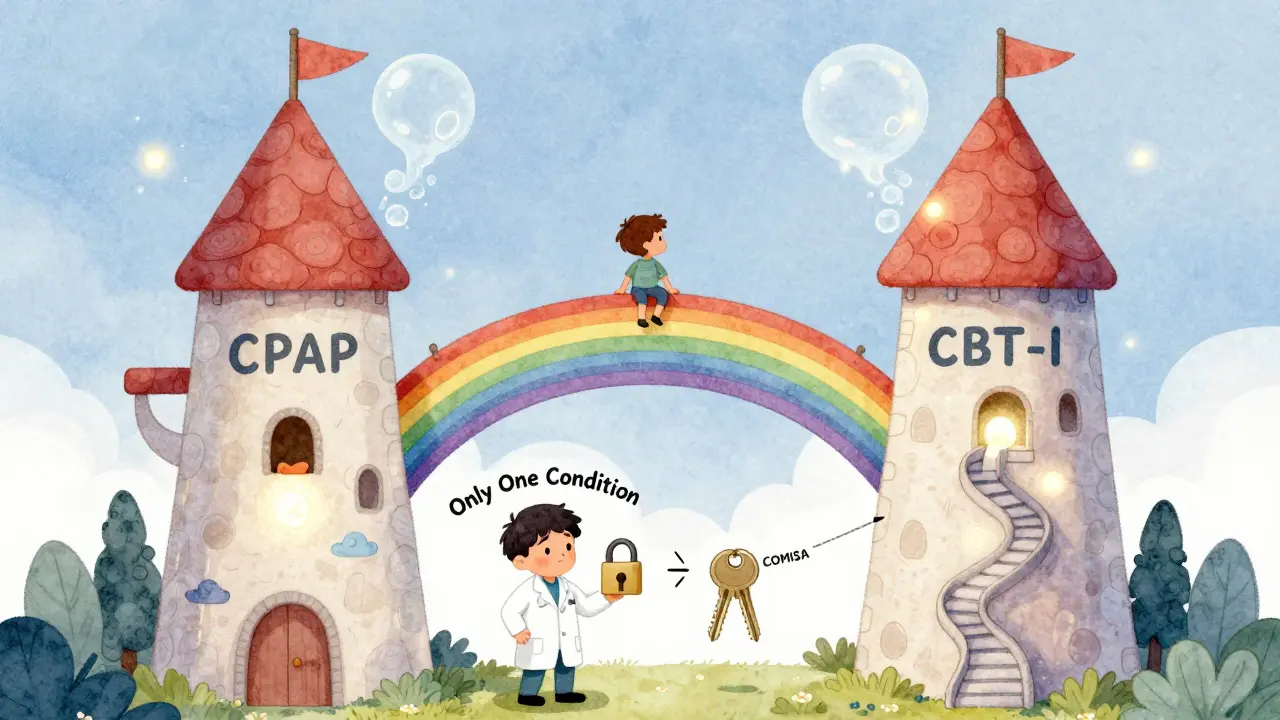
What’s Next for COMISA Treatment?
Research is moving fast. In late 2023, the FDA approved suvorexant - an orexin antagonist - for use with CPAP in COMISA patients. In trials, it boosted insomnia remission to 57% when combined with CPAP, compared to 33% with CPAP alone.
CPAP devices are getting smarter too. ResMed’s AirSense 11 now adjusts pressure based on sleep stage, reducing discomfort during light sleep. Somryst’s COMISA module syncs with CPAP data to personalize CBT-I lessons in real time.
And machine learning is helping predict who’ll respond best to which treatment. A 2023 model from Flinders University correctly predicted treatment outcomes 78% of the time using sleep patterns, anxiety scores, and CPAP usage data.
But the biggest barrier isn’t technology - it’s awareness. Only 1% of insomnia patients ever get CBT-I. And most doctors still think “sleep apnea” and “insomnia” are separate boxes to check.
What You Can Do Right Now
If you suspect you have COMISA:
- Take the Insomnia Severity Index (ISI) test. If your score is 15 or higher, you likely have clinical insomnia.
- Ask your sleep doctor for your AHI score from your sleep study. If it’s 5 or higher, you have sleep apnea.
- If both are true, ask: “Do you treat COMISA with CBT-I and CPAP together?” If they say no, ask for a referral to a behavioral sleep medicine specialist.
- Don’t accept “just use the CPAP” as an answer. Your insomnia is real, and it’s treatable.
- If you can’t find a specialist, try a digital CBT-I program like Sleepio or Somryst - but only if your AHI is under 15.
COMISA isn’t your fault. It’s a system failure. But it’s fixable - if you know how to ask for the right care.
Frequently Asked Questions
Is COMISA the same as having bad sleep and sleep apnea?
No. COMISA is a specific clinical diagnosis where insomnia and sleep apnea occur together and interact in a way that makes both worse. It’s not just “I can’t sleep and I have apnea.” It’s when your brain learns to fear sleep because of apnea-related disruptions, and your breathing problems get worse because you’re chronically stressed and sleep-deprived.
Can I treat COMISA with sleep meds instead of CBT-I?
Sleep medications like Ambien or Lunesta may help you fall asleep faster, but they don’t fix the underlying causes of insomnia. They also don’t improve CPAP adherence. In fact, long-term use can worsen sleep quality and increase dependency. CBT-I is the only treatment proven to retrain your brain and work with CPAP long-term.
Why doesn’t my doctor know about COMISA?
Most doctors are trained to treat sleep apnea and insomnia as separate conditions. COMISA is a newer concept, and only 15% of U.S. sleep centers currently offer integrated treatment. But awareness is growing - especially since 2023, when the American Academy of Sleep Medicine updated its guidelines to recognize COMISA as a distinct clinical entity requiring combined treatment.
Will insurance cover CBT-I for COMISA?
It depends. Many insurers still don’t cover CBT-I unless you’ve tried medication first. But since January 2024, Medicare and some private insurers now have specific billing codes (G2212-G2214) for integrated COMISA care. Ask your provider if they use these codes - if not, they may not be trained in the current standard of care.
How long does COMISA treatment take to work?
Most people see improvement in insomnia within 4-6 weeks of starting CBT-I. CPAP adherence improves within 8-12 weeks. Full remission of both conditions typically takes 3-6 months. The key is consistency - skipping sessions or stopping CPAP when you feel tired delays results. Progress isn’t linear, but it’s real.


