
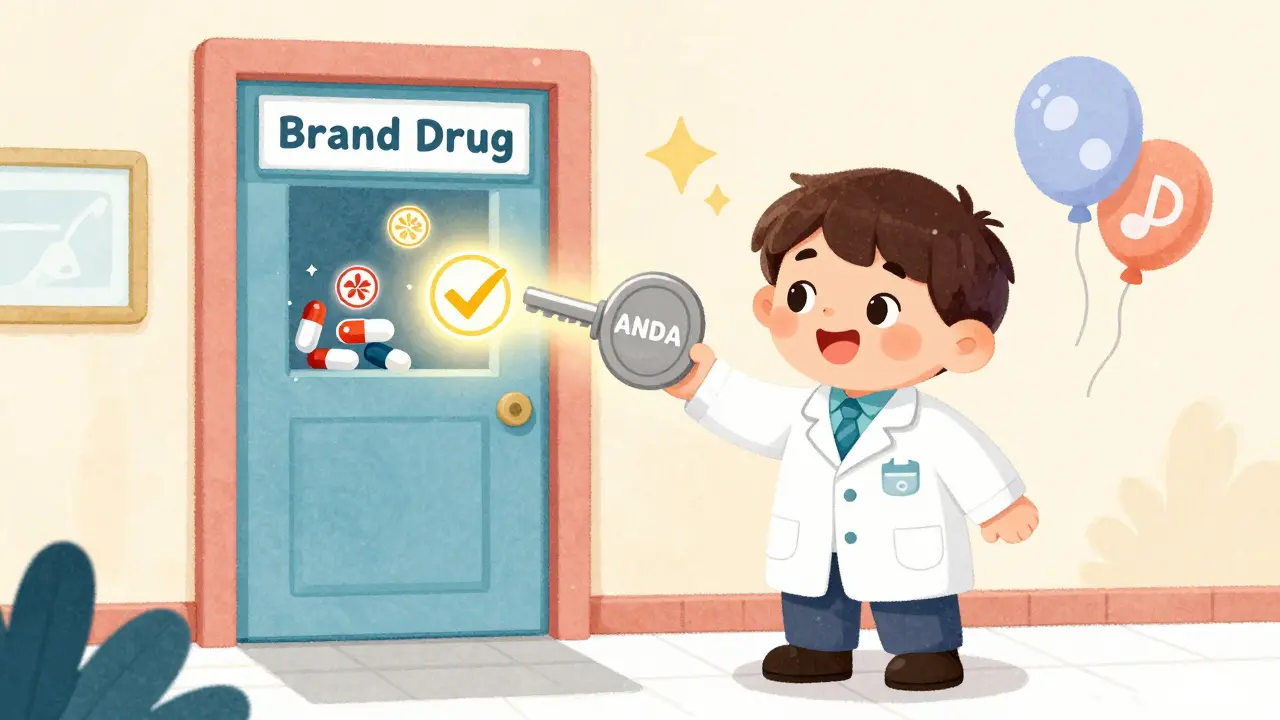
The Hatch-Waxman Act didn’t just change drug rules-it rewrote the entire story of how Americans get affordable medicines. Before 1984, if you wanted to make a generic version of a brand-name drug, you had to start from scratch: run your own clinical trials, prove safety and effectiveness all over again, even though the original drug had already been approved by the FDA. It cost up to $2.6 million in today’s dollars and took years. Most companies didn’t even try. That meant fewer options, higher prices, and patients paying more for the same pills.
What the Hatch-Waxman Act Actually Did
The Drug Price Competition and Patent Term Restoration Act of 1984, better known as the Hatch-Waxman Act, solved this problem by creating a shortcut. It didn’t remove patents or weaken innovation-it found a middle ground. The law let generic drugmakers skip expensive clinical trials by using the brand-name drug’s existing safety data. All they had to prove was that their version was chemically identical and absorbed the same way in the body. That’s called bioequivalence: the generic must deliver 80-125% of the active ingredient into the bloodstream compared to the brand-name drug. If it passes, the FDA says it’s interchangeable.This shortcut came through something called the Abbreviated New Drug Application, or ANDA. Instead of submitting 500 pages of new clinical data, generic companies could file a 50-page application. The FDA approved over 746 ANDAs in 2023 alone. That’s more than two per day, every day, for a year. And it’s why today, 90% of prescriptions in the U.S. are filled with generics.
The Orange Book: The Secret Map to Generic Entry
To make this system work, the law created the Orange Book-officially titled Approved Drug Products with Therapeutic Equivalence Evaluations. It’s not a book anymore; it’s a public database the FDA maintains. Every brand-name drug listed in the Orange Book comes with its approved patents and exclusivity periods. Generic companies use this like a roadmap. They check which patents are still active, when they expire, and whether any exclusivity periods are in play.For example, if a brand-name drug has a patent listed for its tablet coating, a generic maker can’t launch until that patent expires-unless they challenge it. And that’s where things get strategic. The law lets generic companies file what’s called a Paragraph IV certification. That’s a legal notice saying, “We believe this patent is invalid or we won’t be infringing it.” Filing one triggers a lawsuit from the brand company. But here’s the catch: the first generic company to file a Paragraph IV certification gets 180 days of exclusive market access. No other generic can enter during that time. That’s a huge financial incentive. One company can capture 80% of the market in those six months before prices drop further.
Patent Challenges and the 30-Month Stay
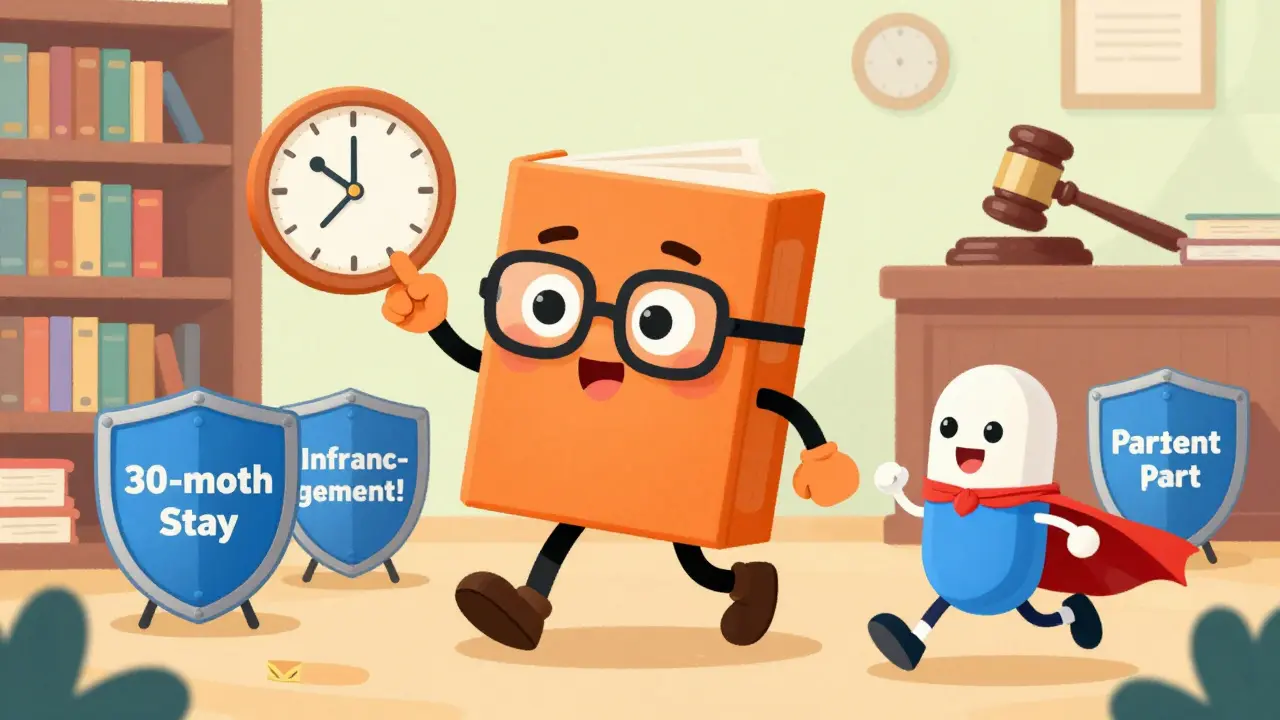
Filing a Paragraph IV certification isn’t a gamble-it’s a calculated move. Once the generic company sends the notice, the brand-name company has 45 days to sue for patent infringement. If they do, the FDA is legally required to delay approving any other generic versions for 30 months. That’s called the 30-month stay. It’s designed to protect patent holders, but it’s also been used to delay competition. The average patent lawsuit under Hatch-Waxman takes 31 months to resolve. That means the 30-month stay often ends right as the court does-and sometimes, the brand company wins, or settles.Some of those settlements have raised red flags. In “pay-for-delay” deals, a brand company pays a generic maker to hold off on launching. The FTC has sued over these deals, calling them anti-competitive. In 2020, the Congressional Budget Office estimated these delays cost the system over $1 billion annually in lost savings. The law didn’t intend for this, but the system created the opportunity-and companies took it.
Patent Term Restoration: Why Innovation Still Wins
The Hatch-Waxman Act didn’t just help generics-it also helped innovators. Drug development takes 10-15 years. By the time a new drug hits the market, half its patent life may already be gone. The Act lets brand companies apply for patent term restoration to make up for time lost during FDA review. They can get up to five extra years of exclusivity, but the total market protection can’t exceed 14 years from the original approval date. That’s why you see some drugs with 12-year exclusivity periods instead of the standard 20-year patent. It’s not a loophole-it’s a reset button.And it’s not just small molecules. The Act was designed for pills and injections. But as biologics-complex drugs made from living cells-became more common, the system didn’t fit. That’s why Congress passed the Biologics Price Competition and Innovation Act (BPCIA) in 2010 to create a separate pathway for biosimilars. The Hatch-Waxman Act still governs the vast majority of generic drugs, but it’s not the whole story anymore.
Who Benefits? Patients, Payors, and the System
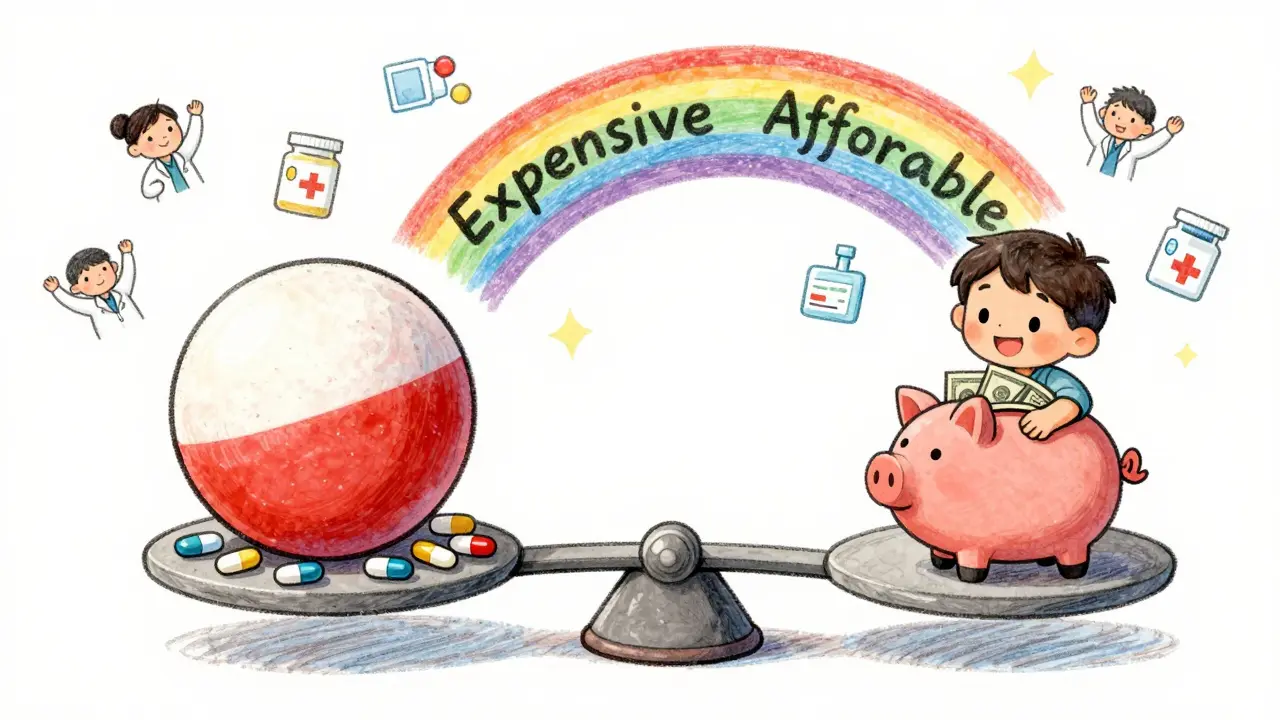
The results speak for themselves. In 1984, generics made up just 19% of prescriptions. Today, they’re over 90%. And while they make up 90% of prescriptions, they account for only 23% of total drug spending. That’s a massive shift. The Congressional Budget Office estimates the Act saved the U.S. healthcare system $1.7 trillion over the last decade. Medicare Part D beneficiaries saved an average of $3,200 per person in 2023 just by using generics.It’s not perfect. Some generic drugs still face shortages-283 in 2023-often due to manufacturing problems or low profit margins. Quality issues at overseas plants have led to recalls. And as drugs get more complex-like inhalers, patches, or injectables-proving bioequivalence gets harder. The FDA has responded with 15 new guidance documents in 2023 alone, refining how generics are tested and approved.
But the core idea still holds: if you can prove your drug is the same, you shouldn’t have to prove it all over again. The Hatch-Waxman Act made that possible. It turned a broken system into a engine of competition.
What’s Next for Generic Drugs?
The FDA’s Generic Drug User Fee Amendments (GDUFA) III, implemented in 2023, is cutting review times. In 2012, an ANDA took 36 months to review. Today, it’s down to 18 months. That’s faster than ever. The agency is also cracking down on brand companies that refuse to provide samples of their drugs to generic makers-something required under the CREATES Act of 2019. Without those samples, generics can’t even start testing.There’s still pressure to fix the system. Lawmakers are looking at how to stop “patent thickets”-when a brand company files dozens of minor patents to block generics. Some are pushing to shorten the 30-month stay or limit pay-for-delay deals. But the basic structure? It’s working. The Hatch-Waxman Act didn’t just lower prices. It gave patients choices. It forced innovation to compete with efficiency. And it proved that regulation doesn’t have to choose between innovation and access-it can do both.
What is the ANDA process under the Hatch-Waxman Act?
The Abbreviated New Drug Application (ANDA) is the streamlined pathway the Hatch-Waxman Act created for generic drug approval. Instead of running new clinical trials, generic manufacturers must prove their product is identical in active ingredient, strength, dosage form, and route of administration to the brand-name drug (called the Reference Listed Drug). They also must show bioequivalence through pharmacokinetic studies-demonstrating that the generic delivers the same amount of drug into the bloodstream at the same rate as the brand, within 80-125% of the reference product.
What is the Orange Book and why does it matter?
The Orange Book, officially titled Approved Drug Products with Therapeutic Equivalence Evaluations, is a public FDA database that lists all approved drug products and their associated patents and exclusivity periods. Generic manufacturers use it to identify which patents they need to challenge before launching. It’s the legal roadmap for when a generic can enter the market-and what legal risks they face. Without the Orange Book, the entire Hatch-Waxman system wouldn’t function.
What is a Paragraph IV certification?
A Paragraph IV certification is a legal statement filed by a generic drug applicant claiming that a brand-name drug’s patent is either invalid or won’t be infringed by the generic version. This triggers a patent lawsuit from the brand company. The first generic to file a Paragraph IV certification gets 180 days of market exclusivity, making it the most valuable strategic move in generic drug development. About 90% of Paragraph IV filings lead to lawsuits.
How does the 30-month stay work?
When a brand-name company sues a generic manufacturer over a patent, the Hatch-Waxman Act automatically stops the FDA from approving the generic for 30 months-or until the court rules, whichever comes first. This gives the brand time to defend its patent, but it also delays generic entry. The average lawsuit takes 31 months, so the stay often lasts the full period. Critics say it’s been used to extend monopolies beyond patent expiration.
Why do some generic drugs have shortages?
Generic drugs often have thin profit margins, so manufacturers may stop making them if production costs rise or demand drops. Many are made overseas, and quality issues or supply chain disruptions can halt production. In 2023, 283 generic drugs were on the FDA’s shortage list. The FDA now requires manufacturers to report potential shortages early and has increased inspections of foreign facilities to prevent disruptions.
Has the Hatch-Waxman Act been updated?
Yes. The most significant update was the CREATES Act of 2019, which allows the FDA to force brand companies to provide drug samples to generic makers, ending a common tactic of blocking competition. The FDA’s GDUFA program, updated in 2023, has improved review times and transparency. Congress also amended patent term restoration in 1997 to include antibiotics. While the core law remains unchanged, these updates address modern challenges like pay-for-delay deals and supply chain risks.
The Hatch-Waxman Act is one of those quiet miracles of policy that saved millions of lives without anyone noticing. It didn’t make headlines like a moon landing, but every time someone filled a prescription for $4 instead of $400, that was its legacy.
It is not merely a legislative act; it is a foundational pillar of American pharmaceutical sovereignty. Without the structural integrity provided by the ANDA framework, the United States would have become a dependent consumer of foreign-manufactured therapeutics, ceding control of public health to multinational profit engines.
I never realized how much the Orange Book mattered until I had to check it for my dad’s medication. It’s not glamorous, but it’s the reason he gets his blood pressure pill for $5.
Let’s be honest: this whole system is a circus. The 180-day exclusivity? A reward for legal bullying. The 30-month stay? A corporate delay tactic dressed up as law. And don’t get me started on the ‘pay-for-delay’ schemes-these aren’t market forces, they’re collusion with a law degree.
The FDA’s ‘guidance documents’? Paper tigers. They don’t fix broken incentives-they just make the paperwork prettier.
And yet, somehow, despite all the manipulation, it still works? That’s not genius-it’s desperation.
People act like this law was some brilliant compromise. It wasn’t. It was the least-bad option after years of industry lobbying. And now we’re stuck with it, pretending it’s sacred.
Meanwhile, patients still can’t get insulin generics. The system doesn’t care about need-it cares about patent expiration dates.
So yes, generics are cheaper. But the game is rigged, and we’re all just players who got told to be grateful for crumbs.
And now we’re supposed to celebrate how ‘efficient’ it is? Efficiency without justice isn’t progress-it’s exploitation with a flowchart.
The Hatch-Waxman Act stands as a paradigmatic example of regulatory innovation in the context of public health policy. By harmonizing intellectual property rights with market access, it achieved a delicate equilibrium that neither the free market nor centralized control could have sustained independently.
Its enduring relevance is evidenced by the fact that, despite technological and pharmacological evolution, the foundational architecture remains intact-a testament to its foresight.
The introduction of the Orange Book as a transparent, publicly accessible registry was not merely administrative; it was a democratization of pharmaceutical knowledge.
Furthermore, the Paragraph IV certification mechanism, while controversial, introduced a legitimate avenue for legal challenge, ensuring that patent monopolies are not extended beyond their statutory boundaries.
It is imperative that we recognize the Act not as static legislation, but as a dynamic framework that continues to adapt through supplementary statutes such as the CREATES Act and GDUFA.
Comparative international analyses reveal that no other nation has replicated this balance with comparable success.
Therefore, any attempt to dismantle or significantly alter its structure without a fully modeled alternative would constitute a reckless endangerment of public health infrastructure.
Let us not confuse the imperfections of implementation with the failure of design.
So let me get this straight-big pharma gets extra patent time, but generics have to fight in court just to sell the same pill? And the first one to sue gets a six-month monopoly? That’s not competition, that’s a lottery where the house always wins.
And now we’re supposed to be impressed that 90% of prescriptions are generics? Great. So 90% of people are just surviving on whatever cheap version got approved last week.
Meanwhile, the same companies that pushed this law are now suing to block biosimilars and hoarding samples. You call this innovation? I call it extortion with a FDA stamp.
They told us this law was about lowering prices-but did you know the same companies that profit from generics also own the brand-name drugs? The whole system is a shell game. One corporation owns the patent, another owns the generic, and they just pass the money back and forth.
The 180-day exclusivity? That’s not competition-it’s collusion with a countdown clock.
And the Orange Book? It’s not a roadmap-it’s a cheat sheet for lawyers.
They say it saved $1.7 trillion? Maybe. But they also say it created 283 drug shortages. Who’s counting the lives lost because the cheapest pill wasn’t made?
Wake up. This isn’t healthcare policy. It’s Wall Street’s version of Monopoly.
I used to think generics were just cheaper versions of the same drug. Then my mom got her thyroid medication switched and had a panic attack because the new one ‘felt different.’ Turns out, even tiny differences in fillers can mess with absorption-especially for people on narrow-therapeutic-index drugs.
The system works, but it’s not perfect. We need better testing for complex drugs-not just pills, but patches, inhalers, injectables.
And we need to stop treating patients like numbers. If someone reacts badly to a generic, they shouldn’t have to fight to get their original brand back.
This law gave us access. Now we need to make sure it gives us safety too.
In India, we’ve seen how generic drugs transformed healthcare-especially for chronic conditions like diabetes and hypertension. But what’s fascinating is how the Hatch-Waxman model inspired our own drug policy reforms. We didn’t copy it-we adapted it. Our regulators looked at the Orange Book and said, ‘We can do this better.’
Now we export generics to Africa, the Caribbean, even parts of Europe. The real win isn’t just price-it’s scalability. When you can make a lifesaving drug for $0.10 a pill, you’re not just competing-you’re changing the global health equation.
But we also learned the hard way: without strong quality control, cheap isn’t safe. That’s why our drug inspectors now train with FDA veterans. Knowledge sharing, not just copying, is the future.
So yes, Hatch-Waxman was revolutionary. But its real legacy? It showed the world that access to medicine isn’t charity-it’s a right that can be engineered.
Let’s stop pretending this is about patients. This law was written by lobbyists and passed by politicians who didn’t understand pharmacology. The 30-month stay? A gift to Big Pharma. The Paragraph IV loophole? A goldmine for patent lawyers.
Yes, generics are cheaper. But so are the quality controls. And the shortages? That’s not an accident-that’s the business model.
Stop celebrating a system that rewards delay and punishes innovation. We need real reform, not more guidance documents.
My uncle was on a generic blood thinner for years. Then he had a stroke. Turned out the new batch had a different filler and his body couldn’t process it right. He’s fine now but it took months to figure it out.
That’s the real cost of this system. We focus on the price tag but forget the human body doesn’t care about FDA approvals-it cares about what’s in the pill.
Maybe we need a registry where patients can report side effects tied to specific generic brands. Not just the drug name-the manufacturer.
That’s the next step. Not more patents. More transparency.
Did you know the FDA doesn’t test every generic batch? They sample. One batch out of a million. And the plants? Mostly in India and China. What if the data’s fake? What if the inspectors are paid off? This isn’t healthcare-it’s a global lottery with your life as the ticket.
And they wonder why people hoard meds? Because they know the system’s rigged.
Back home in Punjab, my cousin’s dad takes a generic version of metformin that costs less than a cup of chai. He’s been on it for 12 years. No complications. No shortages. Just steady control. That’s what this law is supposed to be about-making medicine accessible, not just affordable.
The U.S. talks about innovation like it’s a trophy. But in places like ours, innovation means making sure a diabetic grandma doesn’t have to choose between insulin and rice.
Hatch-Waxman worked because it cut red tape, not because it cut corners. We need more of that mindset-not less.
It’s all a lie. The government says generics are safe. But they’re made in the same factories that produce fake pharmaceuticals for the black market. The FDA doesn’t inspect them properly. The whole system is a scam to keep the poor alive just long enough to keep them paying for more drugs.
And don’t tell me about savings. Who cares if it saved a trillion if it killed ten thousand? You think they count the dead in their spreadsheets?
This isn’t progress. It’s controlled decay.
My daughter has asthma. Her inhaler is a generic. We got it for $15 instead of $300. That’s not a win-it’s survival.
But I had to call the pharmacy three times to make sure it was the same brand her doctor prescribed. The pharmacist said, ‘It’s FDA-approved, same active ingredient.’ But I still didn’t trust it.
That’s the problem. We trust the system… but we don’t trust the people running it.
We need better communication-not more laws.