

DMARD & Biologic Interaction Checker
Common High-Risk Combinations:
- HIGH Methotrexate + NSAIDs (Ibuprofen, Naproxen)
- HIGH Methotrexate + Alcohol
- MODERATE TNF Inhibitors + Live Vaccines
- MODERATE JAK Inhibitors + Strong CYP3A4 Inhibitors
- MONITOR Immunosuppressants + Grapefruit Juice
Safe Alternatives:
- Acetaminophen (Tylenol) for pain relief
- Inactivated (shot) vaccines instead of live vaccines
- Folic acid supplementation with Methotrexate
Imagine your immune system is a security guard. In rheumatoid arthritis (RA), that guard gets confused and starts attacking your own joints instead of protecting them. To stop this chaos, doctors prescribe powerful medications called Disease-Modifying Antirheumatic Drugs (DMARDs). These aren't just painkillers; they are designed to slow down or halt the disease itself.
But here is the catch: these drugs are potent. When you mix different types-like combining traditional pills with advanced biological injections-you create complex chemical interactions in your body. Getting this balance right is the difference between living pain-free and facing serious health risks like severe infections or organ damage. This guide breaks down how these medications work together, what happens when they clash, and how to stay safe while treating your RA.
Understanding the Two Main Types of RA Medications
To understand interactions, you first need to know what you are mixing. There are two primary camps in RA treatment: conventional synthetic DMARDs and biologic DMARDs. They work differently, look different, and carry different risks.
Conventional synthetic DMARDs (csDMARDs) are small molecules, usually taken as pills. The most famous one is methotrexate. It works by broadly suppressing the immune system’s ability to replicate cells. Other common csDMARDs include hydroxychloroquine, sulfasalazine, and leflunomide. Because they affect general cell division, they can impact your liver, kidneys, and bone marrow if not monitored closely.
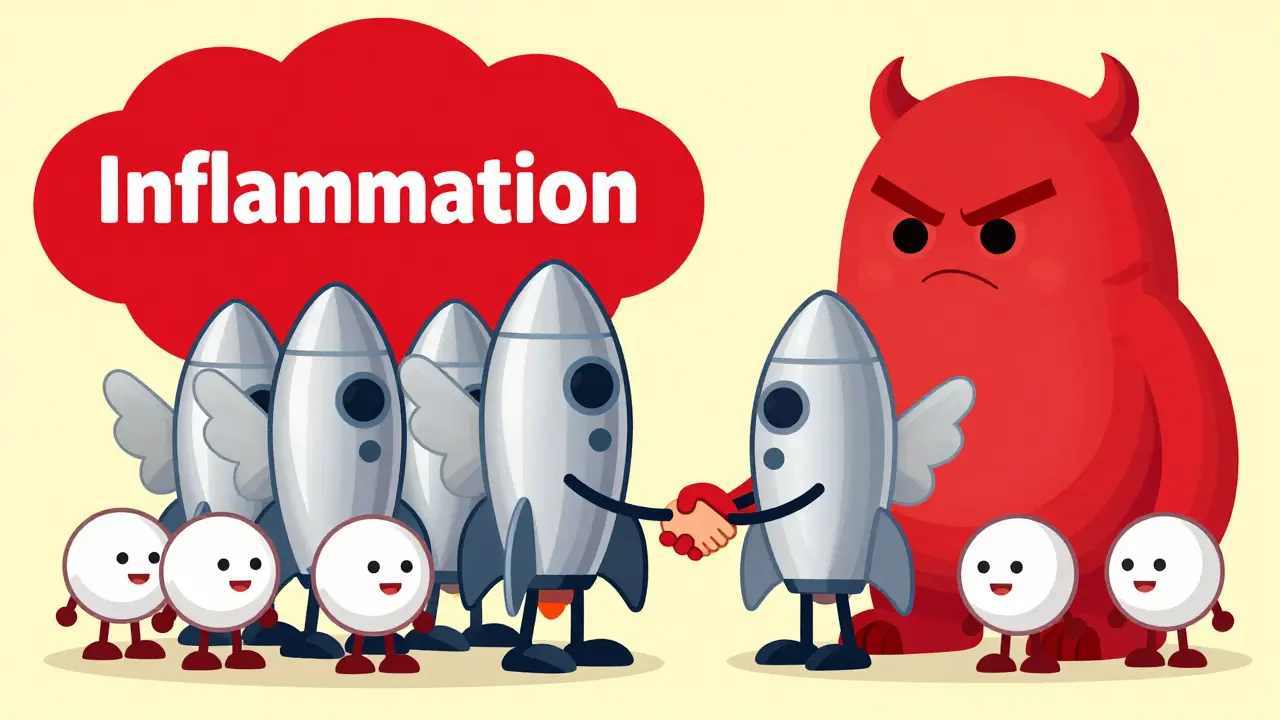
Biologic DMARDs (bDMARDs) are large protein molecules made in living cells. They are targeted missiles. Instead of slowing down the whole immune system, they block specific signals that cause inflammation. For example, TNF inhibitors like adalimumab (Humira) and etanercept (Enbrel) block tumor necrosis factor, a key driver of joint swelling. Others, like tocilizumab (Actemra), block interleukin-6. Because they are proteins, they cannot be swallowed-they must be injected under the skin or infused into a vein.
A newer group, JAK inhibitors (like tofacitinib and upadacitinib), acts like biologics but comes in pill form. They block intracellular signaling pathways. While convenient, they carry unique cardiovascular and infection risks that distinguish them from both traditional DMARDs and biologics.
The Power and Peril of Combination Therapy
You might wonder why doctors often prescribe more than one drug. The answer is synergy. Research shows that combining methotrexate with a biologic often works better than either drug alone. A 2015 study published in the Journal of Managed Care & Specialty Pharmacy found that adding methotrexate to biologic therapy increased the rate of significant symptom improvement (ACR50 response) from about 30-40% to 50-60% within six months.
However, this "more is better" approach has a dark side: additive toxicity. When you combine drugs that suppress the immune system, you don't just add their effects; you multiply the risks. The biggest danger is infection. Your body’s defense mechanisms are turned down on multiple fronts simultaneously.
- Infection Risk: Patients on combination therapy have a higher likelihood of developing serious bacterial, viral, or fungal infections. Tuberculosis (TB) reactivation is a particular concern with TNF inhibitors.
- Liver Stress: Methotrexate can raise liver enzymes. Adding another drug that requires liver metabolism can push the liver over the edge, leading to hepatotoxicity.
- Blood Cell Suppression: Both methotrexate and some biologics can lower white blood cell counts. Combined, they increase the risk of neutropenia, leaving you vulnerable to even minor infections.
This is why regular blood tests are non-negotiable. You aren't just checking if the drug is working; you are checking if it is hurting you silently.
Key Drug Interactions to Watch For
Not all interactions happen inside your body. Some occur at the pharmacy counter or in your kitchen. Here are the most critical interactions between DMARDs, biologics, and other substances.
| Medication Class | Interacting Substance | Potential Consequence |
|---|---|---|
| Methotrexate | NSAIDs (e.g., Ibuprofen, Naproxen) | Increased methotrexate levels in blood, leading to higher toxicity risk (kidney/liver damage). |
| Methotrexate | Alcohol | Severe liver damage. Even moderate drinking can compound the stress on your liver. |
| TNF Inhibitors | Live Vaccines | Risk of contracting the disease the vaccine is meant to prevent (e.g., shingles, flu). Always use inactivated vaccines. |
| JAK Inhibitors | Strong CYP3A4 Inhibitors (e.g., Ketoconazole) | Drastically increased JAK inhibitor levels, raising risk of serious infections and blood clots. |
| All Immunosuppressants | Grapefruit Juice | Can interfere with drug metabolism, altering effectiveness and side effect profiles. |
Pay special attention to NSAIDs. Many RA patients take ibuprofen or naproxen for pain relief. While generally safe, high-dose or frequent NSAID use can reduce kidney function, which slows the clearance of methotrexate from your body. This causes methotrexate to build up to toxic levels. If you need pain relief, talk to your doctor about safer alternatives or timing strategies.
Managing Side Effects and Intolerance
Intolerance is a major reason people stop taking effective medications. About 20-30% of patients cannot tolerate methotrexate due to nausea, fatigue, or mouth sores. Before switching to expensive biologics, doctors often try to fix these issues.
Here are practical steps to manage common side effects:
- Folic Acid Supplementation: Taking 5-10 mg of folic acid daily (but not on the same day as your methotrexate dose) can drastically reduce nausea and mouth ulcers without reducing the drug's effectiveness.
- Dose Splitting: Instead of taking your full weekly methotrexate dose at once, split it into two or three smaller doses over the week. This lowers peak concentration in your gut, reducing nausea.
- Subcutaneous Injection: If pills make you sick, ask about injectable methotrexate. It bypasses the stomach entirely and is often better tolerated.
- Cool Compresses for Injection Sites: For biologics, ice packs before and after injection can reduce redness, itching, and bruising at the site.
If you still struggle, don't suffer in silence. There are many options. Biosimilars, which are highly similar versions of brand-name biologics, have entered the market since 2016. They offer the same efficacy at 15-30% lower cost, making long-term therapy more sustainable financially.
Safety Monitoring: Your Non-Negotiable Checklist
Treating RA is a marathon, not a sprint. To run safely, you need regular check-ups. Your rheumatologist will likely require the following monitoring schedule, especially when starting new combinations.
- Complete Blood Count (CBC): Checks for anemia and low white blood cell counts. Usually done every 4-8 weeks initially, then every 3 months if stable.
- Liver Function Tests (LFTs): Monitors for liver inflammation. Critical for methotrexate users.
- Kidney Function Tests: Ensures your kidneys are clearing drugs properly.
- Tuberculosis Screening: A chest X-ray or blood test before starting any TNF inhibitor or JAK inhibitor to rule out latent TB.
- Hepatitis B and C Screening: Important before starting biologics, as these drugs can reactivate dormant viruses.
If you develop a fever, cough, or unusual bruising, do not wait for your next appointment. Contact your doctor immediately. Early detection of infection or toxicity saves lives.

Navigating Costs and Access
Let's talk money. Traditional DMARDs like methotrexate cost roughly $20-$50 per month. Biologics? That number jumps to $1,500-$6,000 monthly. This disparity creates a massive barrier to care. According to the Arthritis Foundation, 41% of patients cite cost as a major concern, and nearly 30% admit to skipping doses to save money. Never skip doses. It leads to flare-ups and potentially makes the drug less effective later.
Use every resource available:
- Patient Assistance Programs (PAPs): Most pharmaceutical companies offer free or discounted drugs for eligible uninsured or underinsured patients.
- Specialty Pharmacies: Ninety-five percent of biologics are dispensed through specialty pharmacies. They handle insurance prior authorizations and delivery logistics.
- Biosimilars: Ask your doctor if a biosimilar version of your biologic is available. They are clinically equivalent but cheaper.
- Co-pay Cards: Insurance manufacturers often provide cards that cap your out-of-pocket costs at $0-$50 per month.
If cost is forcing you to choose between food and medicine, tell your healthcare provider. There are always alternative therapies or financial aid options worth exploring.
Future Directions in RA Treatment
The landscape of RA treatment is evolving rapidly. New guidelines from the American College of Rheumatology (ACR) emphasize a "treat-to-target" approach. This means setting a clear goal-usually clinical remission-and adjusting medications until that goal is met, rather than just managing symptoms.
Recent approvals like upadacitinib (Rinvoq), a JAK inhibitor approved for early RA, offer oral alternatives to injections with high efficacy rates. However, safety remains paramount. The FDA issued black box warnings for JAK inhibitors regarding serious heart events, cancer, and blood clots. This highlights the ongoing balance between potency and safety.
Researchers are also looking at novel targets like GM-CSF and more selective JAK inhibitors to minimize off-target effects. For now, the best strategy remains a personalized plan developed with your rheumatologist, balancing efficacy, safety, and lifestyle preferences.
Can I take over-the-counter pain relievers with my RA medication?
You need to be very careful. Acetaminophen (Tylenol) is generally safe. However, NSAIDs like ibuprofen, naproxen, or aspirin can interact dangerously with methotrexate, increasing toxicity risks. Always consult your doctor before adding any OTC painkiller to your regimen.
What vaccinations should I avoid while on biologics?
You must avoid live vaccines, such as the nasal spray flu vaccine, MMR, varicella (chickenpox), and yellow fever vaccines. These contain weakened viruses that could cause actual infection in an immunocompromised person. Stick to inactivated (shot) vaccines, and ideally get them before starting biologic therapy.
How long does it take for DMARDs to start working?
Patience is key. Traditional DMARDs like methotrexate can take 6 to 12 weeks to show noticeable improvement. Biologics may work faster, often within 4 to 8 weeks. If you see no improvement after 3-6 months, your doctor may adjust your dosage or switch medications.
It is frankly astonishing how many patients ignore the pharmacokinetic implications of combining NSAIDs with methotrexate. The literature is unequivocal on this point: renal clearance inhibition leads to toxic accumulation. One would think that basic literacy regarding drug interactions would be a prerequisite for self-medication, but clearly, we are dealing with a populace that prefers anecdote over evidence. The article correctly identifies the synergy, yet it fails to sufficiently condemn the negligence of those who casually mix ibuprofen without consulting their rheumatologist. It is not merely a risk; it is a preventable catastrophe born of ignorance.
I have been on Humira for three years and recently switched to Rinvoq because the injections were becoming too cumbersome. Has anyone else experienced the cardiovascular warnings mentioned here? I am trying to understand if the black box warning applies to someone my age with no prior heart history, or if it is just a blanket caution from the FDA to cover their bases. The cost difference is negligible for me since insurance covers both, but the oral route is tempting if the safety profile holds up.
Hey Kimberly, good question about Rinvoq. The black box warning is real, but context matters a lot. If you are under 65 and don't have existing heart disease or cancer history, your personal risk is generally considered low by most rheum specialists. That said, it is always smart to keep an eye on blood pressure and cholesterol. I suggest asking your doc for a baseline cardiac workup before switching, just to have peace of mind. Also, remember that JAK inhibitors work faster than biologics usually, so you might feel relief sooner.
ugh another long read... i just want to know if i can still drink wine at dinner lol. the liver stuff sounds scary but everyone drinks. also why is methotrexate so hard on the stomach?? i hate taking pills anyway :/
Hey Annemarie! Totally get the struggle with meds. But hey, try splitting your MTX dose like the article says, it really helps with the nausea! And yeah, maybe cut back on the wine just a bit to keep that liver happy. You got this! Stay strong and dont give up on finding what works for u! 💪
The US healthcare system is a joke if people are skipping doses because of cost. 🤡 Meanwhile, other countries have universal coverage and actually care about their citizens' health. We are prioritizing corporate profits over human lives, and it is disgusting. These biosimilars are a band-aid on a bullet hole. Wake up sheeple! 🇺🇸📉
Mr. Barrera’s commentary is as intellectually vacuous as it is emotionally charged. The existence of patient assistance programs and specialty pharmacies demonstrates a nuanced approach to pharmaceutical distribution that your simplistic narrative ignores. Furthermore, attributing complex pharmacoeconomic challenges solely to 'corporate profit' ignores the rigorous R&D costs involved in developing biologic therapies. One might expect a more sophisticated understanding of global healthcare disparities from someone who presumably has the leisure time to post such diatribes.
The epistemological framework surrounding DMARD efficacy often overlooks the subjective phenomenology of pain management. While the biochemical pathways of TNF-alpha inhibition are well-documented, the holistic integration of these agents into a patient's lived experience remains under-theorized. We must consider the ontological shift that occurs when one's immune system is artificially modulated. Is the suppression of inflammation truly a return to homeostasis, or merely a suspended animation of the body's natural defensive architecture? This duality warrants deeper philosophical inquiry beyond mere clinical metrics.
Hema, thats super deep! But honestly, when your joints are screaming, you just want them to stop hurting lol. I found that tracking my symptoms in an app helped me see patterns. Its not all philosophy, sometimes its just about getting through the day without crying. Keep fighting tho! You are stronger than you think! ✨
They do not tell you about the long-term neurological effects. The 'side effects' listed are just the tip of the iceberg. Big Pharma knows exactly what they are doing. They are suppressing our immune systems to make us dependent on their endless supply chain. Read between the lines of those FDA warnings. It is all part of the plan to weaken the population. Trust no one.
Chill out Tucker. Most of us are just trying to live normal lives. In India, we have our own struggles with access to these expensive drugs, but conspiracy theories do not help anyone. Stick to the facts and listen to your doctors. Peace.
This guide is incredibly helpful for navigating the complexities of RA treatment. It is empowering to know that options like biosimilars exist to reduce financial burden. Remember, community support is vital. Share your experiences and help others find resources. We are in this together, and staying informed is our best defense against uncertainty. Let us continue to lift each other up!