
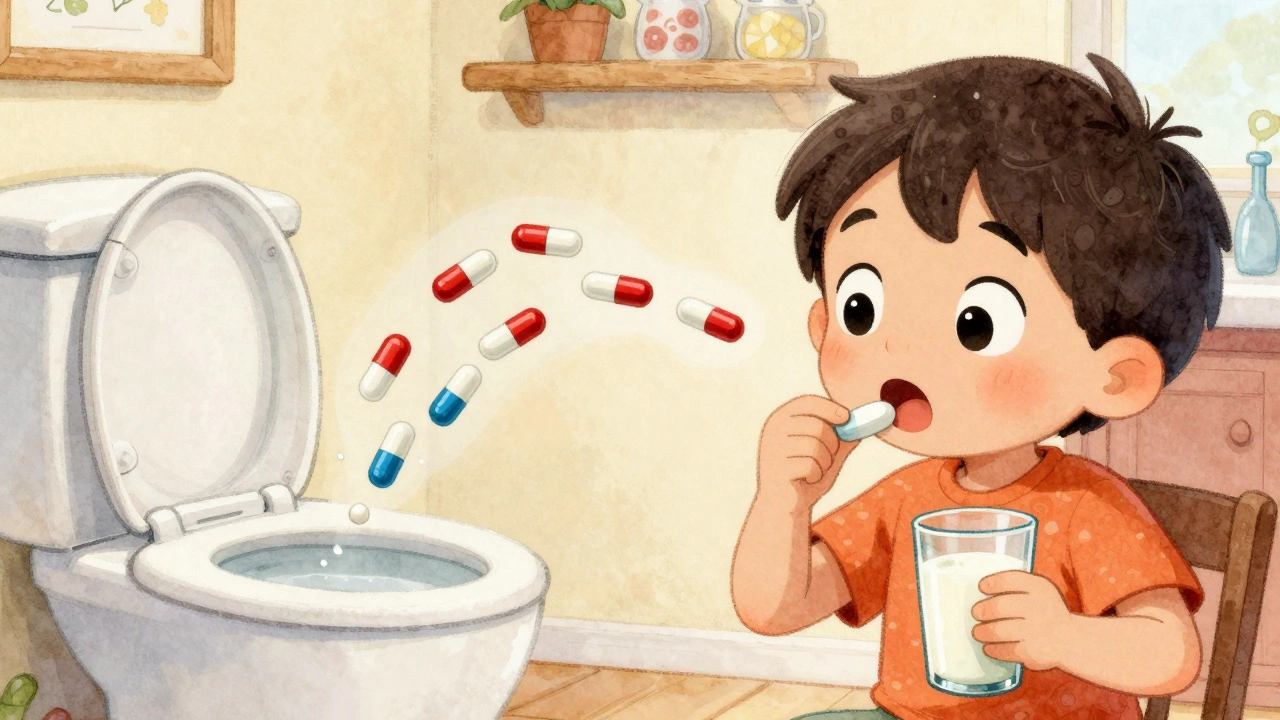
It’s not just about food allergies or lactose intolerance. If you’re taking an antibiotic like doxycycline or ciprofloxacin, what you eat with it - especially dairy - can turn your treatment into a waste of time and money. You might think swallowing a pill with a glass of milk is harmless, even helpful. But science says otherwise. Calcium in milk, cheese, yogurt, and even fortified plant milks can bind to certain antibiotics before they’re absorbed, creating a chemical trap that keeps the drug from ever reaching your bloodstream. The result? Your infection doesn’t clear up. It lingers. And worse, it might come back stronger.
Why Dairy Interferes with Antibiotics
The problem isn’t dairy itself - it’s the calcium. When you swallow a tetracycline or fluoroquinolone antibiotic, the drug molecules travel through your stomach and into your small intestine, where they’re supposed to be absorbed into your blood. But if calcium is already there - from milk, yogurt, or a calcium-fortified orange juice - it grabs onto the antibiotic like a magnet. This forms a solid, insoluble compound called a chelate. Your body can’t absorb chelates. So instead of entering your bloodstream, the antibiotic passes right out of you, useless.
This isn’t new science. Researchers first noticed it in the 1960s with tetracycline. Since then, dozens of studies have confirmed it. One 2022 study in the Journal of Rawal Academy of Sciences found that yogurt cut ciprofloxacin absorption by 92%. Milk still knocked it down by 70%. Even a single glass of milk taken with the pill can reduce drug levels by 30% to 36%. For antibiotics that need to hit a certain concentration to kill bacteria, that’s the difference between healing and hospitalization.
Which Antibiotics Are Affected?
Not all antibiotics react this way. Penicillin, amoxicillin, azithromycin, and most other common classes aren’t bothered by dairy. But two major groups are:
- Tetracyclines: Tetracycline, doxycycline, minocycline. These are used for acne, Lyme disease, respiratory infections, and more. Tetracycline is the most sensitive - dairy can reduce absorption by up to 90%. Doxycycline is a bit less affected, but still significantly impacted.
- Fluoroquinolones: Ciprofloxacin, levofloxacin, moxifloxacin. These treat UTIs, sinus infections, pneumonia, and more. Ciprofloxacin is especially vulnerable. Studies show even small amounts of dairy can slash its effectiveness.
It’s not just dairy, either. Calcium supplements, antacids with aluminum or magnesium, iron pills, and even calcium-fortified soy or almond milk can cause the same problem. If it has calcium, it’s risky.
How Long Should You Wait?
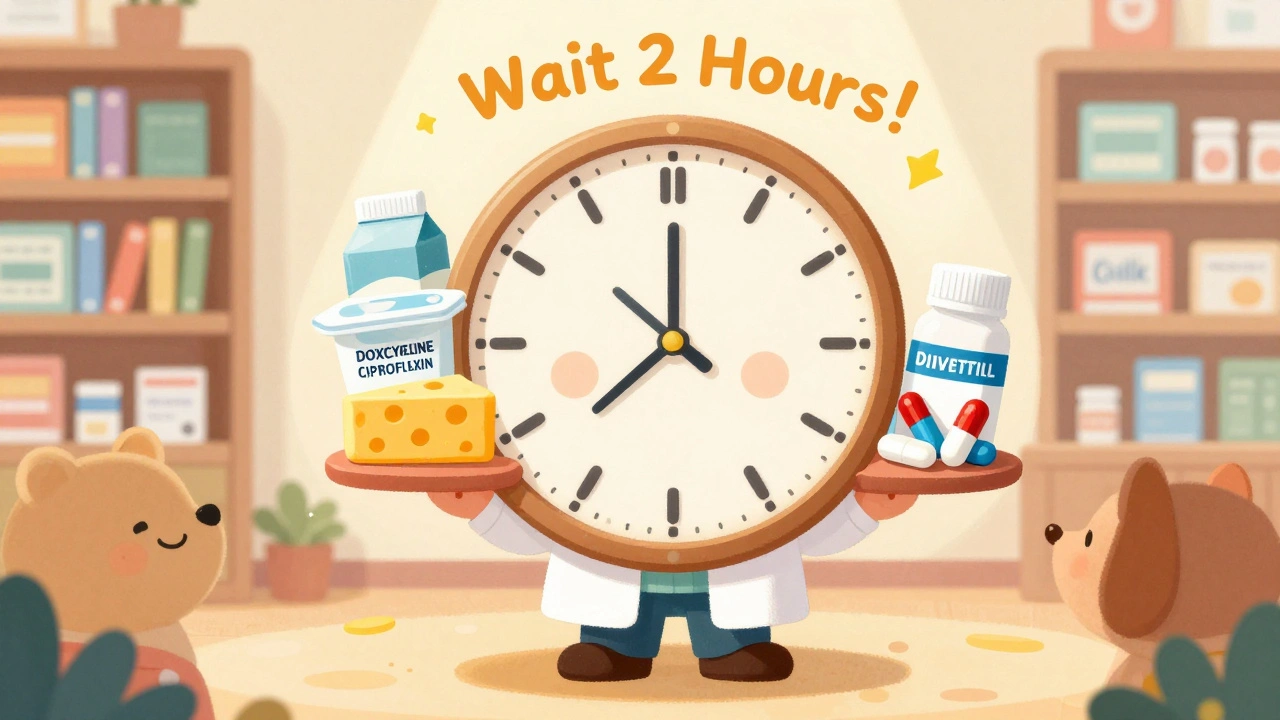
Timing isn’t suggestion - it’s science. The goal is to keep the antibiotic and calcium in your gut at separate times so they never meet.
For tetracyclines, the standard advice is to take the pill at least 1 hour before or 2 hours after eating dairy. Some experts, including the European Association of Hospital Pharmacists, recommend waiting 3 hours to be extra safe, especially with older tetracycline formulations.
For fluoroquinolones like ciprofloxacin, the window is wider. Take the pill 2 hours before dairy, or wait 4 to 6 hours after. That’s because fluoroquinolones bind more tightly to calcium and stay in your system longer. If you take ciprofloxacin at 8 a.m., don’t have your yogurt until at least 2 p.m. - and ideally not until dinnertime.
Here’s a simple rule: if you’re on one of these antibiotics, plan your meals around your pills. Don’t take them with breakfast if you drink milk. Don’t take them right before bed if you snack on cheese. Space them out. It’s not about being perfect - it’s about avoiding the overlap.

Real Consequences: What Happens When You Ignore This
People don’t always realize they’re doing something wrong. A 2022 survey found that 43% of patients prescribed tetracyclines or fluoroquinolones got no timing instructions from their doctor. That’s a problem.
On Reddit, a nurse shared a case: a patient on doxycycline for Lyme disease kept drinking milk with every dose. Her symptoms didn’t improve for weeks. Only after her pharmacist asked about her morning routine did they find the issue. Once she switched to taking the pill on an empty stomach, her fever broke in two days.
Another study in the Journal of Patient Experience tracked 200 people on ciprofloxacin for UTIs. Those who followed the 2-hour rule had a 98% success rate. Those who didn’t? Only 72% got better. That’s a 26-point gap - all because of timing.
And it’s not just about one failed treatment. When antibiotics don’t work, bacteria survive. They adapt. They become resistant. The WHO estimates that poor timing with dairy and supplements contributes to 5-10% of community-based antibiotic resistance cases. That means more people needing stronger drugs, longer hospital stays, and higher medical bills.
What About Yogurt, Cheese, and Plant Milks?
Yes, yogurt counts. Even though it’s fermented and has probiotics, it still has calcium - and sometimes more than milk. The same 2022 study showed yogurt reduced ciprofloxacin absorption by 92%, worse than milk. Cheese? Same thing. Hard cheeses have concentrated calcium. Even a slice of cheddar with your pill can interfere.
Plant-based milks? Don’t assume they’re safe. Soy milk, almond milk, oat milk - if they’re fortified with calcium (and most are), they’re just as risky as dairy. Check the label. If it says “calcium added” or “rich in calcium,” treat it like milk. Same goes for calcium-fortified orange juice, cereals, and protein shakes.
And don’t forget antacids or iron supplements. Tums, Rolaids, and iron pills can cause the same binding. Take them at least 2-4 hours apart from your antibiotic.
What Can You Do Instead?
You don’t have to give up dairy forever. You just need to plan.
- If you take your antibiotic in the morning, wait until lunch or later to have milk, yogurt, or cheese.
- If you take it at night, skip the bedtime snack of cheese or a glass of milk. Have it at lunch instead.
- Use water or plain juice (no calcium) to swallow your pill.
- Set a phone reminder: “Take pill - no dairy for 2 hours.”
- Ask your pharmacist: “Does this medicine interact with calcium?” They’re trained to catch this.
Some newer formulations, like extended-release ciprofloxacin (Cipro XR), are designed to be less affected by calcium. But they cost 10 times more than the generic version. And even then, timing is still recommended. There’s no magic bullet - just smart timing.
What’s Changing?
Things are improving. In January 2023, the FDA required clearer warnings on all tetracycline and fluoroquinolone packaging. Digital apps like Medisafe and MyMeds now flag dairy interactions when you enter your meds. Pharmacists are getting better at counseling patients. The American Pharmacists Association says patient awareness has risen from 35% in 2018 to 52% in 2023.
But there’s still a gap. Elderly patients on calcium supplements for osteoporosis are especially at risk. So are parents giving antibiotics to kids who need milk with their medicine. Education needs to get better.
Research is moving forward too. New tetracycline derivatives that resist calcium binding are in clinical trials. But they won’t be available until at least 2026. Until then, the old rule still holds: separate your antibiotic from calcium.
Bottom Line
Antibiotics are powerful. But they’re not magic. If you take them with dairy, you’re sabotaging your own treatment. You’re not being careless - you’re just unaware. And that’s exactly what makes this problem so widespread.
Don’t assume your doctor told you everything. Don’t assume “it’s just milk.” Don’t assume your pill will work no matter what you eat. If you’re on tetracycline or ciprofloxacin, write down the timing rules. Stick to them. Your body needs that drug to work - and it can’t if calcium is blocking the door.
One hour before. Two hours after. That’s it. Simple. Effective. Life-changing.
Interesting breakdown. I never realized how much calcium could interfere with antibiotics. I’ve been taking doxycycline for weeks and always had my coffee with oat milk-turns out that’s probably why my sinus infection kept coming back. Switched to water with my pill and noticed a difference in three days. Small change, huge impact.
Allow me to elucidate: the calcium-antibiotic chelation phenomenon is not merely a pharmacokinetic curiosity-it’s a textbook example of molecular affinity overriding clinical intuition. The tetracycline-calcium complex exhibits a binding constant of approximately 10^4 M⁻¹, rendering oral bioavailability nearly negligible when co-administered. This isn’t ‘avoid dairy’-it’s a fundamental violation of coordination chemistry. If your pharmacist didn’t explain the chelate ring formation, they’re not just negligent-they’re complicit in therapeutic failure.
And yes, fortified almond milk is just as culpable. The ‘plant-based’ label is a marketing Trojan horse. Calcium is calcium, whether it comes from a cow or a corporation’s lab.
Also, the 2022 study cited? The Journal of Rawal Academy of Sciences is a predatory publication. But the data still holds. The mechanism is sound. The conclusion is inescapable. You’re welcome.
It’s wild how we trust pills more than our bodies. We’ll chug milk like it’s medicine, then wonder why we’re still sick. Maybe the real antibiotic is listening. Not swallowing.
lol so calcium is bad now? next they'll say water causes antibiotics to dissolve too fast. i took cipro with yogurt for 3 weeks and my UTI vanished. the pharma lobby just wants you to buy more pills. also, i'm pretty sure the 'journal of rawal academy' is just some guy in his basement. but i still won't stop my morning smoothie.
THIS IS A GOVERNMENT PLOT. THEY WANT YOU TO NEED MORE ANTIBIOTICS. WHY DO YOU THINK THEY MAKE MILK FORTIFIED WITH CALCIUM? IT’S TO KEEP YOU SICK SO YOU BUY MORE DRUGS. I READ ON A FORUM THAT THE FDA KNEW ABOUT THIS IN 1972 AND COVERED IT UP BECAUSE BIG PHARMA OWNED THE DAIRY INDUSTRY. I’M NOT TAKING MY PILLS WITH WATER-IM TAKING THEM WITH A GLASS OF ORANGE JUICE AND A CUP OF TEA. THEY CAN’T CONTROL MY BODY.
MY DOCTOR DIDN’T TELL ME THIS BECAUSE HE’S ON THEIR PAYROLL. I SAW A VIDEO OF A MAN IN A WHITE COAT SMILING WHILE A KID DRANK MILK WITH HIS ANTIBIOTIC. THAT’S A CRIME.
This is such an important reminder. I’ve had friends who thought ‘it’s just milk’ and ended up back in the ER. If you’re on one of these meds, please-take a second to check your routine. You’re not being picky, you’re being smart. And if you forgot once? No guilt. Just reset and keep going. Healing isn’t about perfection. It’s about showing up for yourself.
wait so i can’t have my cheese toast with my pill? what am i supposed to eat? bread? bread is boring. also who even reads labels anymore? i thought almond milk was healthy. now i’m just confused. and why does this even matter? i feel fine.
While the pharmacokinetic interaction between divalent cations and tetracyclines is well-documented, the clinical significance varies based on dosing regimen and patient-specific factors. For instance, doxycycline’s relative resistance to chelation compared to tetracycline may render the 2-hour window less critical in some populations. Nonetheless, adherence to temporal separation remains the gold standard for optimal therapeutic outcomes.
Have you ever considered that the calcium-binding mechanism is a distraction? What if the real danger is the glyphosate in the milk? Or the plastic micro-particles in the yogurt tubs? I’ve been taking my antibiotics with goat milk from a farm in Vermont, and my blood tests show higher drug levels-but I also found a tiny RFID chip in my oat milk carton last week. The same one that’s in my insulin pump. THEY’RE TRACKING US THROUGH OUR ANTIBIOTICS. 🤖🥛 #DontTrustTheMilk
Love this. I’m a nurse and I see this all the time-people think ‘it’s just milk’ and then wonder why the infection doesn’t go away. I always tell my patients: if it’s got calcium on the label, treat it like a rival in a duel. Give your pill space. One hour before, two after. Doesn’t have to be perfect. Just intentional. You’ve got this.