

Every year, hundreds of essential generic drugs vanish from hospital shelves and pharmacy counters across the U.S. These aren’t rare specialty medications-they’re the drugs millions of people rely on daily: antibiotics, chemotherapy agents, anesthetics, blood pressure pills, and insulin. When they disappear, it’s not just an inconvenience. It’s a crisis. And the root cause isn’t one single mistake. It’s a broken system built on thin margins, global dependencies, and zero room for error.
Manufacturing Failures Are the Top Cause
More than half of all generic drug shortages-62% according to FDA data from 2020-come down to manufacturing problems. That’s not a small glitch. It’s a system-wide failure. A single contaminated batch can shut down an entire production line for months. Equipment breakdowns, improper cleaning procedures, or failed FDA inspections all trigger the same result: no drug gets made.
Take the case of a sterile injectable antibiotic made in a single facility in India. One fungal contamination in a cleanroom led to a 14-month shutdown. Hospitals scrambled to find alternatives. Some patients got delayed cancer treatments. Others were switched to less effective or more expensive drugs. The problem? That facility was the only U.S. supplier of that specific drug. No backup. No redundancy. Just one factory, one line, one chance.
These aren’t rare events. They happen regularly. The FDA has flagged over 3,000 generic drug discontinuations since 2010. Many of those weren’t because demand dropped-they were because manufacturers couldn’t meet quality standards anymore. Maintaining FDA-compliant facilities is expensive. For a drug that sells for pennies per pill, the cost of upgrading equipment or retraining staff often doesn’t make financial sense.
Global Supply Chains Are Fragile
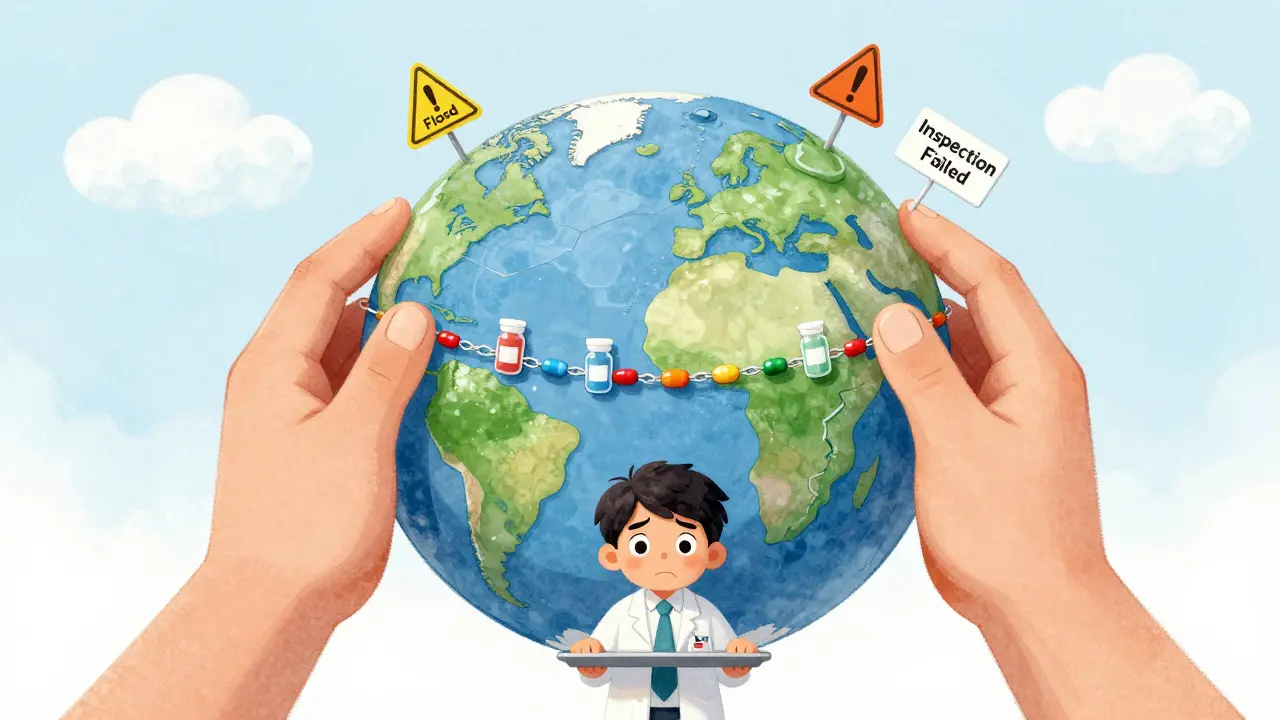
Eighty percent of the active pharmaceutical ingredients (APIs) used in U.S. generic drugs come from just two countries: China and India. That’s not a coincidence. It’s economics. Labor is cheaper. Regulations are looser. Production costs are lower. But it also means a flood in India, a political standoff in China, or a port strike in Los Angeles can ripple across the entire U.S. drug supply.
During the pandemic, lockdowns in Shanghai halted API shipments. Air freight costs tripled. Shipping delays stretched from weeks to months. Hospitals ran out of IV fluids, sedatives, and heart medications. The U.S. didn’t have the domestic capacity to fill the gap. There are fewer than 100 FDA-registered facilities making finished generic drugs in the U.S. Most of them are running at full capacity already. No spare room. No buffer.
And here’s the kicker: many of these foreign factories aren’t inspected as often as U.S. plants. The FDA inspects only about 10% of overseas facilities each year. That means problems can go undetected for years-until a batch fails, and a shortage hits.
No Extra Capacity Means No Safety Net
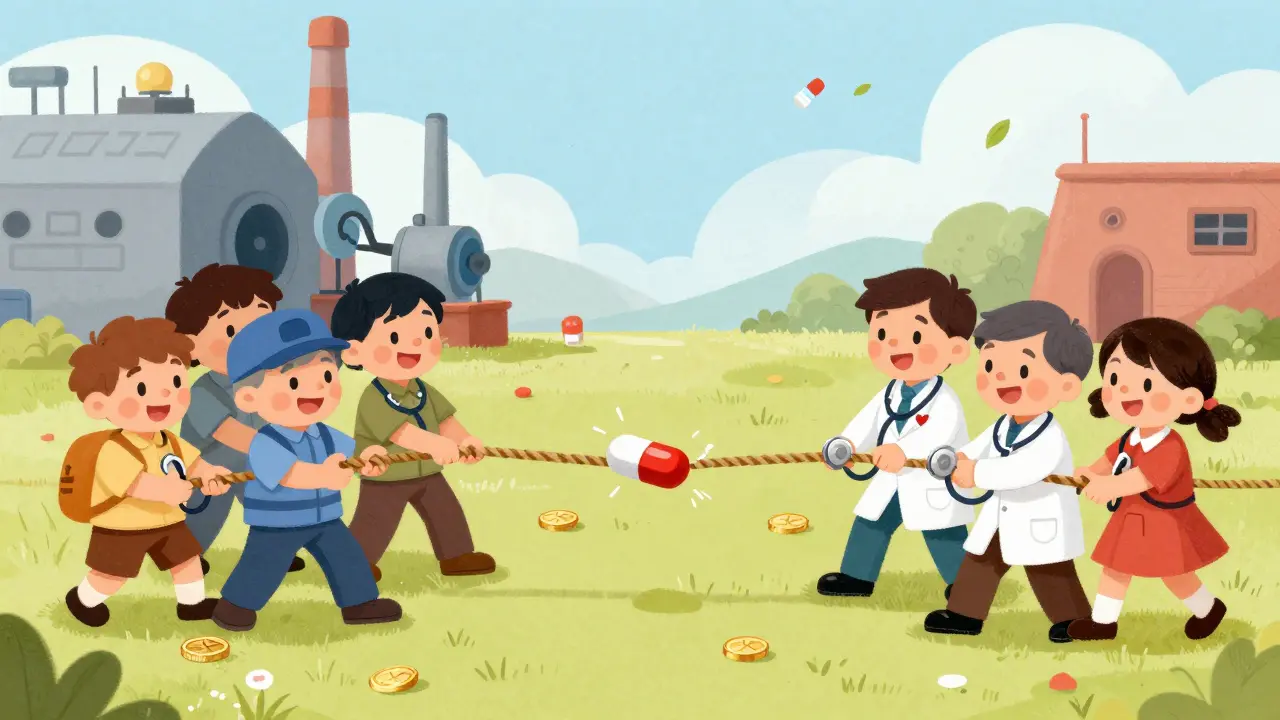
Branded drug makers keep extra production lines running. They build in slack. Generic manufacturers don’t. Why? Because they’re fighting over pennies.
Generic drugs are sold in a race to the bottom. When a patent expires, dozens of companies rush to make the same pill. The first to market makes a little profit. Then others enter. Prices drop. Soon, the drug sells for $0.10 a tablet. Profit margins shrink to 10-15%. Meanwhile, branded drugs still make 30-40% margins.
With so little profit, manufacturers cut every cost they can. That includes not investing in backup equipment, not building extra capacity, not stocking raw materials. They run lean. Too lean. One breakdown, one delay, one inspection failure-and the entire supply vanishes.
There’s no incentive to be prepared. If you’re the only one making a drug, you might make a little more. But if five companies make it, the price collapses. So everyone waits for someone else to invest. And no one does.
Pharmacy Benefit Managers Control the Market
It’s not just manufacturers. The middlemen are part of the problem.
Three pharmacy benefit managers-CVS Caremark, Express Scripts, and OptumRx-control about 85% of prescription drug spending in the U.S. They decide which drugs get covered, which ones get preferred, and which ones get pushed aside. They negotiate rebates from manufacturers. And they often choose the cheapest drug, even if it’s from a single-source supplier with a shaky track record.
The Federal Trade Commission found in 2023 that PBMs make decisions about life-saving medications without transparency or accountability. They don’t tell hospitals or patients why a drug is excluded from a formulary. They don’t disclose how much they’re paid by manufacturers to favor one drug over another.
Result? A drug that’s reliable, widely available, and slightly more expensive gets dropped. A cheaper, single-source drug gets pushed in. Then it goes into shortage. And suddenly, patients are stuck.
Meanwhile, hospitals and pharmacists spend 50-75% more time managing shortages than they did 10 years ago. They’re calling other hospitals, checking alternate suppliers, trying to find equivalents. All while patients wait.
Why Canada Handles This Better
Canada has the same global supply chain. Same API sources. Same generic drug market. But they have far fewer shortages.
Why? Because they don’t leave it to the market. Canada has a national drug stockpile specifically for shortages. When a drug runs low, the government steps in. They buy extra. They coordinate between manufacturers, pharmacies, and hospitals. They share information openly.
In the U.S., the Strategic National Stockpile exists-but only for bioterrorism or natural disasters. Not for a shortage of doxycycline or propofol.
Canada also has stronger communication between regulators, payers, and manufacturers. When a problem arises, everyone talks. In the U.S., manufacturers often stay silent. Hospitals don’t know why a drug disappeared. Pharmacists get blamed. Patients suffer.
The Vicious Cycle
It’s not one thing. It’s a loop:
- Low prices → low profits → no investment in capacity
- No capacity → one failure → total shortage
- Shortage → panic buying → price spikes → PBMs drop the drug
- Drug dropped → manufacturer quits making it → fewer suppliers
- Even fewer suppliers → higher risk of future shortages
Each step feeds the next. And it’s accelerating. The number of drugs entering shortage hit its peak in 2018. Then jumped again in 2020 during the pandemic. And it hasn’t dropped since.
What’s Being Done?
There are signs of change. In 2023, Congress introduced the RAPID Reserve Act. It proposes creating a strategic reserve of critical generic drugs-like antibiotics and anesthetics-and offering incentives for domestic manufacturing. That’s a start.
The FTC is also investigating PBMs. If they’re found to be pushing cheaper, riskier drugs for profit, that could force transparency.
The American Medical Association is pushing hospitals to stop switching patients to drugs in short supply. If a drug is available, use it. Don’t wait for the cheaper, riskier one.
But none of these fix the core issue: generic drugs are treated like commodities, not life-saving tools. You can’t run a health system on the same model as a warehouse selling toilet paper.
What Needs to Change
Here’s what real change looks like:
- Government subsidies for manufacturers making low-margin but essential drugs
- Minimum stockpile requirements for critical generics
- More domestic API production-not just finished pills, but the raw ingredients
- Transparency rules: manufacturers must report potential shortages 6 months in advance
- PBMs must disclose why they exclude drugs from formularies
Without these steps, shortages will keep happening. And every time they do, someone’s treatment gets delayed. Someone’s pain gets worse. Someone might not make it.
This isn’t about politics. It’s about basic healthcare. Generic drugs are the backbone of the U.S. system. If that backbone breaks, the whole structure collapses.
It’s wild how we treat life-saving pills like they’re bulk toilet paper on Amazon. We’ve turned healthcare into a discount bin auction, and now people are dying because no one wanted to pay a few extra cents per tablet. The system’s not broken-it was designed this way. Profit over people, always. But hey, at least our stock prices are up, right? 🤡
Oh wow, another ‘corporate greed’ rant. Let me guess-next you’ll say Big Pharma is evil? Newsflash: generics are cheap because they’re boring. No R&D. No innovation. Just copy-paste pills. If you want reliability, pay for branded. Stop blaming manufacturers for playing the game you forced them into.
So let me get this straight-the FDA inspects 10% of overseas facilities, PBMs pick the cheapest drug regardless of reliability, manufacturers can’t afford backups, and we wonder why people die? This isn’t a supply chain issue-it’s a moral failure. And yet no one’s in jail. Just... wow.
Oh my god, I can’t believe someone actually wrote this like it’s news. We’ve known this for 15 years. The only surprise is that we’re still surprised. Someone’s got to be making money off this chaos-probably the same people who own the PBMs and the Indian factories. It’s a pyramid scheme with syringes.
My mom’s on insulin. She had to switch brands three times last year because ‘the cheaper one was out.’ No one told her why. No one apologized. Just a pharmacy tech shrugging like it’s normal. It’s not normal. It’s criminal.
As someone from India, I see this daily. Our factories are world-class-but we’re treated like cheap labor hubs. The same workers who make your antibiotics work 14-hour shifts in 40°C heat. And then we’re blamed when quality slips? The real villain isn’t the factory-it’s the pricing model that forces corners to be cut. 🙏
Canada? You’re kidding. Canada has single-payer because they’re socialist. We have freedom. Freedom to go broke because you can’t find your blood pressure med. If you want safety nets, move to Sweden. But don’t blame the market for working exactly how it’s supposed to.
It’s not about subsidies or stockpiles-it’s about dignity. We’ve reduced human health to a spreadsheet line item. A pill that costs $0.08 isn’t a triumph-it’s a tragedy. And the people who cheer this efficiency are the same ones who think ‘market discipline’ is a moral virtue. You’re not a capitalist-you’re a sociopath with a Bloomberg terminal.
Big Pharma and the FDA are in cahoots. They let the cheap generics in so they can make you sick, then sell you the expensive ‘solution’ later. The whole system is a psyop. Why do you think they banned the original insulin formula? So they could patent the ‘new’ version. It’s all planned. I’ve got documents. Someone needs to leak this.
Wait-so if a factory in India has a fungal issue, and it’s the only supplier, why doesn’t the U.S. just fast-track another one? I thought we had emergency powers for stuff like this? Or is it because no one wants to spend the money until someone dies? 😔
Let’s be real: capitalism doesn’t care about your insulin. It cares about margins. The idea that healthcare should be treated like a public good is a fantasy dreamed up by people who’ve never run a business. The market doesn’t owe you a pill. You owe it to yourself to pay more-or learn to live without.
India and China make the world’s generics because they can. We used to make them too-but we got lazy. Now we cry when the pipeline breaks. Maybe it’s time to rebuild. Not with subsidies. With pride. We used to make things. Let’s make pills again. 🇺🇸💪
Every time a drug shortages, hospitals blame manufacturers. But no one asks why the FDA approved a single-source supplier in the first place. Why wasn’t there a requirement for dual sourcing? Why is this even legal? Someone should audit every single FDA approval since 2010. This isn’t incompetence-it’s negligence.
Insulin shortages. Doxycycline. Propofol. These aren’t ‘issues.’ They’re preventable deaths. And the fact that we treat them as logistical inconveniences proves how deeply we’ve dehumanized medicine. The system isn’t failing. It’s working exactly as intended.