
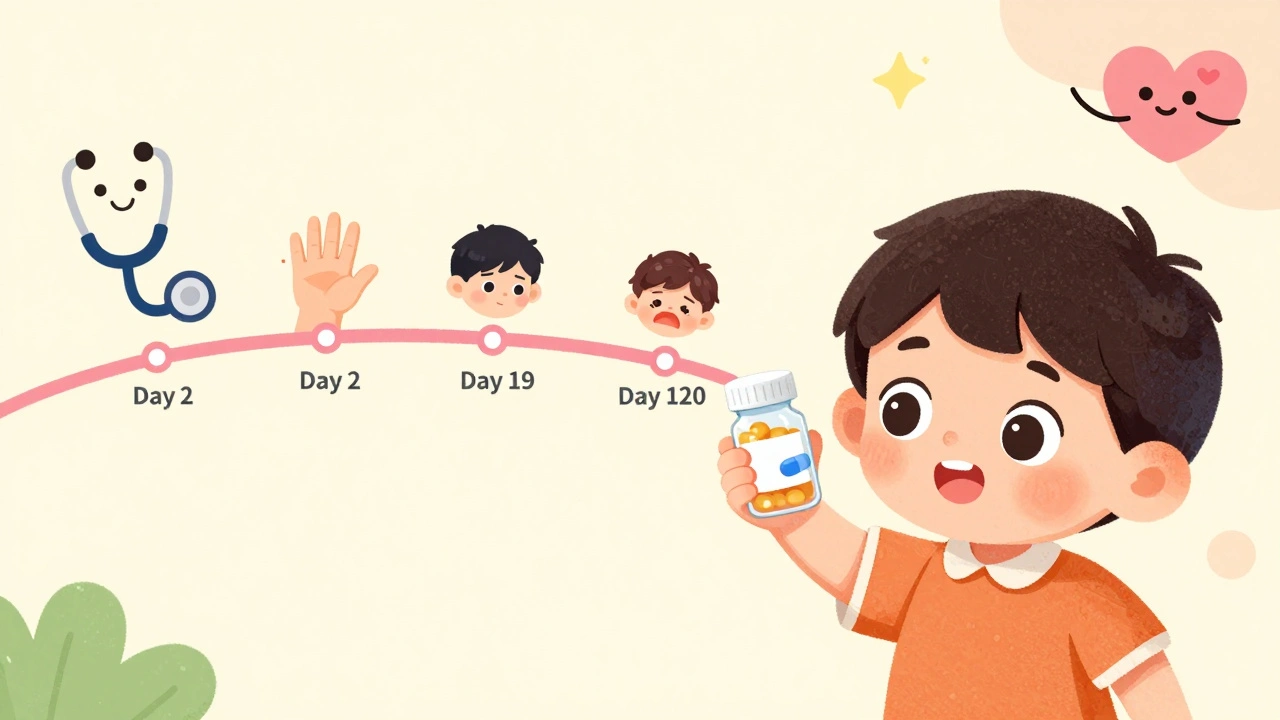
Side Effect Time Predictor
Ever started a new medication and weeks later wondered, is this side effect even from the pill? You’re not alone. Many people blame a new drug for symptoms that actually came from stress, aging, or an unrelated illness. But sometimes, the drug really is the culprit-and knowing when to expect trouble can save you from misdiagnosis, unnecessary tests, or even dangerous delays in care.
Why Timing Matters More Than You Think
Not all side effects show up the same way. Some hit fast-within hours. Others creep in slowly, over months. If you don’t know the typical timeline, you might stop a life-saving drug too soon… or ignore a warning sign until it’s too late. The science behind this is called time-to-onset (TTO) analysis. It’s not just guesswork. Researchers use statistical models like the Weibull distribution to map out when side effects are most likely to appear after you start taking a drug. A shape parameter (β) tells the story: if β is less than 1, the risk drops over time (early onset). If it’s greater than 1, the risk builds up (delayed onset). Most side effects fall into the early category-78% of them, according to a major 2014 study. This isn’t academic jargon. It’s practical. If your doctor knows your symptoms started at day 3, they can rule out a lot of things. If it’s day 45? That points to something else entirely.Antibiotics: Fast and Furious
Ciprofloxacin (Cipro) is a classic example. It’s a powerful antibiotic, often prescribed for urinary infections or traveler’s diarrhea. But it can cause nerve damage-peripheral neuropathy-that starts fast. The median time? Exactly 2 days. That’s faster than most people expect. In fact, women tend to feel it even sooner than men-2 days versus 4 days on average. If you’re on Cipro and suddenly feel tingling, burning, or weakness in your hands or feet, don’t wait. Call your doctor. This isn’t something that resolves on its own. Stopping the drug early can prevent permanent nerve damage. Other antibiotics like levofloxacin and moxifloxacin follow similar patterns. Their side effects usually show up within the first week. That’s why doctors often warn patients to watch for symptoms right away.Statins: The Myth of the Delayed Muscle Pain
Statins-drugs like atorvastatin and rosuvastatin-are among the most prescribed medications in the world. They lower cholesterol. But many people quit them because of muscle pain. Here’s the twist: research shows the pain often starts within the first few weeks, but it’s not always the drug. A 2021 JACC study followed 60 people who had stopped statins due to muscle pain. They were given either the real statin or a sugar pill-without knowing which. What happened? Half the people felt better within three days of stopping either the real drug or the placebo. That’s the nocebo effect: your brain expects side effects, so you feel them-even when the drug isn’t there. That doesn’t mean statin pain isn’t real. It just means timing matters. True statin-induced myopathy usually shows up between 1 and 4 weeks. If your pain starts on day 10, it’s worth investigating. If it shows up on day 60? Maybe not.Antiepileptics: The Slow Burn
Drugs like pregabalin (Lyrica) and gabapentin (Neurontin) are used for nerve pain, anxiety, and seizures. Their side effects-dizziness, fatigue, brain fog-don’t hit like a sledgehammer. They creep in. The median time-to-onset? 19 days for pregabalin and 31 days for gabapentin. That’s why patients often say, “I felt fine for weeks, then suddenly I couldn’t get out of bed.” A review of over 1,200 patient reports on Drugs.com found that 58% mentioned dizziness or tiredness within the first week. That’s a bit faster than the median, but still confirms the pattern: these side effects build gradually. If you start feeling off after 10 days on pregabalin, it’s likely the drug. If it’s day 2, probably not.
ACE Inhibitors: The Silent Delay
Lisinopril, enalapril, ramipril-these blood pressure drugs are safe for most people. But one rare side effect can be deadly: angioedema. Swelling of the face, lips, tongue, or throat. It can block your airway. Here’s the catch: it doesn’t always happen fast. Histamine-mediated angioedema (from allergies) shows up within hours. But the kind caused by ACE inhibitors? That’s bradykinin-mediated-and it can appear anytime from the first week to six months later. A patient review on Drugs.com from 2022 said: “Developed severe angioedema 4 months after starting. My doctor didn’t connect it until I found research.” That’s exactly the problem. If you’re on an ACE inhibitor and your lips swell up-even if you’ve been on it for months-stop the drug and seek help immediately. Delayed onset doesn’t mean it’s safe.Interferon and Immune Drugs: The Long Game
Interferon beta-1a, used for multiple sclerosis, has one of the longest known time-to-onset patterns for nerve-related side effects: 526.5 days-almost 18 months. That’s longer than most people stay on the drug. If you start feeling numbness or tingling after a year and a half, it’s worth mentioning to your neurologist. Natalizumab (Tysabri), another MS drug, causes peripheral neuropathy with a median onset of 141.5 days-nearly five months. That’s far later than antibiotics or statins. These drugs work by changing your immune system. Side effects from immune-modulating drugs often take time to build because the body needs to react, adapt, and sometimes overreact. That’s why long-term monitoring is critical.Drug-Induced Liver Injury: The Wild Card
Liver damage from medications is tricky. It doesn’t always follow a pattern. Acetaminophen (Tylenol) overdose can cause liver failure within 24 hours. But idiosyncratic reactions-those unpredictable, rare ones-usually show up around 42 days after starting the drug, with a range of 20 to 117 days. Drugs like amoxicillin-clavulanate, sulfonamides, and certain antiseizure meds fall into this category. Symptoms? Fatigue, nausea, yellow skin, dark urine. If you’ve been on a new medication for six weeks and feel unusually tired, get your liver checked. Don’t assume it’s just “the flu.”
How Clinicians Use This Info
Hospitals aren’t just guessing anymore. Systems like Epic now flag potential drug reactions based on timing. Mayo Clinic reported a 22% improvement in detecting side effects after adding TTO algorithms to their electronic records in 2022. The FDA says: if a side effect happens within 30 days of starting a drug, it’s automatically flagged for review. That’s why your pharmacist might call you if you start a new drug and report dizziness on day 12. But here’s the problem: most doctors don’t have time to memorize these timelines. That’s why patients need to be their own advocates. Keep a simple log: start date, symptoms, when they began. Bring it to your next appointment.What You Can Do Today
You don’t need to be a scientist to use this knowledge. Here’s how:- When you start a new drug, ask: “When do side effects usually show up?” Write it down.
- Track symptoms in a notebook or phone app. Note the date they started.
- If something feels off within the first week, think: Is this normal for this drug?
- If symptoms appear after 3 months, don’t automatically assume it’s unrelated. Check the drug’s known TTO window.
- Don’t stop a drug without talking to your doctor-but do speak up if timing doesn’t match what you expected.
The Bigger Picture
This isn’t just about avoiding bad reactions. It’s about trusting your body-and your doctor-better. When side effects appear at the right time, it helps confirm the drug is the cause. When they don’t, it helps rule it out. The future is even smarter. By 2025, researchers are building AI models that predict side effect timing based on your genetics, age, sex, and even gut bacteria. The NIH’s All of Us program is starting to integrate this data into TTO predictions. But for now, the best tool you have is awareness. Know the patterns. Know your timeline. And never ignore a symptom just because you’ve been on the drug for a while.How soon after starting a drug do side effects usually appear?
It depends on the drug. Most side effects appear within the first few days or weeks-78% of them, according to pharmacovigilance studies. Antibiotics like ciprofloxacin often cause reactions within 2 days. Statins may trigger muscle pain after 1-4 weeks. Some drugs, like ACE inhibitors or interferon, can cause delayed reactions weeks, months, or even over a year later.
Can a side effect start months after I begin taking a drug?
Yes. Some drugs, especially those affecting the immune system or nerves, have long time-to-onset patterns. For example, ACE inhibitors can cause angioedema as late as 6 months after starting. Interferon beta-1a may trigger nerve symptoms after nearly 18 months. If you develop new symptoms-even months later-don’t assume it’s unrelated. Check with your doctor and review the drug’s known side effect timeline.
Why do some people get side effects right away and others don’t?
It’s a mix of biology and chance. Genetics, age, sex, kidney or liver function, and even gut bacteria can change how your body processes a drug. Women, for example, tend to develop ciprofloxacin-induced nerve pain faster than men. Some people have slower metabolism of the drug, leading to buildup and earlier symptoms. Others may have a higher threshold for side effects-or simply don’t notice them until they’re severe.
Is it possible to have a side effect and not know it’s from the drug?
Absolutely. Many side effects mimic common conditions-fatigue from hypothyroidism, dizziness from dehydration, joint pain from arthritis. If you don’t know the typical time-to-onset for your drug, you might blame stress, aging, or another illness. That’s why tracking symptoms and their start date is so important. A symptom appearing 19 days after starting pregabalin? That’s a red flag. Same symptom on day 5? Probably not the drug.
What should I do if I think a drug is causing side effects?
Don’t stop the drug suddenly unless it’s life-threatening (like swelling or trouble breathing). Instead, write down: what you’re feeling, when it started, and how it’s changed. Call your doctor or pharmacist. Bring your medication list. Mention the timing-it’s the most important clue they have. If you’re on a high-risk drug like an ACE inhibitor or statin, they may ask you to stop it temporarily to see if symptoms improve.
Finally, someone breaks down the actual science instead of just saying 'side effects happen.' Most people think if it's not immediate, it's not the drug. That's dangerous. I've seen patients stop life-saving meds because they felt 'fine' for two weeks-then had a stroke. Timing isn't just helpful, it's life-or-death. If you're on an ACE inhibitor and your lip swells at month 5? STOP. Call 911. Don't wait for your next appointment.
Also, women get cipro neuropathy faster? That's not a fluke. We metabolize drugs differently. Why do so many studies still use male-only cohorts? Fix the data, fix the outcomes.
This is the kind of post that makes me feel less alone. I was on gabapentin for 3 months before I realized I couldn't think straight anymore. My doctor said 'it's just aging.' I pushed back because I remembered reading about the 31-day median. Turned out it was the drug. I weaned off slowly. My brain fog lifted in 10 days.
But here’s the thing-why do we treat patients like passive recipients? We’re the ones living with the side effects. If we’re not taught to track timing, how are we supposed to advocate? This isn’t just pharmacology-it’s patient dignity.
Oh my god. I just read this and I’m crying. Not because it’s sad-but because it’s so damn obvious and yet NO ONE talks about it.
I was on statins for 6 months. Started getting muscle pain on day 18. My doctor said 'it’s just exercise.' I didn’t lift weights. I didn’t even walk more than usual. I kept a journal. Showed it to my pharmacist. She looked at me like I’d spoken Latin.
Then I found this study. Turned out I was right. They put me on ezetimibe. No pain. No issues. Why does medicine still feel like guesswork? We have the data. We just don’t use it.
Also, the nocebo thing? That’s the most terrifying part. We’re not just reacting to chemicals-we’re reacting to fear. And fear is contagious.
OMG YES. I started cipro for a UTI and my feet felt like they were on fire by day 2. I called my doc immediately. She was like 'probably just nerves' and I was like 'SIS I HAVE A PHD IN BEING A HUMAN.' I stopped it. No permanent damage. But if I’d waited? I’d be walking with a cane now. 🚨
Also-why do we still treat meds like magic beans? 'Take this, don’t ask questions.' Like I’m not the one living in this body. I keep a meds log on my phone. It’s saved me twice. #MedicationAwareness
yo this is fire. i’ve been on lisinopril for 8 months and last week my tongue swelled up. i thought it was allergies. turned out to be ACE inhibitor angioedema. doc was like 'oh that’s rare' like it’s some myth. i found the paper on drugs.com and showed it to him. he had to look it up.
we need a side effect timer app. like 'started drug on april 12' then it auto-flags when you hit the median onset for each med. i’d pay for that. also why is no one talking about how the fda only flags stuff under 30 days? what about the 6-monthers? they’re not less dangerous.
ps i’m not a doctor but i play one on reddit 😅
And don’t get me started on the nocebo effect being dismissed as 'just in their head.' If your brain can make you feel pain from a sugar pill, then the pain is real. It’s not 'all in your head'-it’s in your nervous system. And that’s biology. Not weakness.
This post is brilliant. But it shouldn’t have to be. This should be taught in med school. In high school. In pharmacy ads. In every damn prescription bottle.
And yet here we are. Watching people die because we didn’t listen to the data.
This is so important. I’m from Nigeria, and here, most people don’t even get proper prescriptions. They buy meds from street vendors. But even in places with good healthcare, timing is ignored. My cousin was on antiseizure meds for 5 weeks, then started having hallucinations. Doctor said 'stress.' Turned out it was drug-induced psychosis. Median onset? 42 days. He was right on the bell curve.
Thank you for writing this. I’m sharing it with my community. We need to stop treating side effects like bad luck. They’re signals. And we’re the ones who hear them first.
Let me just say this: if you’re not tracking your drug onset timelines, you’re not being responsible with your health. You’re gambling. And it’s not your fault-because the system doesn’t teach you how to be a patient. It teaches you to be obedient.
I’ve had three different meds cause delayed reactions. Each time, I was told, 'It’s probably not that.' Each time, I was right. Each time, I had to fight. I keep a spreadsheet. Drug. Start Date. Symptom. Onset Day. Reference Link. I’ve saved myself from ER visits, hospitalizations, and permanent damage.
So if you’re reading this and you’re on a new drug? Do it. Today. Don’t wait. Your future self will thank you.
And if your doctor rolls their eyes? Find a new one. Because if they don’t respect data, they don’t respect you.