
When a pharmaceutical company tweaks its manufacturing process-whether it’s swapping out a mixer, moving a step to a new building, or changing the supplier of an active ingredient-it’s not just an internal operational decision. It’s a regulatory event. And if you get it wrong, you could be looking at a manufacturing changes warning letter, a product recall, or even a shutdown. The FDA doesn’t care if your change was "just a small upgrade." If it affects the quality, safety, or effectiveness of the drug, it needs approval before you ship it.
Why Manufacturing Changes Are Treated Like High-Risk Events
Think of a drug as a recipe with exact measurements. Change one ingredient, even slightly, and the final product might not work the same. That’s why regulators treat manufacturing changes like potential threats to patient safety. The goal isn’t to slow down innovation-it’s to make sure that every batch of medicine you take is just as safe and effective as the one approved in the original application.
The FDA’s system, outlined in 21 CFR 314.70 for drugs and 21 CFR 601.12 for biologics, divides changes into three buckets: major, moderate, and minor. Each has a different path for notification and approval. This isn’t arbitrary. It’s based on risk. A change that alters the chemical synthesis of an active ingredient? That’s a major change. A change that swaps a conveyor belt for an identical model? That’s likely minor.
The Three Tiers of Regulatory Reporting
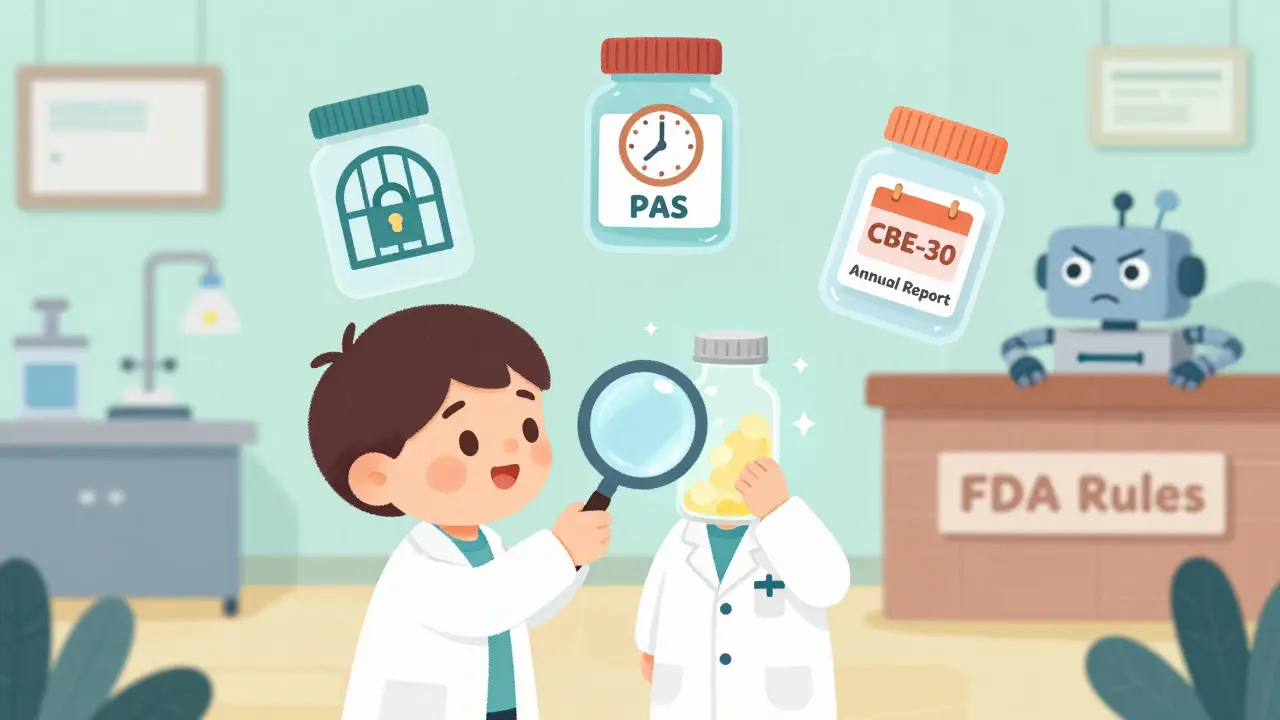
There’s no guessing game. The FDA gives you clear rules. Here’s how they break down:
- Prior Approval Supplement (PAS) - For major changes. You cannot implement the change until the FDA approves it. This includes switching to a new API synthesis route, changing the primary manufacturing site, or modifying equipment that affects critical process parameters. You submit detailed data-validation reports, stability studies, comparative batch results-and wait. This can take 6 to 12 months. If you move forward without approval, you’re breaking the law.
- Changes Being Effected in 30 Days (CBE-30) - For moderate changes. You can make the change after submitting the supplement, but you must wait 30 days before shipping the new version. This applies to things like replacing a tablet press with an identical model from the same manufacturer, changing a filter material with equivalent specifications, or updating software that controls a critical process. You still need to notify the FDA, but you don’t have to wait for their green light.
- Annual Report - For minor changes. These are low-risk tweaks: moving a non-critical step within the same facility, changing a label font, or updating a non-critical supplier. You don’t need to notify the FDA ahead of time. Just document it, track it, and include it in your annual report due by the product’s approval anniversary date.
What Counts as a Major Change?
Not all changes are obvious. Sometimes, what looks like a simple equipment swap is actually a major change. The FDA defines major changes as those with a "high potential to adversely affect product identity, strength, quality, purity, or potency." Here are real examples that trigger a PAS:
- Switching from batch to continuous manufacturing for a biologic
- Changing the solvent used in API crystallization
- Relocating the final fill-finish step to a new facility
- Introducing a new sterilization method for injectables
- Replacing a lyophilizer (freeze-dryer) with a different model that alters cycle time or pressure
In 2023, the FDA issued a warning letter to Lupin Pharmaceuticals for replacing a lyophilizer without a PAS. The new machine had different drying rates. The FDA said that could affect product stability. They were right. That’s why you don’t just look at the machine specs-you look at how the change affects the product.
Equipment Replacements: The Most Common Pitfall
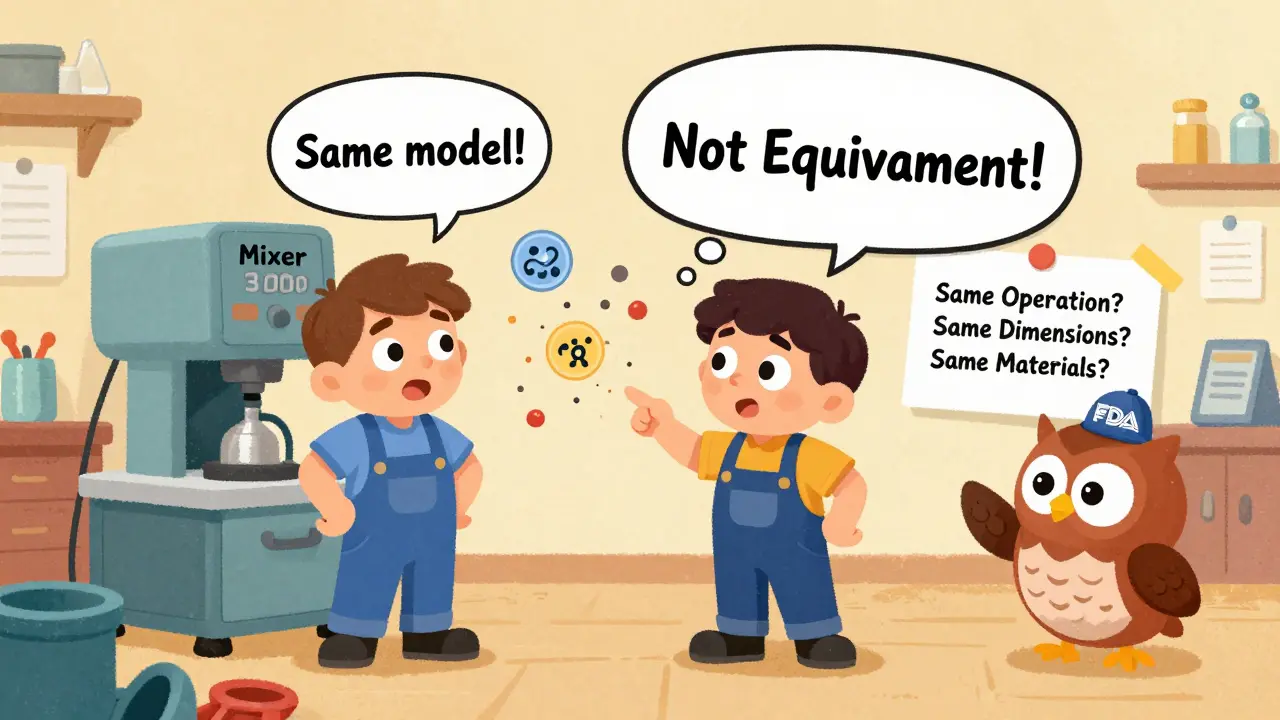
Equipment changes are the #1 source of regulatory violations. Why? Because companies assume "same model = same change." But that’s not always true.
The FDA’s 2022 guidance says equipment is only "equivalent" if it has:
- The same principle of operation
- The same critical dimensions
- The same material of construction
So if you replace a tablet press with a newer version from the same manufacturer, but it has a different compression force range or a different feeder design, that’s not equivalent. That’s a CBE-30 or possibly a PAS. One company spent 37 hours in a cross-functional meeting just to decide whether a new mixer qualified as CBE-30. The issue? The API’s particle size distribution was sensitive to mixing speed. Even a 5% change in RPM could alter dissolution rates.
How Other Regulators Compare
The FDA isn’t alone. The European Medicines Agency (EMA) uses a different system:
- Type IA - Minor changes. Notify within 12 months. You can implement immediately.
- Type IB - Moderate changes. Notify and wait for approval before implementing. Timeline: 30 to 60 days.
- Type II - Major changes. Full review. Approval required before implementation. Can take 6-12 months.
Health Canada mirrors the FDA with Level I (PAS), Level II (CBE-30), and Level III (annual report). But the EMA’s Type IA gives companies more flexibility. You can make a tiny change and notify later. The FDA doesn’t have that. Even the smallest change requires documentation, and if it’s not minor, you’re stuck waiting.
WHO Prequalification adds another layer: if you’re selling to global markets, you might need a Comparability Protocol-essentially a science-backed plan showing your change didn’t hurt the product. That means stability data, bioequivalence studies, and statistical analysis. It’s expensive. But for companies selling to Africa or Southeast Asia, it’s mandatory.
What Happens If You Get It Wrong?
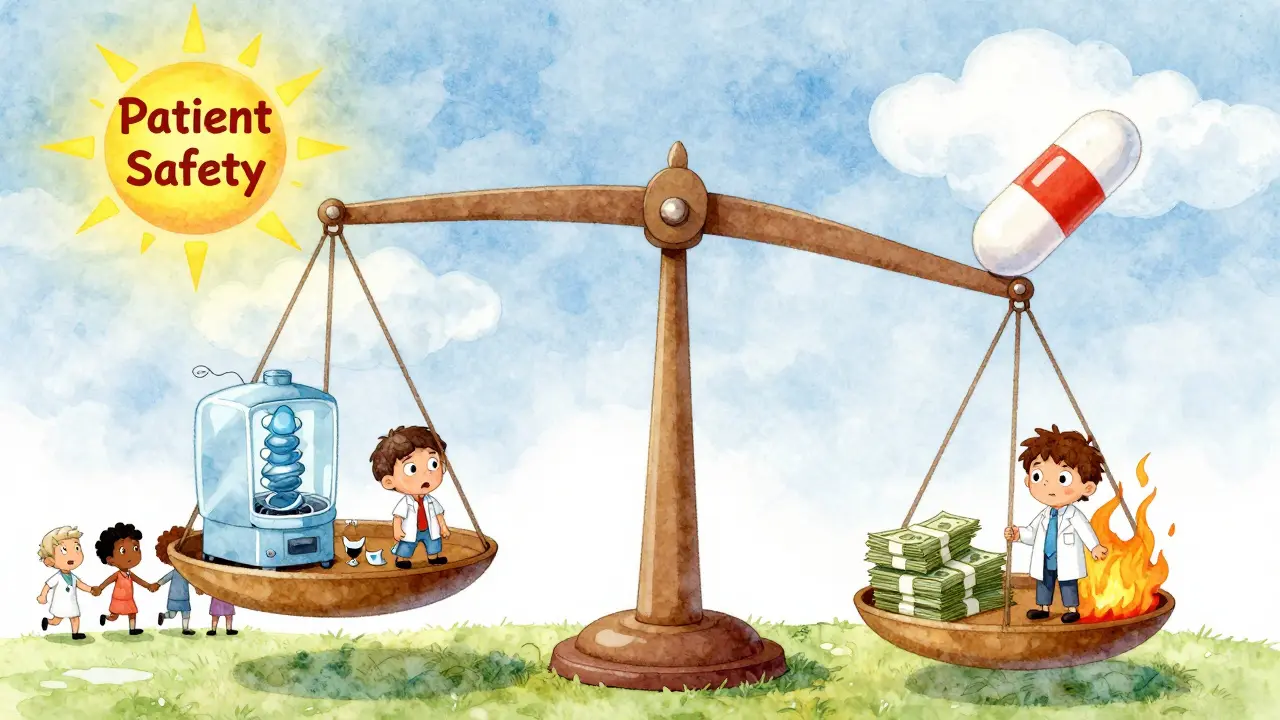
In 2022, 22% of all FDA warning letters were tied to improper manufacturing change control. Of those, 37% were about equipment changes misclassified as minor when they were major.
Penalties aren’t theoretical. Companies have faced:
- Product recalls costing millions
- Import alerts blocking shipments
- Warning letters that trigger investor scrutiny
- Delayed approvals for new products due to "regulatory trust issues"
In one case, a generic drugmaker got a warning letter because they replaced a filter without a PAS. The FDA found the new filter changed the particle size of the drug. The product was recalled. The company lost $18 million in revenue and had to revalidate the entire process.
How to Avoid Mistakes
Here’s how smart companies do it:
- Use a risk assessment tool - The Parenteral Drug Association’s Technical Report No. 60 recommends Failure Modes and Effects Analysis (FMEA). Score each change on impact, likelihood, and detectability. If the score is above 100, it’s likely a PAS.
- Document everything - Even for minor changes. Keep facility diagrams, equipment specs, validation reports, and batch records. The FDA will ask for them.
- Involve the right people - Don’t let manufacturing decide alone. Bring in quality, regulatory, and validation teams. One person can miss a hidden risk.
- Consult the FDA early - If you’re unsure, request a pre-submission meeting. The 2021 biologics guidance says this explicitly: "If FDA disagrees with your classification, it may delay approval." Better to ask now than get a warning letter later.
- Train your team - ASQ data shows it takes 18 months for a regulatory professional to become consistent in classifying changes. Don’t rely on one person’s memory.
The Future Is Risk-Based and Real-Time
The FDA’s 2023 draft guidance on quality risk management is a sign of where things are headed. Instead of rigid categories, they want companies to use science to justify their decisions. Real-time monitoring, AI-driven process control, and continuous manufacturing are making traditional change control feel outdated.
By 2025, 40% of new change submissions are expected to include real-time data from sensors and analytics to prove product quality didn’t change. That’s a game-changer. Imagine submitting a change with live data showing that your new mixer produces identical particle size distribution to the old one. That could turn a PAS into an annual report.
But until then, the rules are clear. Don’t assume. Don’t guess. Document. Assess. Notify. Wait. The cost of a mistake isn’t just financial-it’s patient safety.
What happens if I implement a manufacturing change without FDA approval?
If you implement a major change without a Prior Approval Supplement (PAS), you’re in violation of federal law. The FDA can issue a warning letter, seize your product, block imports, or order a recall. In severe cases, they may require you to halt production entirely. Even if the change didn’t harm the product, the regulatory breach alone can trigger serious consequences, including loss of trust and delayed approvals for future products.
Can I use the same equipment model and still need a CBE-30?
Yes. Even if the equipment model is identical, if it’s from a different manufacturer, has different calibration settings, or is installed in a new location that affects environmental controls (like temperature or humidity), the FDA may require a CBE-30. The key is whether the change could affect critical quality attributes (CQAs). If there’s any doubt, treat it as a moderate change.
Do I need to notify the FDA for every supplier change?
Not always. If you switch to a new supplier of a non-critical excipient (like a filler or colorant) and the new material meets the same specifications, it’s likely a minor change and only needs an annual report. But if you change the supplier of an active pharmaceutical ingredient (API) or a critical component that affects dissolution or stability, that’s a major change requiring a PAS. Always validate the new material with testing.
How long does a CBE-30 submission take to process?
You don’t wait for FDA approval on a CBE-30. You submit it at least 30 days before distributing the product. The FDA reviews it after you’ve started shipping. If they find an issue, they may ask for additional data or request a recall. That’s why it’s critical to submit high-quality documentation-your 30-day window is your only safety net.
What’s the difference between a PAS and a CBE-30 in terms of data requirements?
A PAS requires comprehensive data: full process validation, stability studies across three consecutive batches, analytical method validation, and a comparability protocol showing the product is equivalent before and after the change. A CBE-30 needs less-typically comparative batch data from three batches, a summary of validation results, and justification for why the change won’t impact quality. The key difference is depth. PAS = full scientific case. CBE-30 = focused, targeted evidence.


