
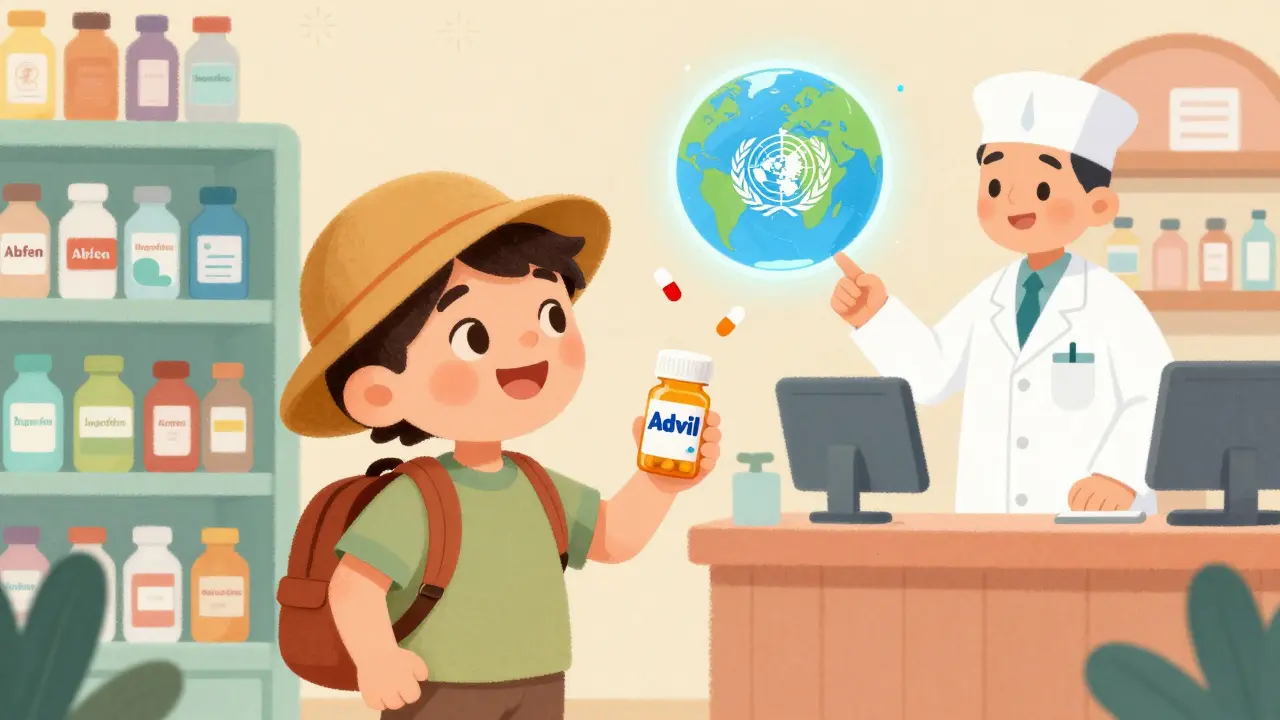
When you’re traveling abroad and need to refill a prescription, you might assume it’s as simple as showing your pill bottle to a pharmacist. But here’s the reality: the medicine you take every morning in Phoenix might have a completely different name, shape, or dosage label in Tokyo, Paris, or Mexico City. And getting it wrong isn’t just inconvenient-it can be dangerous.
Why Medication Names Vary Across Countries
Pharmaceutical companies use different brand names for the same drug in different countries. That’s why Advil in the U.S. is called Ibuprofène in France and Abfen in Poland. The active ingredient-ibuprofen-is the same. But if you don’t know that, you might walk into a pharmacy in Barcelona and ask for Advil, only to be handed something completely unrelated. Even more confusing: some drug names sound almost identical but do entirely different things. Ambyen (used in the UK for heart rhythm issues) and Ambien (a U.S. sleep aid) are a classic example. Mix them up, and you could end up with a dangerous reaction. This isn’t rare. A 2022 survey found that 68% of international healthcare providers have encountered prescription errors because of name confusion. The solution? Always look up the generic name of your medication. That’s the active ingredient, standardized globally by the World Health Organization (WHO) under the International Nonproprietary Name (INN) system. For example:- Advil → Ibuprofen
- Lexapro → Escitalopram
- Viagra → Sildenafil
- Metformin → Metformin (same everywhere)
How Dosage Labels Can Trick You
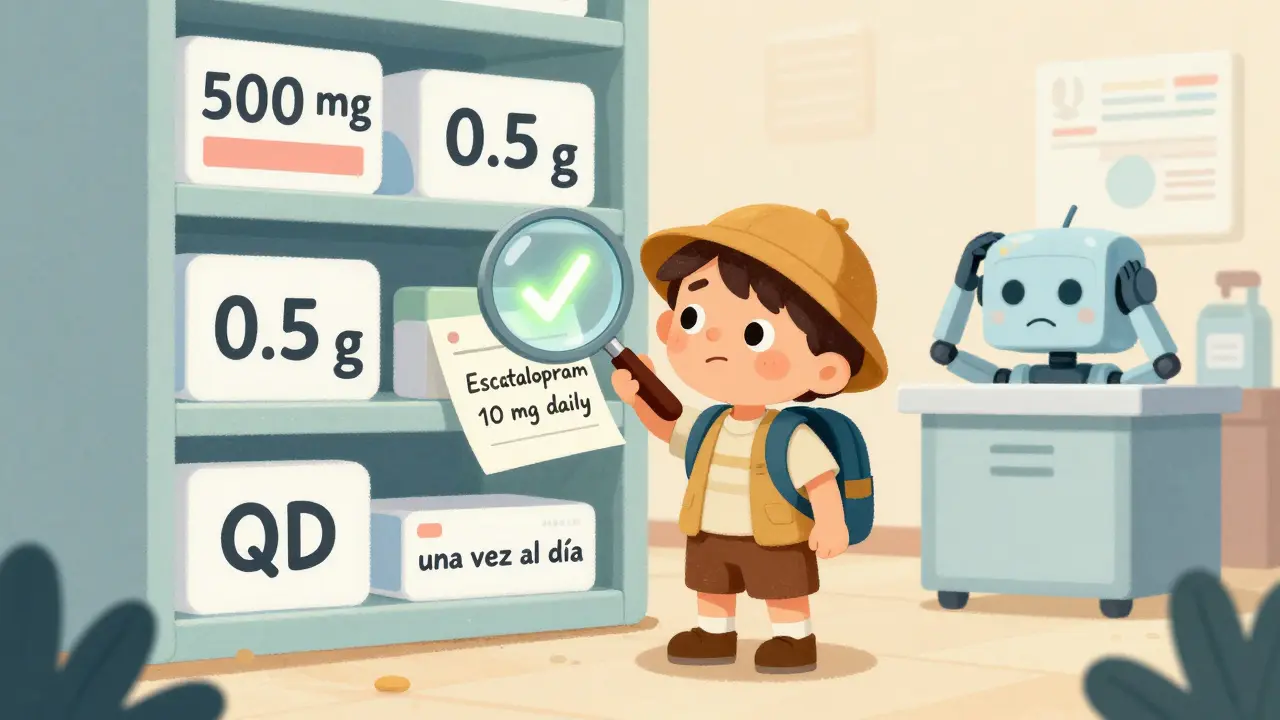
Dosage formats vary wildly by country. In the U.S., you’ll see doses like “500 mg” or “1 g.” But in many European countries, you’ll see “0.5 g” or “1000 mg.” That’s the same thing-but if you misread it, you could take half or double your dose. A Reddit thread from a pharmacy tech in 2023 tells the story: a patient brought in a Spanish prescription for “1g” of a medication. The pharmacist initially thought it meant 1 gram (1000 mg), but the patient was actually supposed to take 1 tablet of 1000 mg, not 1 gram of powder. The confusion almost led to an overdose. Always double-check:- Is the dose in milligrams (mg) or grams (g)?
- Is the tablet size marked as “500” or “0.5”?
- Are instructions written as “take once daily” or “una vez al día”?
What to Bring When Traveling With Prescriptions
Don’t rely on memory or apps alone. Here’s what you need to carry:- Your original prescription bottle with the pharmacy label
- A printed copy of your prescription in English, including drug name, strength, dosage, and prescriber info
- A handwritten note with the generic name, dosage, and reason for use (e.g., “Escitalopram 10 mg daily for depression”)
- A letter from your doctor explaining why you need the medication (especially for controlled substances)
- A list of brand-to-generic equivalents for your top 3 medications
When to Use Translation Tools-And When Not To
Google Translate, DeepL, or Siri might help you order coffee in Italian. But they’re not safe for medication translation. A 2023 analysis by ASAP Translate found that AI tools misinterpret dosage instructions in 3 out of 10 cases. They don’t understand medical abbreviations like “QD” (once daily) or “BID” (twice daily). They can’t tell the difference between “5 mL” and “5 mg.” And they often confuse similar-sounding drug names. Professional translation services like RxTran and Stepes use medical terminology databases that cross-reference WHO INN names, country-specific brand lists, and regulatory guidelines. They’re the only reliable option for pharmacies handling international prescriptions. For travelers? Use these tools only to get a rough idea. Never trust them for actual dosing. Always verify with a pharmacist.How Foreign Pharmacies Handle Translation
In countries with high numbers of international visitors-like Dubai, Bangkok, or London-many pharmacies now have staff trained to handle foreign prescriptions. Some even have digital systems that auto-translate prescription labels into multiple languages. According to a 2023 report from ASAP Translate, hospitals in Dubai served patients from 47 countries in 2022. To manage this, many pharmacies use integrated systems that pull data from First Databank or RxTran to match foreign prescriptions with local equivalents. But not all pharmacies are equipped. Smaller clinics or rural pharmacies might not have translation software. That’s why you need to come prepared. Ask questions like:- “Is this the same as [generic name]?”
- “Can you show me the packaging so I can compare the dose?”
- “Do you have a printed patient leaflet in English?”
Regulations You Need to Know
In the U.S., federal law requires pharmacies to provide translated medication labels for patients with limited English proficiency. New York mandates translations in Chinese, Italian, Russian, and Spanish. California is expanding that list to include Tagalog, Vietnamese, and Arabic based on local demographics. But abroad? Rules vary. In Canada, prescriptions must be in English or French. In Germany, pharmacists are required to provide a German-language patient leaflet, even if the prescription came from another country. In Japan, controlled substances like opioids or benzodiazepines require a special import permit-even if you have a valid U.S. prescription. Check the embassy website of your destination country before you go. They often list rules for bringing in medications. Some countries ban common U.S. drugs entirely-like pseudoephedrine (found in cold medicines) in Japan or codeine in Australia.
Real-Life Scenarios That Saved Lives
One traveler in Paris ran out of her diabetes medication. She had the bottle with “Metformin 500 mg” on it. The pharmacist didn’t recognize the brand name, but she had written the generic name on a sticky note. The pharmacist matched it to the local equivalent, Glucophage, and gave her the right dose. Another traveler in Thailand needed his blood pressure pills. He showed the pharmacist a photo of the bottle on his phone. The pharmacist recognized the pill’s color and shape and found the Thai brand. But when he asked for “10 mg,” the pharmacist handed him a 20 mg tablet because the Thai label said “20.” The traveler caught the mistake because he had written down the exact dosage on his list. These aren’t luck stories. They’re the result of preparation.What to Do If You Can’t Find Your Medication
Sometimes, your exact medication isn’t available. That’s when you need to find a therapeutic equivalent. Use trusted resources:- Drugs.com/International - Lets you search for brand names by country
- WHO INN Database - Official list of generic drug names
- MedlinePlus - Reliable drug info from the U.S. National Library of Medicine
Bottom Line: Safety Over Convenience
Translating medication names and doses isn’t about language skills. It’s about precision. A single misread digit or confused brand name can lead to hospitalization-or worse. The best strategy? Know your generic names. Bring written proof. Verify everything with a pharmacist. Don’t trust apps. Don’t assume similarity means safety. Traveling with prescriptions is doable-but only if you treat it like a medical mission, not a travel tip.Can I use Google Translate to understand my foreign prescription?
No. Google Translate and similar tools often misinterpret medical terms, dosage formats, and abbreviations. They can’t distinguish between milligrams and grams, or between similar-sounding drug names. Relying on them can lead to dangerous overdoses or underdosing. Always verify with a licensed pharmacist.
What’s the difference between a brand name and a generic name for medication?
The brand name is what the drug company calls it-like Advil or Lipitor. The generic name is the active ingredient-ibuprofen or atorvastatin. Generic names are standardized worldwide by the WHO. Brand names vary by country. Always use the generic name when seeking medication abroad.
Do I need a translation of my prescription to fill it overseas?
Not always, but it helps. Many pharmacies can read English prescriptions, especially if they include the generic name and dosage. However, in countries like Japan, Germany, or France, pharmacists may require a local-language version for legal compliance. Always carry a printed translation or a note with the generic name and dosage.
Are there medications banned in other countries that are legal in the U.S.?
Yes. Common U.S. drugs like pseudoephedrine (in cold medicines), codeine (in cough syrups), and certain ADHD medications are restricted or banned in countries like Japan, Australia, and the UAE. Always check your destination country’s customs website before traveling with any medication.
What should I do if I can’t find my exact medication abroad?
Find the generic name and use trusted resources like Drugs.com/International or the WHO INN database to locate an equivalent. Never substitute without consulting a pharmacist. If no equivalent exists, contact your doctor for a temporary alternative or adjust your travel plans to ensure continuity of care.
Man, I just got back from Thailand and this hit home hard. I had my blood pressure meds, but the bottle said '20 mg' and I thought it was 20 tablets, not 20 milligrams per pill. Thank god I had the generic name written down - amlodipine - and the pharmacist was super chill. He pulled up the local brand, showed me the pill, and we compared colors and imprints. I almost took a double dose because I trusted the label without thinking. Don't be like me. Write it down. Take a photo. Carry it like your life depends on it - because it kinda does.
Also, never trust Google Translate to tell you if something's 'once daily' or 'twice daily.' I once saw someone try to translate 'BID' as 'bath in daily' and nearly got arrested for trying to buy soap pills. True story.
So let me get this straight - we live in a world where a pill called 'Ambyen' in the UK and 'Ambien' in the US are completely different drugs, but we still let AI translate our prescriptions? That’s not negligence, that’s a horror movie waiting to happen.
I’ve seen pharmacists in Mexico squint at a U.S. script like it’s hieroglyphics and then hand you a box of cough syrup because ‘it sounds close.’ And we wonder why people end up in ERs. The real tragedy? The system’s not broken - it’s just lazy. We have WHO INN, we have databases, we have translators who specialize in med jargon… but nope, we’d rather pray to the Google Translate gods and hope for the best.
Meanwhile, Japan bans pseudoephedrine like it’s heroin. And we’re still shocked when our cold meds get confiscated? Wake up. This isn’t a travel hack. It’s a survival guide written in blood and misread milligrams.
Let’s be clear: this entire post is a glorified PSA for people who can’t read a pill bottle. The fact that you need a ‘handwritten note’ to understand that 0.5g = 500mg means you shouldn’t be trusted with a toaster, let alone a prescription. And why are we outsourcing medical literacy to ‘pharmacists in Bangkok’? The U.S. has the most advanced pharmaceutical infrastructure on the planet - if you can’t translate your own meds, maybe you shouldn’t be traveling.
Also, ‘Drugs.com/International’? That’s a third-party site. Not FDA-approved. Not regulated. Just some guy with a blog and a .com domain. You’re more likely to get poisoned by a Wikipedia edit than by a mislabeled pill. But sure, trust a Reddit post over your own doctor’s handwriting. Classic.
OMG I’m crying rn 😭 I just got back from Italy and I thought ‘Lipitor’ was a brand of pasta 😂 I was so embarrassed but the pharmacist was so sweet and gave me a free biscotti 🍪
But seriously, why do we make this so hard? Like… can’t we just have ONE global drug name? Like, why does everything have to be so complicated?? I just want to take my pill and not have to be a detective 🤷♀️
Also, I used DeepL to translate my script and it said ‘take once daily’ but I think it meant ‘take with wine’?? I’m not sure anymore 😅
Pls send help. And maybe a translator. And a hug. 🤗
This is one of those topics where the stakes are so high and the solutions are so simple, yet we still treat it like an afterthought. The fact that people are dying because they confused 'Ambyen' with 'Ambien' isn't a failure of language - it's a failure of systems. Why aren't pharmacies globally required to display both brand and generic names side by side? Why aren't prescription labels standardized in format? Why do we still rely on handwritten notes and lucky guesses?
I’ve worked in international health logistics for over a decade. I’ve seen pharmacies in Nairobi, Berlin, and Manila use the same WHO INN database to cross-reference meds. It’s not rocket science. It’s just underfunded. The real bottleneck isn’t the traveler - it’s the lack of investment in global health infrastructure. If we spent half as much on standardizing drug labeling as we do on advertising brand-name pills, this wouldn’t be an issue.
And yes, Google Translate is dangerous. But it’s not the villain. It’s the symptom. The real villain is complacency.
Why are we even talking about this? It’s 2024. You have a phone. You have internet. You have a camera. You have a dictionary. You have a doctor. You have Google. You have a brain. If you can’t figure out that 'Advil' is 'ibuprofen' then you’re not ready to leave the house, let alone the country. And don’t get me started on 'translation services' - you think a $20 app is going to magically know that '1g' means one tablet and not one gram? That’s not translation, that’s gambling.
People need to stop outsourcing basic responsibility to strangers in foreign pharmacies. You’re not a tourist. You’re a patient. Act like it. Bring your own damn labels. Write it down. Don’t be a liability.
Also, Japan bans pseudoephedrine? Good. Maybe we should ban all the junk we pump into our bodies. But no, we’d rather argue about translation than fix the root problem: we take too many pills and don’t understand what they do.
Ugh I HATE this post. Like, seriously? Another 'be careful abroad' lecture? What about the fact that U.S. pharma companies deliberately change drug names to confuse people and sell more? It’s not an accident - it’s a profit scheme. And now you want me to trust a 'WHO INN database' like it’s holy scripture? Who funds that? Big Pharma? Of course they do.
And don’t even get me started on 'pharmacists in Dubai' - they’re just middlemen for the global drug cartel. They don’t care if you live or die. They just want you to buy the local brand. And your 'printed note'? They’ll throw it in the trash and hand you a 500 mg tablet labeled '1g' just to make you feel like you got a deal.
This isn’t safety. It’s fearmongering dressed up as helpful advice. And I’m tired of it.
Dear Sir/Madam,
Thank you for sharing this vital information regarding international pharmaceutical compliance. I am a medical logistics coordinator based in Mumbai, and I can confirm that in India, over 78% of foreign prescriptions are processed using WHO INN cross-referencing systems integrated with the National Pharmaceutical Pricing Authority database. However, a critical gap exists in rural pharmacies where digital infrastructure is lacking. I recommend travelers carry a QR code linking to their medication profile on the WHO INN portal, which can be scanned by any smartphone-enabled pharmacist.
Additionally, I have developed a free mobile application called 'MediGlobe' which auto-translates brand names into local equivalents using AI validated by the Indian Council of Medical Research. I would be honored to share it with your readers.
With deepest respect,
Rakesh Kakkad
Global Health Systems Analyst
Been there. Done that. Got the T-shirt (and the 3 different pill bottles from 3 countries).
Best tip I got? Take a photo of your pill - front and back - with a dollar bill next to it for scale. That’s how I figured out my Thai meds were the same as my U.S. ones. Same color, same imprint, same size. The pharmacist just needed to see the pill, not the label.
Also, don’t stress about the brand name. Ask: 'Is this the same as [generic name]?' Most pharmacists will nod and say 'yes' even if they don’t speak English. Body language is universal.
And yeah, Google Translate? Use it to order food. Not your heart meds.
The WHO INN system is a Western construct imposed on global medicine. Most countries do not recognize it as authoritative. In China, traditional herbal formulations are preferred. In Russia, generics are often counterfeit. In the Middle East, prescriptions are handwritten and verbally confirmed. Your entire framework is built on a myth of universal standardization. This post is not helpful. It is dangerous. It encourages blind trust in institutions that do not exist in the real world.
Travelers should carry no medication. They should rely on local healers. Or better yet - stay home.
Bro I just took my pill in Mexico and the pharmacist gave me a different color and I was like 'wait is this the same?' and he just shrugged and I was like 'ok cool' and I took it and I’m still alive so idk man.
Maybe we’re overthinking this? Like, what’s the worst that could happen? You feel weird for a day? You go to the hospital? So what? We’re all gonna die anyway.
Just read Rakesh’s comment - that QR code idea is actually genius. I’m gonna make one for my meds this weekend. And yeah, I know I sound like a broken record, but I’ve seen people get sick because they didn’t check the dose format. One guy in Costa Rica took a '10 mg' tablet thinking it was 10 times smaller because the label said '10' and he assumed it was 10 micrograms. He ended up in the ER. Just… write it down. Take a pic. Make a note. It takes 30 seconds. And it could save your life.
Also, if you’re gonna trust a guy who shrugs and says 'it’s fine' - you’re not just risking your health. You’re risking your future. Don’t be that guy.