

Fluoroquinolone Risk Assessment Tool
Risk Assessment
This tool helps you understand the risk of developing fluoroquinolone-induced delirium based on individual factors. The FDA has warned that these antibiotics can cause sudden mental confusion in older adults.
Every year, millions of older adults in the U.S. are prescribed fluoroquinolones for common infections like urinary tract infections or pneumonia. These antibiotics - including levofloxacin, ciprofloxacin, and moxifloxacin - work fast, are convenient, and often seem like the obvious choice. But behind the convenience lies a hidden danger: a sudden, terrifying drop in mental clarity that many doctors miss. This isn’t just a rare side effect. It’s delirium. And for older adults, it can change everything.
What Is Fluoroquinolone-Induced Delirium?
Delirium isn’t just being a little confused. It’s a sudden, severe disruption in brain function. Someone who was sharp and alert one day might, within 24 to 72 hours of starting an antibiotic, become disoriented, hallucinate voices or shadows, forget their own name, or panic over nothing. They may stare blankly, struggle to follow a conversation, or become aggressive without warning. This isn’t dementia. It’s not depression. It’s delirium - and fluoroquinolones are one of the most common drug triggers in older adults.
The FDA updated its warnings in 2018 after reviewing hundreds of cases. They now require labels to explicitly mention: disturbances in attention, memory impairment, and serious disturbances in mental abilities called delirium. These aren’t theoretical risks. They’re documented. In one case published in PMC6089571, a 78-year-old woman developed vivid visual and auditory hallucinations just three days after starting 750 mg of levofloxacin. She thought strangers were in her room. She couldn’t recognize her daughter. Within 48 hours of stopping the drug, she was back to normal.
Why Do Fluoroquinolones Cause This?
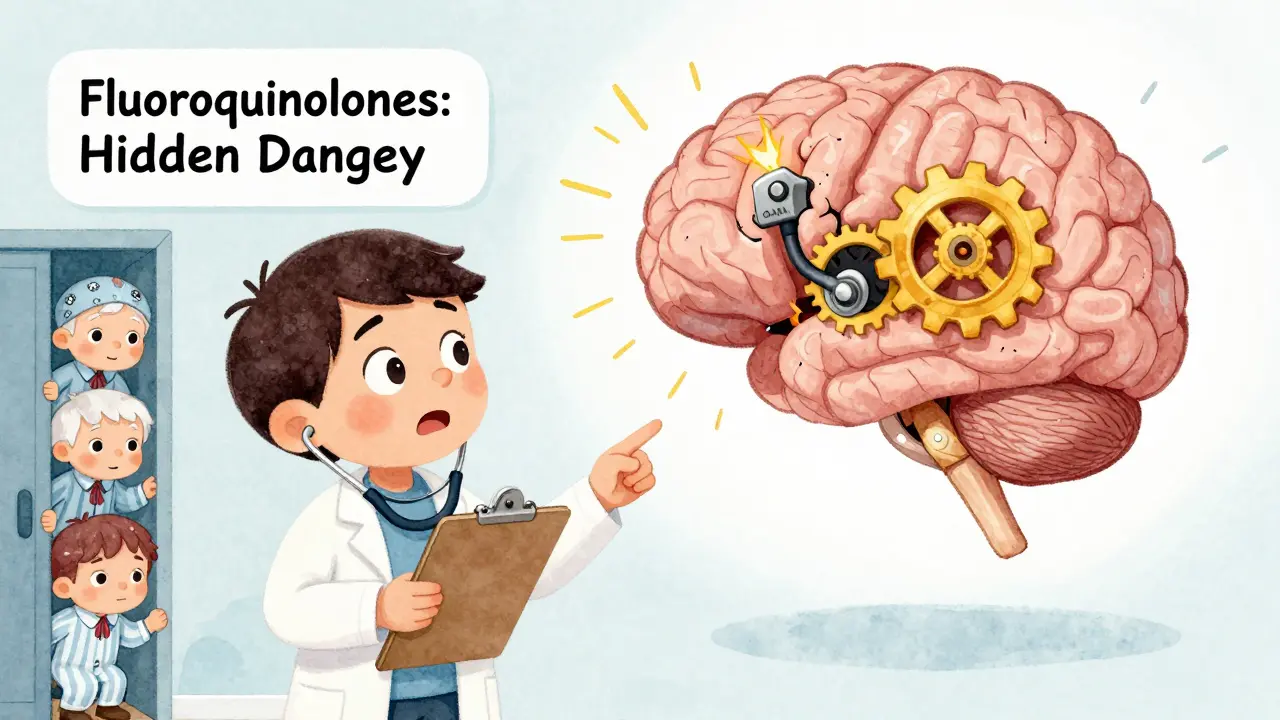
It’s not just about the infection. It’s about what the drug does inside the brain. Fluoroquinolones interfere with GABA, the brain’s main calming chemical. When GABA is blocked, brain activity goes into overdrive. Think of it like removing the brakes from a car. That’s when hallucinations, agitation, and confusion start.
Some fluoroquinolones also overstimulate NMDA receptors - the same ones targeted in some types of brain injury. This leads to excitotoxicity, a process where brain cells get overloaded and stressed. Older brains are especially vulnerable because they naturally have less GABA activity, weaker blood-brain barriers, and reduced kidney function. Since 85% of levofloxacin is cleared by the kidneys, even mild kidney decline can cause the drug to build up to dangerous levels.
Not all fluoroquinolones are equal. Levofloxacin and ciprofloxacin are the most frequently linked to delirium. Moxifloxacin and gemifloxacin are also risky, but less commonly reported. Why? Because they cross into the brain more easily than other antibiotics. Levofloxacin reaches 50-90% of plasma levels in cerebrospinal fluid - meaning it doesn’t just touch the brain. It floods it.
Who’s at Risk?
If you’re over 65, you’re already in the high-risk group. About 40% of hospitalized adults are over 65 - and nearly half of all hospital spending targets this group. But age isn’t the only factor.
- Renal impairment: Even mild kidney disease (CrCl under 50 mL/min) doubles the risk. Many older adults don’t know their kidney function is declining.
- Pre-existing cognitive issues: Even mild memory problems make someone far more susceptible.
- High doses: 750 mg daily of levofloxacin is twice the standard dose for UTIs. That’s often prescribed for "severe" infections - but is it necessary?
- Other medications: Combining fluoroquinolones with steroids, antipsychotics, or even some heart medications increases the risk.
One study found that 18% of all antibiotic-induced delirium cases were linked to fluoroquinolones - making them one of the top offenders, alongside certain antifungals and antivirals. Yet, most clinicians don’t think of antibiotics when someone suddenly becomes confused. They check for strokes, infections like sepsis, or metabolic imbalances. They rarely look at the medication list.
How Often Does This Happen?
You might think, "That’s rare." And technically, yes - fluoroquinolone-induced delirium accounts for less than 0.5% of all adverse reactions. But "rare" doesn’t mean insignificant. When you’re dealing with 26.9 million fluoroquinolone prescriptions in the U.S. in 2019 alone, even a 0.5% rate means over 134,000 people experienced serious cognitive side effects. Many were never diagnosed.
Real-world data from the FDA’s FAERS database shows 1,842 neuropsychiatric reports tied to fluoroquinolones between 2015 and 2020. That’s just what got reported. Most cases never make it into formal databases. Families assume it’s "just aging." Nurses think it’s "hospital delirium." Doctors assume it’s dementia flaring up.
But here’s the key: it’s reversible. In nearly every documented case, symptoms disappear within 48 to 96 hours after stopping the drug. That’s the difference between a week in the ICU and a quick recovery. The problem? Recognition is delayed - often by 24 to 48 hours. One doctor on Reddit said he’d seen three cases in 10 years. Each time, it took two days to realize the antibiotic was the cause.
What Should You Do?
If you or a loved one is over 65 and gets prescribed a fluoroquinolone, ask these questions:
- Is this infection serious enough to warrant a fluoroquinolone? Or could a safer antibiotic work?
- What’s my kidney function? Is the dose adjusted?
- Am I on any other medications that might interact?
- What are the signs of delirium? What should I watch for?
The American Geriatrics Society’s 2023 Beers Criteria lists fluoroquinolones as "potentially inappropriate" for older adults. That means they should be avoided unless there’s no other option. The CDC and FDA both say: reserve fluoroquinolones for infections with no alternative treatment.
Alternatives exist. For urinary tract infections, nitrofurantoin or trimethoprim-sulfamethoxazole are safer. For pneumonia, amoxicillin-clavulanate or doxycycline often work just as well - with far lower risk. Even cephalosporins like cefdinir are better choices than levofloxacin for many older patients.

What Happens If It’s Missed?
Delirium isn’t just uncomfortable. It’s dangerous. People who experience it are more likely to:
- Stay in the hospital longer - often by 3 to 7 extra days
- End up in a nursing home instead of returning home
- Suffer falls, pressure ulcers, or pneumonia from being bedridden
- Die - studies show delirium doubles the risk of death within a year
Dr. Shamik Bhattacharyya, who led a major review in Neurology, said: "People who have delirium are more likely to have other complications, go into a nursing home instead of going home after being in the hospital and are more likely to die than people who do not develop delirium."
And here’s the worst part: once someone survives fluoroquinolone-induced delirium, their brain may never fully recover. Some develop lasting memory problems. Others become more vulnerable to future episodes of delirium - even from minor infections or other medications.
What’s Changing?
Thankfully, things are shifting. After the FDA’s 2016 and 2018 warnings, fluoroquinolone prescriptions for older adults dropped by over 20%. Hospitals like UCSF cut levofloxacin use for UTIs by 35% after implementing risk-screening protocols. Pharmacies now flag high-risk patients before dispensing.
But the problem isn’t solved. Fluoroquinolones are still widely prescribed for uncomplicated infections. Many doctors still see them as "easy" solutions. And patients rarely question them.
Future solutions are coming. Researchers are looking for biomarkers to predict who’s most at risk. Some hospitals are building automated alerts in electronic health records. Drugmakers are testing new fluoroquinolone versions with less brain penetration.
But right now, the best protection is awareness. If you’re caring for an older adult, know the signs. If you’re a patient, ask for alternatives. Delirium isn’t inevitable. It’s preventable - if we stop treating it as normal aging and start seeing it for what it is: a drug reaction.
What to Do If Delirium Happens
If someone you care for suddenly becomes confused, hallucinating, or disoriented after starting an antibiotic:
- Stop the fluoroquinolone immediately - don’t wait for the doctor’s call.
- Call their doctor or go to urgent care. Say: "They started [drug name] and now they’re acting completely different. I’m worried it’s delirium."
- Bring the medication bottle. Many ERs don’t know fluoroquinolones can cause this.
- Request basic tests: electrolytes, kidney function, blood sugar, and a brain CT if needed.
- Ask: "Could this be caused by the antibiotic?"
Recovery is usually fast - but only if the drug is stopped early. Waiting 48 hours can mean an extra week in the hospital. Don’t wait.
Meanwhile, the pharmacy is still selling these like candy. Classic.
Share this. Print it. Stick it on the fridge. Someone you love might need this tomorrow.
Always ask: 'What’s new?' before assuming it’s aging. It’s not. It’s preventable. I wish every family had this post.