

For millions of people taking extended-release medications, especially for ADHD, the simple act of eating breakfast can make or break their entire day. It’s not just about hunger-it’s about how your body absorbs the medicine. If you take your pill with a big bowl of cereal one day and on an empty stomach the next, you might not even realize why your focus crashes by mid-morning. The truth? Breakfast timing isn’t a suggestion. For some medications, it’s a scientific requirement.
How Food Changes How Your Medicine Works
Extended-release medications are designed to release their active ingredients slowly over hours, not all at once. That’s why you only need to take them once a day. But that slow release doesn’t happen in a vacuum. What’s in your stomach when you swallow the pill matters a lot. Take ADDERALL XR, for example. It’s made of tiny beads that dissolve at different rates. When you eat a high-fat breakfast-say, bacon, eggs, and toast-before taking it, those beads don’t absorb as well. A 2002 study found that early drug exposure dropped by 30-40% when taken after breakfast. That means you might feel fine at 8 a.m., but by 10 a.m., your focus is gone. You think you’re just having a bad day. But it’s your medicine, not you. Now compare that to CONCERTA. It uses a completely different system called OROS-a tiny pump inside the pill that pushes the medicine out steadily, no matter what you’ve eaten. The same study showed less than 5% variation in drug levels whether CONCERTA was taken with food or on an empty stomach. That’s the difference between a reliable tool and one that works only when the conditions are perfect.Why ADHD Medications Are the Biggest Example
About 6.1 million children and teens in the U.S. have been diagnosed with ADHD. Most of them take stimulant medications in the morning to help them focus in school. But many parents and patients don’t know that the type of medication they’re using changes how food affects it. ADDERALL XR users often report wild swings in performance. One day, they’re sharp and calm. The next, they’re distracted, irritable, or even nauseous. That’s not normal mood variation. That’s inconsistent drug absorption. One Reddit user, who goes by PharmaStudent2020, switched from ADDERALL XR to CONCERTA after years of confusion: “My concentration would crash by 10 a.m. on school days when I ate breakfast-but I was fine on weekends when I skipped breakfast until noon.” Teachers and working adults feel this too. One user on Drugs.com wrote: “As an elementary school teacher, I need consistent morning focus. Taking CONCERTA with my breakfast ensures I don’t have to choose between eating and functioning.” That’s the kind of real-life impact most doctors never explain.It’s Not Just ADHD-Other Medications Are Affected Too
ADHD drugs get the most attention, but they’re not the only ones. Levothyroxine, used for hypothyroidism, absorbs up to 50% less when taken with food. That means you could be taking your full dose, but your body is only getting half. Your TSH levels stay high, your energy stays low, and your doctor keeps upping your dose-thinking you’re non-compliant. You’re not. You’re just eating breakfast too soon. GLP-1 agonists like semaglutide (Ozempic, Wegovy) require you to wait at least 30 minutes before eating. Take it with your coffee and bagel? You’re wasting money and missing out on weight loss or blood sugar control. Even cholesterol meds behave differently. Simvastatin and pravastatin work better when taken at night because your liver makes most cholesterol while you sleep. But atorvastatin? It doesn’t care. It’s long-lasting enough to stay effective no matter when you take it.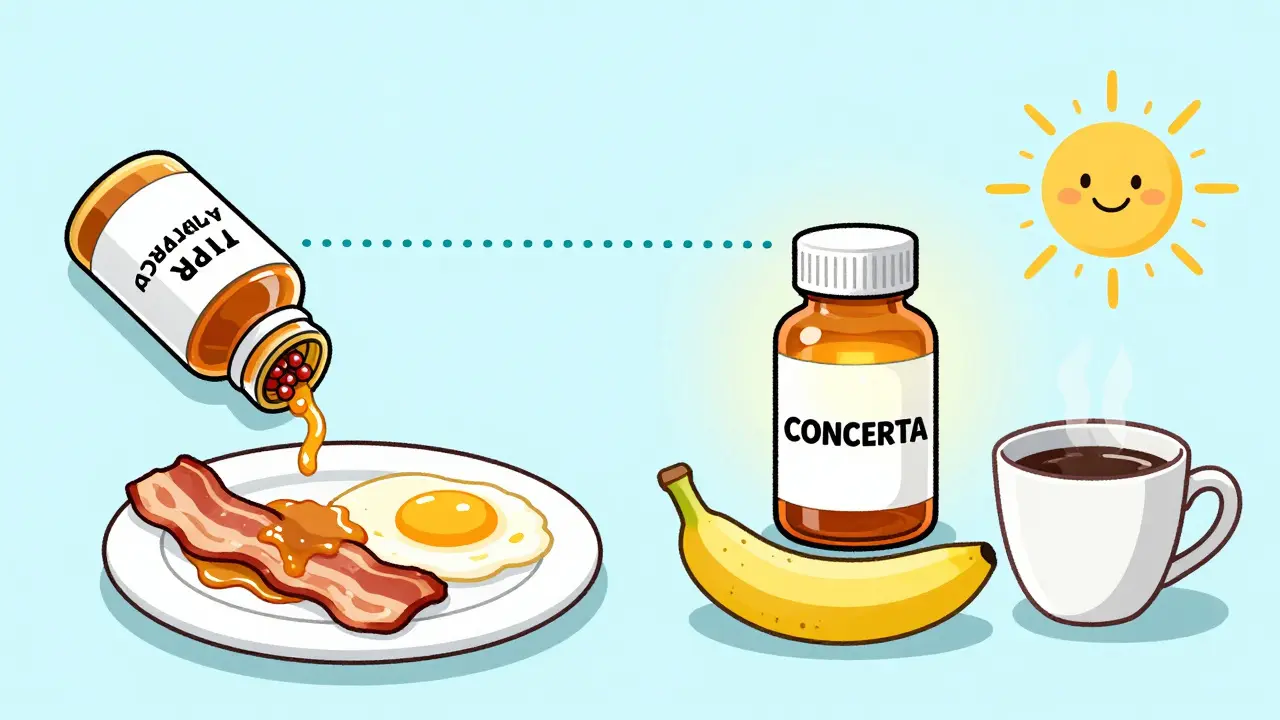
What Experts Say About Consistency
Dr. Jennifer Chen at Mount Elizabeth Hospital puts it plainly: “The timing of medication intake is a crucial aspect of effective and safe medication use. It can be just as significant as the medication itself.” The American Psychiatric Association found that spending just 15-20 minutes explaining timing rules during the first prescription visit reduces non-adherence by 37%. That’s huge. Most patients aren’t being told this stuff. They’re handed a pill bottle and told to “take it in the morning.” That’s not enough. The FDA agrees. In its 2023 draft guidance, they specifically recommend that doctors “counsel patients on the importance of consistent food timing relative to dose administration, particularly for medications known to have significant food effects.”Real-World Consequences of Inconsistent Routines
Inconsistent timing isn’t just annoying-it’s dangerous. The FDA estimates that poor medication routines contribute to 1.3 million adverse events in the U.S. every year. That includes hospital visits, overdoses, and treatment failures. One study of 1,247 ADHD patients found that 68% had better symptom control when they stuck to a consistent food-and-medication schedule. For 42% of them, the biggest improvement came from following food timing rules for their specific drug. Drugs.com reviews tell the story too. CONCERTA has a 7.4/10 average rating, with 62% of users saying it works consistently all day. ADDERALL XR? 7.1/10, and only 48% report steady effects. The difference? Food.
What You Should Do-Simple, Clear Steps
If you or someone you care about takes extended-release medication, here’s what to do:- Find out if your medication is affected by food. Check the prescribing information or ask your pharmacist. If it’s an OROS tablet (like CONCERTA), food likely doesn’t matter. If it’s bead-based (like ADDERALL XR), it does.
- Choose one routine and stick to it. Either always take it 30 minutes before breakfast, or always take it with a light snack. Never switch back and forth.
- If you need to eat with your pill, keep it small and low-fat. A banana or a handful of almonds won’t interfere like a full breakfast will. Avoid greasy, fried, or high-fat meals.
- Track your symptoms for a week. Use a simple scale: 1 = barely focused, 10 = crystal clear. Note what you ate and when you took your pill. You might be surprised by the pattern.
- Ask your doctor about switching. If you’re on ADDERALL XR and struggling with inconsistency, CONCERTA or other food-insensitive options might be a better fit. Don’t assume you have to live with the ups and downs.
The Bigger Picture: Why This Matters Now
The extended-release medication market is worth over $148 billion. And drugmakers are paying attention. Since 2018, 92% of new extended-release CNS drugs submitted to the FDA included food-effect studies. That’s up 45% from the previous decade. Companies know that patients will choose medications that work reliably, no matter what they eat. That’s why CONCERTA’s market share in pediatric ADHD jumped to 62% in 2022, while ADDERALL XR fell to 38%. It’s not just marketing. It’s science. People are voting with their prescriptions. New tech is making this even easier. Apps like MedMinder now give personalized reminders: “Take your pill 30 minutes before breakfast.” Beta testing showed 92% adherence. That’s not magic. That’s smart design. In the next few years, we’ll likely see personalized timing based on genetics. Some people metabolize stimulants faster or slower based on their CYP2D6 gene. By 2026, your doctor might tell you, “Take your pill with breakfast because your genes make you absorb it better that way.”Final Thought: Your Routine Is Your Medicine
Medication doesn’t work in isolation. It works with your life. If you’re eating breakfast at 7 a.m. on weekdays and 11 a.m. on weekends, your body doesn’t know the difference. It just knows the pill came at a different time, with different food, and that changes everything. You don’t need to be perfect. But you do need to be consistent. Pick a time. Pick a way. Stick with it. That’s the real secret to making extended-release medications work for you-not just on paper, but in your classroom, your office, your life.Does it matter if I take my ADHD medication with breakfast?
It depends on the medication. If you’re taking CONCERTA or other OROS-based formulations, food doesn’t significantly affect absorption. But if you’re taking ADDERALL XR, a high-fat breakfast can reduce early drug levels by 30-40%, leading to poor focus by mid-morning. Always take it the same way every day-either always with food or always on an empty stomach.
Why does my medication work on weekends but not on school days?
This is common with ADDERALL XR and similar bead-based medications. On weekends, you might skip breakfast or eat later, meaning you take your pill on an empty stomach. On school days, you eat breakfast right before or with your dose, which lowers drug absorption. The inconsistency in timing and food intake causes the difference in effectiveness.
Can I take my medication with just coffee and a muffin?
It depends. A small, low-fat snack like a banana or a few crackers is usually fine. But a muffin, especially if it’s buttery or frosted, can still interfere with absorption of medications like ADDERALL XR. Stick to simple, low-fat options if you must eat with your pill. For best results, take it 30 minutes before eating anything.
Is CONCERTA better than ADDERALL XR because of food effects?
For many people, yes. CONCERTA uses a patented OROS system that releases medication steadily regardless of food intake. ADDERALL XR’s bead-based system is more sensitive to stomach conditions. Studies and real-world reviews show CONCERTA delivers more consistent symptom control throughout the day, especially for people who eat breakfast regularly.
What if I feel nauseous taking my pill on an empty stomach?
Try a small, low-fat snack-like a slice of toast or a handful of almonds-about 15-20 minutes before your pill. Avoid greasy, sugary, or large meals. If nausea continues, talk to your doctor. You may be able to switch to a food-insensitive formulation like CONCERTA, or adjust your timing slightly.
Do thyroid or blood pressure meds also need consistent breakfast timing?
Yes. Levothyroxine (for thyroid) absorbs up to 50% less with food and should be taken 30-60 minutes before breakfast. Blood pressure meds like lisinopril or metoprolol are less affected-timing matters less than consistency. But for some statins like simvastatin, taking them at night works better. Always check your specific medication’s guidelines.
Bro, I took Adderall XR with a bacon cheeseburger at 7 a.m. and crashed by 9:30 like I’d been hit by a truck. Then I tried it on an empty stomach and boom - laser focus until 4 p.m. My teacher thought I was lazy. Turns out I was just eating wrong. This post saved my GPA. 🤯
While the anecdotal evidence presented is compelling, it is imperative to recognize that individual pharmacokinetic variability may significantly influence outcomes. A standardized approach to medication timing, while beneficial in population-level studies, may not universally apply without clinical supervision.
Let’s be real - this isn’t about breakfast. It’s about control. The pharmaceutical industry doesn’t want you to have agency over your own biology. They sell you a pill, then make you bend your entire morning ritual around it. CONCERTA isn’t better - it’s just a more expensive cage. They engineered the damn thing to be food-insensitive so you’d never question the system. You think you’re optimizing your focus? You’re just learning to obey.
And don’t get me started on the FDA’s ‘draft guidance.’ That’s corporate lobbying dressed as public health. They’re not protecting you. They’re protecting profit margins. Wake up.
It’s fascinating how the post conflates correlation with causation. The 30-40% reduction in drug exposure cited from the 2002 study was under controlled laboratory conditions with a specific meal composition - not the average American breakfast. Furthermore, the sample size was small, and no longitudinal data was presented. The anecdotal Reddit quotes are emotionally resonant but methodologically worthless. The real issue is that patients are being misinformed by oversimplified content designed for clicks, not clinical accuracy.
Also, the claim that 68% of ADHD patients improved with consistency? That’s from a single observational study with no control group. Please don’t treat Reddit as peer-reviewed literature.
I’ve been managing ADHD for 12 years, and this is the first time someone explained why my meds felt like a rollercoaster. I used to blame myself - ‘Why am I so unfocused today?’ Turns out, I was eating a bagel with cream cheese before my Adderall and wondering why I’d crash by lunch. Switched to taking it 45 minutes before breakfast with just water - life changed.
And yeah, CONCERTA’s a game-changer for people who can’t stick to a rigid schedule. But don’t just switch because it’s popular. Talk to your pharmacist. Track your symptoms. Your body’s not broken - it just needs consistency.
To anyone struggling: you’re not lazy. You’re not failing. You’re just using the wrong tool for your routine. There’s a better fit out there. Keep looking.
Everyone’s acting like this is groundbreaking. Newsflash: the FDA’s bioavailability guidelines for extended-release formulations have been public since 2005. The 2002 study you cited? I’ve read it. It’s in the Adderall XR prescribing info. You don’t need Reddit to tell you to take your meds on an empty stomach. You need to read the damn label.
Also, levothyroxine? That’s been common knowledge since the 80s. People just don’t read. And now you’re turning pharmacology into a lifestyle blog. Chill.
It’s not about breakfast. It’s about American dietary collapse. We’ve normalized greasy, high-fat meals as ‘normal breakfasts’ - bacon, sausage, hash browns, pancakes with syrup. No wonder your meds don’t work. Your body’s in a state of metabolic chaos. The solution isn’t switching to Concerta - it’s eating like a human. A boiled egg. Some berries. A cup of black coffee. That’s not ‘dieting.’ That’s basic physiology.
And if you can’t manage that? Maybe your problem isn’t ADHD. Maybe it’s your entire lifestyle.
OMG I cried reading this. I’m a single mom and I take Adderall XR. I used to eat cereal with my pill because I was rushing to get the kids to school. Then I’d be useless by 10 a.m. My kids thought I was ‘being mean.’ Turns out I was just running on empty meds.
I started taking it 30 mins before breakfast with a banana - and now I can actually help with homework. I’m not perfect. But I’m present. Thank you for saying this out loud.
This is the epitome of medical infantilization. You’re telling people to ‘track their symptoms’ and ‘ask their doctor’ like they’re children who can’t handle responsibility. Medication isn’t a magic bullet. It’s a tool. And if you can’t manage the timing of a pill with your meals, perhaps you shouldn’t be taking it at all. Your life is your responsibility - not your pharmacist’s.
THIS. IS. EVERYTHING. 💔 I took Adderall XR with my coffee and croissant every day for 3 years. Thought I was just ‘bad at focus.’ Turned out I was wasting $300/month. Switched to Concerta. Now I’m not just functional - I’m thriving. I even made a sticky note: ‘PILL FIRST. BREAKFAST LATER.’ 😭🙌
why does everyone act like this is news? i’ve been on meds since i was 8 and my mom yelled at me every morning to take it before i ate anything. i didn’t even know it was a ‘thing’ until i read this. we were just doing what we were told. no one told us why. that’s the real tragedy.
Consistency isn’t about discipline. It’s about rhythm. Your body doesn’t think in schedules - it thinks in patterns. When you disrupt the rhythm - food, sleep, meds - your nervous system doesn’t know how to respond. It’s not about the pill. It’s about harmony. The real question isn’t ‘when should I take it?’ It’s ‘what kind of life am I building around this pill?’
Maybe the goal isn’t to optimize absorption. Maybe it’s to build a life where you don’t need to optimize everything just to feel human.