
What Exactly Is Arthritis?
Arthritis isn’t just one condition-it’s more than 100 different diseases that target your joints. But when people say "arthritis," they’re usually thinking about two main types: osteoarthritis and rheumatoid arthritis. These two are wildly different in how they start, how they act, and how they’re treated. Getting them mixed up can lead to the wrong care, and that can make things worse.
Osteoarthritis: The Wear-and-Tear Type
Osteoarthritis (OA) is the most common form of arthritis in the U.S., affecting about 32.5 million adults. It’s not an autoimmune disease. It’s not caused by your immune system attacking you. It’s simple mechanical breakdown. Cartilage-the soft cushion between your bones-wears down over time. When that happens, bone rubs on bone. That’s where the pain, creaking, and stiffness come from.
It usually shows up in joints that carry weight or get lots of use: knees, hips, spine, and hands. In the hands, you’ll often see bony bumps near the fingertips (called Heberden’s nodes) or in the middle joints (Bouchard’s nodes). These are classic signs of OA.
Pain from OA gets worse when you move the joint and improves when you rest. Morning stiffness? It’s usually short-less than 30 minutes. You might feel it after sitting for a while, but it clears up fast once you get moving.
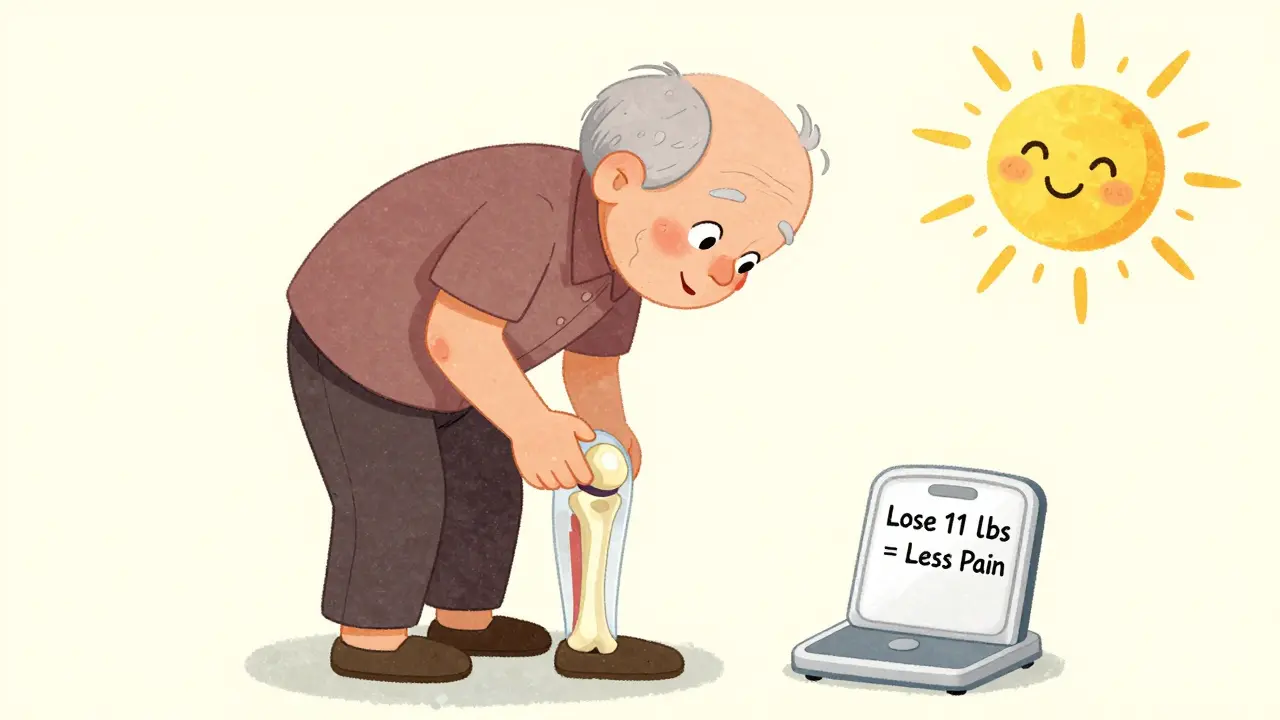
Age is the biggest risk factor. Most people start noticing symptoms after 50. But obesity plays a huge role too. If you’re carrying extra weight, your knees take the hit. Losing just 5 kilograms (about 11 pounds) can cut knee pain in half. Smoking doesn’t raise your risk for OA, but it can slow healing and make pain harder to manage.
Rheumatoid Arthritis: The Body Turns on Itself
Rheumatoid arthritis (RA) is the opposite of OA. It’s an autoimmune disease. That means your immune system, which normally fights germs, gets confused and starts attacking your own joints. It targets the synovium-the lining around the joint. That causes swelling, heat, and pain. Left untreated, this inflammation can destroy cartilage and bone within months.
RA doesn’t wait until you’re old. It can strike at any age, even in teens and young adults. Juvenile idiopathic arthritis is the childhood version. Women are more likely to get it than men.
The symptoms are different. Stiffness in the morning lasts more than an hour-sometimes hours. Pain and swelling happen on both sides of the body at the same time. If your left wrist is swollen, your right one will be too. That symmetry is a red flag for RA.
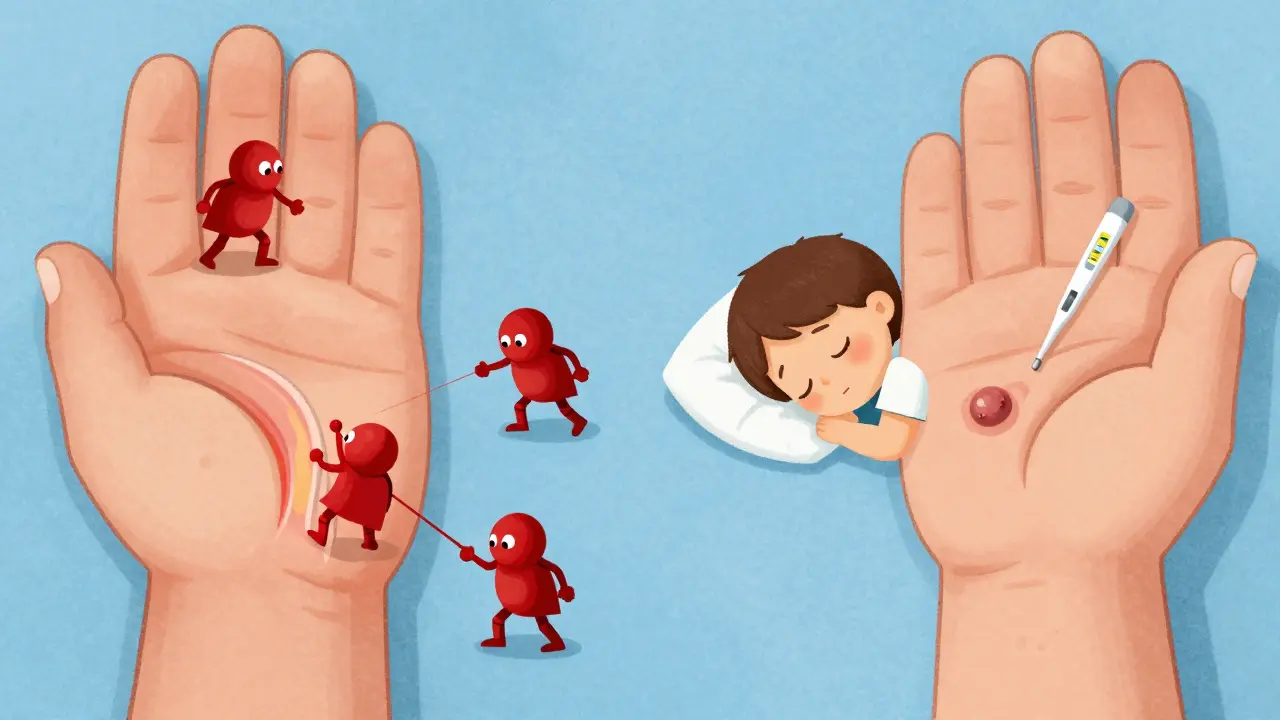
RA doesn’t stop at the joints. It can affect your lungs, heart, eyes, and even your skin. You might get tired all the time, lose weight without trying, or have low-grade fevers. Some people develop firm lumps under the skin near joints-called rheumatoid nodules. You won’t see those with OA.
Smoking is a major trigger for RA. People who smoke have two to three times higher risk. Genetics matter too. If you carry certain genes like HLA-DRB1, your chances go up. But even with those genes, you won’t get RA unless something-like smoking or an infection-triggers it.
How They’re Diagnosed
Doctors don’t just guess. They use tools to tell the difference.
For OA, an X-ray is usually enough. You’ll see narrowed joint space, bone spurs, or changes in the bone shape. Blood tests? They’re usually normal. That’s a clue.
For RA, blood tests are critical. Two key markers are checked: rheumatoid factor (RF) and anti-CCP antibodies. If both are positive, it strongly points to RA. But even if they’re negative, RA can still be there-about 20% of people with RA test negative. That’s why doctors also look at symptoms, joint patterns, and sometimes ultrasound or MRI to spot early inflammation.
Ultrasound is becoming more common for early RA. It can see swelling in the synovium before X-rays show damage. That’s important because treatment works best when started early.
Treatment: Night and Day Differences
OA and RA need completely different treatments. Mixing them up can be dangerous.
For OA, the goal is to reduce pain and keep you moving. Weight loss is the most effective thing you can do. Physical therapy helps strengthen muscles around the joint. NSAIDs like ibuprofen help with pain and inflammation. Injections of corticosteroids or hyaluronic acid can give temporary relief. Platelet-rich plasma (PRP) is being tried more often, but evidence is still mixed. When everything else fails, joint replacement surgery is common-about 90% of all joint replacements in the U.S. are for OA.
For RA, it’s not about comfort-it’s about stopping damage. You need disease-modifying drugs right away. Methotrexate is the first-line treatment. If that’s not enough, biologics like adalimumab or TNF inhibitors are used. Newer options like JAK inhibitors (tofacitinib) work by blocking signals in the immune system. These drugs can slow or even stop joint damage. The window for best results? The first 3 to 6 months after symptoms start. Delay treatment, and you risk permanent deformity.
RA patients rarely need joint replacements as their first step. When they do, it’s often after years of damage. They might also need tendon repairs or synovectomy (removal of inflamed joint lining).
Other Arthritis Types You Should Know
OA and RA make up most cases, but they’re not the only ones.
- Gout: Caused by uric acid crystals building up in joints, usually the big toe. Pain hits fast-often overnight-and is intense. Diet (red meat, alcohol) plays a big role.
- Psoriatic Arthritis: Comes with psoriasis (scaly skin patches). It can affect fingers, toes, spine, and even cause swelling in entire fingers (dactylitis).
- Ankylosing Spondylitis: Affects the spine and sacroiliac joints. Causes stiffness in the lower back, especially in the morning. More common in men.
- Lupus Arthritis: Part of systemic lupus. Joints hurt and swell, but unlike RA, it rarely causes permanent damage.
Each has its own triggers, tests, and treatments. But if you’re unsure what you have, start with OA and RA-they’re the most common and the most easily confused.
Why Getting It Right Matters
Imagine being told you have OA and given painkillers. You take them, but your joints keep swelling, you’re exhausted, and you’re losing weight. You’re not getting better because you’re not treating the real problem. That’s what happens when RA is missed.
On the flip side, if you have OA but get a powerful immune-suppressing drug meant for RA, you’re risking infections, liver damage, or other side effects for no benefit.
Doctors see this mix-up more often than you’d think. Especially in the hands. Both OA and RA can cause pain there. But OA hits the end joints of fingers; RA hits the knuckles and wrists. That small detail changes everything.
There’s no cure for either OA or RA. But with the right diagnosis, you can control symptoms, protect your joints, and keep living your life. For RA, early treatment can mean remission. For OA, lifestyle changes can slow it down-maybe even stop it from getting worse.
What You Can Do Today
- If you have joint pain lasting more than 6 weeks, especially with morning stiffness over an hour, see a rheumatologist-not just your primary doctor.
- Keep a symptom journal: When does pain happen? What makes it better or worse? Are both sides affected?
- Don’t ignore fatigue or fever with joint pain. That’s not normal for OA.
- If you’re overweight, losing even a few pounds reduces pressure on your knees and hips.
- Quit smoking. It raises your risk for RA and makes OA pain worse.
Arthritis doesn’t have to mean giving up movement. But you need to know what you’re dealing with. Get the right diagnosis. Start the right treatment. And don’t wait.
Can osteoarthritis turn into rheumatoid arthritis?
No. Osteoarthritis and rheumatoid arthritis are completely different diseases with different causes. OA is mechanical wear and tear; RA is autoimmune. One doesn’t become the other. But it’s possible to have both at the same time-especially as you age. That’s why accurate diagnosis matters.
Is arthritis only a problem for older people?
Not at all. While osteoarthritis is more common after 50, rheumatoid arthritis can start at any age-even in children. Juvenile idiopathic arthritis affects kids under 16. Gout and psoriatic arthritis often strike people in their 30s and 40s. Arthritis isn’t just an "old person’s disease."
Do blood tests always show rheumatoid arthritis?
No. About 20% of people with RA test negative for rheumatoid factor (RF) and anti-CCP antibodies. That’s called seronegative RA. Doctors don’t rely on blood tests alone. They look at symptoms, joint patterns, swelling, and imaging like ultrasound to make the call.
Can I prevent arthritis?
You can’t prevent RA-it’s autoimmune and tied to genetics and triggers like smoking. But you can lower your risk for osteoarthritis by maintaining a healthy weight, staying active, and avoiding joint injuries. Quitting smoking also helps reduce RA risk. Prevention isn’t guaranteed, but your choices matter.
Are natural remedies like turmeric or fish oil helpful?
Some people find relief from turmeric or omega-3s (fish oil) for mild joint pain. They may reduce inflammation a little, but they won’t stop joint damage in RA or reverse cartilage loss in OA. They’re not replacements for proven treatments. Always talk to your doctor before using supplements-some can interact with RA medications.
Just had my first rheumatoid flare last month and this post saved my sanity. I thought it was just "old age" until my wrists swelled up like balloons. Took me 8 months to get a rheum doc-don’t wait like I did. Start with blood tests, even if you think it’s OA. You’re not crazy, it’s real.
Of course the medical industry wants you to believe there are two types. They sell two different drugs. The real cause? Glyphosate in your food, GMOs, and vaccines poisoning your immune system. OA and RA are both symptoms of corporate poison. Ask yourself: who profits?
While the article is generally accurate, it fails to mention that IL-6 inhibitors are now first-line for seronegative RA patients who don't respond to methotrexate. Also, hyaluronic acid injections for OA have been shown in multiple meta-analyses to offer no clinically significant benefit over placebo after 6 months. Please update your sources.
RA doesn't care if you're 18 or 80. It just shows up like a ghost and says, 'Hey, your body hates you now.' And then it steals your mornings.
Interesting how everyone talks about OA and RA like they’re the only two. But what if it’s not about joints at all? What if it’s about your liver being clogged from years of processed food? Or your gut microbiome screaming for help? We’re treating symptoms like they’re the disease. We’re missing the forest for the trees.
Yeah right. "Quit smoking to prevent RA." Like that’s the real problem. The real problem is Big Pharma pushing pills instead of letting you eat real food. They want you dependent. They made arthritis a lifetime subscription. Wake up.
My grandma had OA. My mom has RA. I’m 29 and already feeling it in my knuckles. I started walking daily and eating more greens. Not a cure, but I’m not giving up. You’re not too young to care. 💪
America’s obesity crisis is why everyone has OA. Stop blaming age. Blame burgers and soda. We need a national joint health initiative. Not more pills. More accountability.
My sister got diagnosed with seronegative RA last year-blood tests were negative, but her ultrasound showed inflammation in her metacarpals. She started on methotrexate and now she’s hiking again. I cried when she sent me the photo. Early detection isn’t just helpful-it’s life-changing. 🙏
I used to think arthritis was just creaky knees. Then I watched my husband go from typing emails to crying because he couldn’t hold a coffee cup. That’s not aging. That’s betrayal. By your own body. And no, turmeric won’t fix it. Just like aspirin won’t fix a broken heart.
They say RA isn't genetic. But in India, everyone knows: if your aunt has it, you will too. The doctors here ignore it until you can't walk. Then they say 'take this pill.' No one asks why it started. No one looks at the water. Or the air. Or the stress. We are all just waiting to break.