
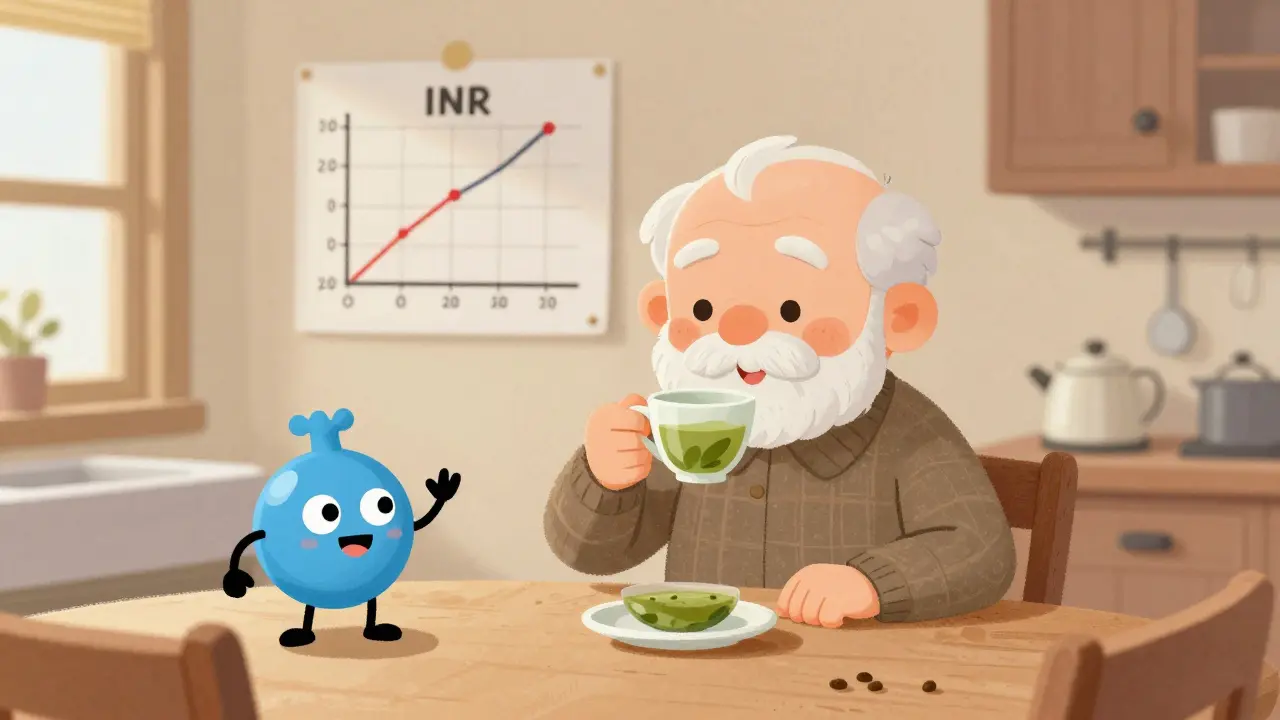
Warfarin Green Tea Intake Calculator
Green Tea Intake Calculator
Determine if your green tea consumption is within safe limits while taking warfarin. This tool calculates the potential impact on your INR based on your intake.
If you're taking warfarin to prevent dangerous blood clots, you’ve probably been told to watch your diet. But what about green tea? It’s healthy, refreshing, and packed with antioxidants - so why would it matter? The truth is, green tea can quietly mess with your INR levels, and if you’re drinking it daily without knowing how, you could be putting yourself at risk.
How Warfarin Actually Works
Warfarin, sold under brand names like Coumadin and Jantoven, doesn’t thin your blood like water. Instead, it blocks vitamin K from doing its job. Vitamin K is essential for making clotting factors - proteins your body needs to stop bleeding. Without enough active vitamin K, your blood takes longer to clot. That’s the goal when you have atrial fibrillation, a mechanical heart valve, or a history of deep vein clots.
Your doctor checks your INR (International Normalized Ratio) regularly to make sure your blood is clotting at the right speed. Too low - under 2.0 - and you’re at risk for clots. Too high - over 3.5 - and you could bleed internally without warning. The sweet spot? Usually between 2.0 and 3.0, depending on your condition.
Green Tea Has Vitamin K - But Not Much in a Cup
Here’s where it gets confusing. Green tea leaves are loaded with vitamin K - about 1,428 micrograms per 100 grams of dried leaves. But when you brew a cup, most of that stays in the leaf. The actual amount in your tea? Roughly 0.03 micrograms per 100 grams of brewed tea. That’s tiny.
Compare that to spinach: 483 micrograms per 100 grams. Or broccoli: 141 micrograms. A single serving of either has more vitamin K than a whole gallon of green tea. So why the warning?
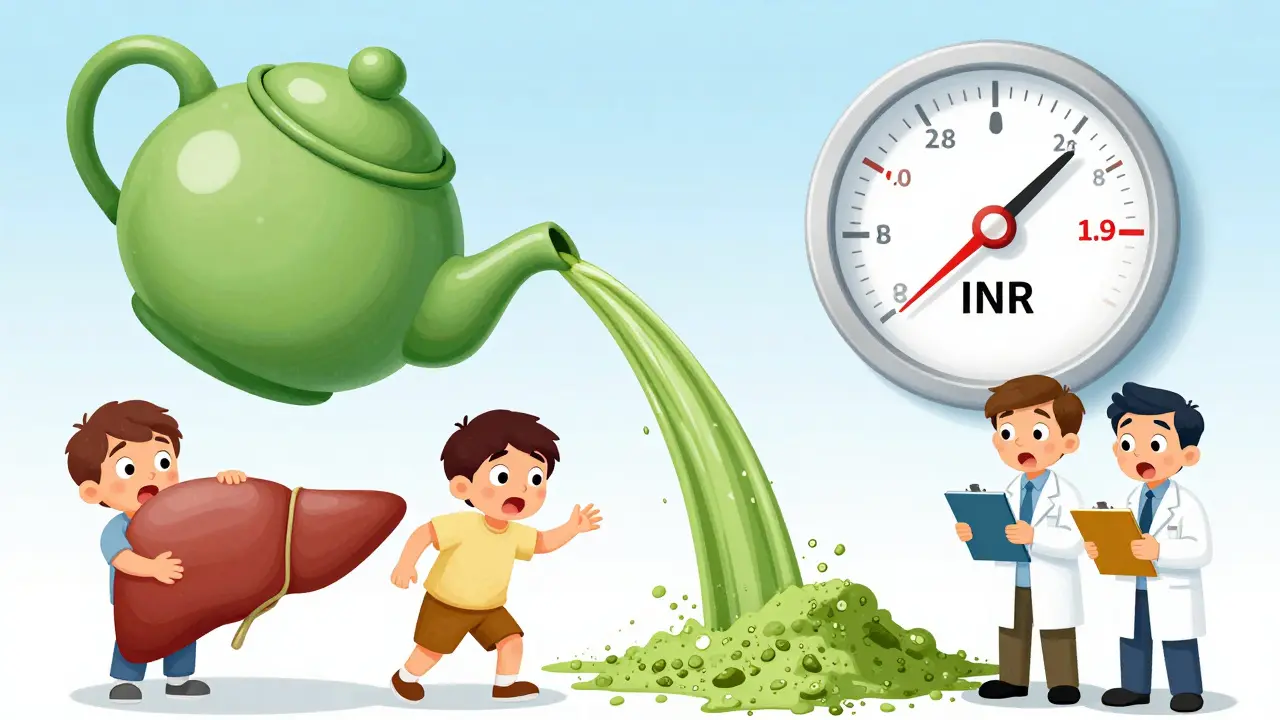
The problem isn’t one or two cups. It’s what happens when you drink more than a gallon a day. In documented cases, people who guzzled 0.5 to 1 gallon of green tea daily saw their INR drop from 3.8 to 1.4 - a dangerous plunge that put them at risk for stroke or clotting. One case from 2006 involved a man on 7.5 mg of warfarin whose blood started clotting normally again because his body had so much extra vitamin K from the tea.
Not All Green Tea Is the Same
Here’s the twist: not every green tea behaves the same. Regular brewed green tea? Low risk. Matcha? That’s a different story.
Matcha is made from ground whole tea leaves. You’re not drinking an infusion - you’re consuming the leaf itself. That means you’re getting way more vitamin K. One study found matcha has 10 to 20 times the vitamin K of regular brewed green tea. People who switched to daily matcha lattes saw their INR drop from 2.8 to 1.9 in just two weeks. Their warfarin dose had to be increased by 15% to compensate.
Even brewing method matters. Hot water pulls more vitamin K out of the leaves than cold brew. So if you’re sipping iced green tea all day, you might be safer than someone drinking three hot cups.
It’s Not Just Vitamin K - There’s a Paradox
Green tea also contains catechins - powerful antioxidants that can actually slow blood clotting by interfering with platelet function. That means, theoretically, green tea could make warfarin work better, not worse.
So why do we mostly see INR dropping? Because vitamin K’s effect is stronger and more direct. The catechins might help a little, but they don’t cancel out the vitamin K. It’s like trying to put out a fire with a bucket of water while someone keeps pouring gasoline on it.
That’s why some people report stable INRs on two cups of green tea daily - their vitamin K intake is low enough that the catechins’ effect doesn’t tip the balance. Others who switch to matcha or start drinking gallons of tea suddenly see their numbers crash.
What Do Experts Really Say?
The American Heart Association says you can safely drink up to three cups of green tea a day without changing your warfarin dose - as long as you keep it consistent. That’s the key word: consistent.
Going from zero tea to five cups a week? That’s risky. Drinking two cups every day for months, then suddenly stopping? Also risky. Your body gets used to a steady level of vitamin K. Change that, and your INR swings.
Dr. John Smith from Mayo Clinic says matcha is the real red flag. “We’ve seen 15% of matcha users need dose adjustments,” he told Mayo Clinic Proceedings in 2023. “It’s not the tea - it’s the powder.”
Meanwhile, the University of California San Diego guidelines say: “May lower INR in large (i.e., >1 gallon/day) quantities.” They don’t warn about one or two cups. They warn about gallons.
Real People, Real Results
Online communities tell the real story. On Reddit’s r/Warfarin, users share what works - and what doesn’t.
One user, “ClotFreeSince2018,” drank four matcha lattes a day for two weeks. His INR dropped from 2.8 to 1.9. He had to increase his warfarin dose. Another, “TeaLover87,” drank two cups of regular green tea daily for five years - INR stayed rock solid between 2.3 and 2.6.
On PatientsLikeMe, 8.7% of warfarin users said green tea affected their INR - but almost all of them were drinking more than 500 mL (about 2 cups) daily. Most didn’t realize it was the tea until their INR went haywire.
A 2022 survey found 62% of warfarin users had no idea green tea could interfere - until they experienced it themselves. That’s a scary gap in education.
What Should You Do?
Here’s the practical guide:
- If you drink 1-3 cups (240-720 mL) of regular brewed green tea daily: Keep doing it - but don’t change your habit. Don’t start drinking it if you didn’t before. Don’t quit cold turkey. Consistency is everything.
- If you drink more than 720 mL (3 cups) daily: Talk to your anticoagulation clinic. You may need your INR checked every two weeks instead of monthly.
- If you drink matcha: Treat it like a new medication. Tell your doctor. Get an INR check within a week of starting. Be prepared to adjust your warfarin dose.
- If you drink more than 1,000 mL (1 quart) daily: Stop. This is dangerous. Your INR can drop fast. Call your doctor immediately.
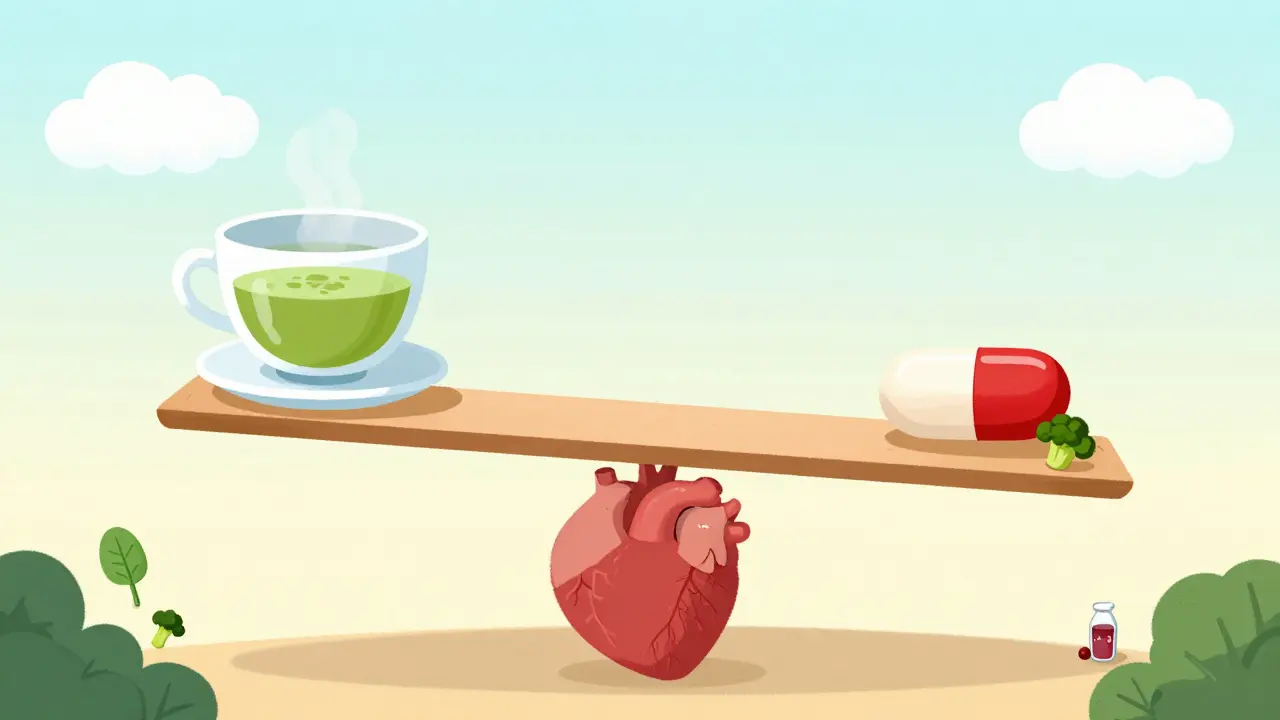
Don’t avoid green tea out of fear. Avoid changing how much you drink. That’s what causes the spikes and drops.
What About Other Teas?
Black tea? Similar to green tea in vitamin K content - low in brewed form. But if you’re drinking a gallon of it daily, same rules apply.
Herbal teas? Most don’t have vitamin K. But some - like ginkgo, goji berry, or ginger - can affect platelets or liver enzymes and change how warfarin works. Don’t assume they’re safe just because they’re “herbal.”
Cranberry juice? That’s a different beast. It can raise your INR by interfering with how your body breaks down warfarin. Green tea? It lowers it by giving you vitamin K. Opposite effects - same warning: keep it steady.
The Bigger Picture
Warfarin is still the go-to drug for mechanical heart valves and some clotting disorders. Newer blood thinners like apixaban or rivaroxaban don’t interact with vitamin K - so they’re easier to manage. But they’re not for everyone. If you’re on warfarin, you’re likely on it for a reason.
And you’re not alone. About 2.5 million Americans take it. Nearly 30 million drink tea daily. That’s a lot of people who could be at risk - not because they’re doing something wrong, but because no one told them how to do it right.
The good news? You don’t need to quit green tea. You just need to be smart about it. Track your intake. Stick to your routine. Talk to your doctor before making changes. And if you’re switching to matcha? Don’t guess - test your INR.
Green tea isn’t the enemy. Inconsistency is.
Can I drink green tea while on warfarin?
Yes - but only if you keep your intake consistent. One to three cups of regular brewed green tea per day is generally safe for most people on warfarin. The key is not to suddenly start drinking it, stop drinking it, or increase your amount. Changes in intake can cause your INR to swing dangerously.
Does green tea lower INR levels?
Yes - but only at very high doses. Drinking more than one gallon (about 3.8 liters) of green tea daily can flood your system with vitamin K, which directly counteracts warfarin and causes INR to drop. This has been documented in multiple case reports. Normal consumption (1-3 cups) does not have this effect.
Is matcha safer or riskier than regular green tea?
Matcha is significantly riskier. Because you consume the entire ground tea leaf, matcha contains 10 to 20 times more vitamin K than brewed green tea. Even one or two servings daily can lower INR enough to require a warfarin dose adjustment. If you use matcha, tell your doctor and get your INR checked within a week of starting.
How much green tea is too much on warfarin?
More than 720 mL (3 cups) daily is considered high risk and should be discussed with your anticoagulation provider. More than 1,000 mL (1 quart) daily is dangerous and can cause your INR to drop into unsafe levels. If you regularly drink this much, your INR should be checked every two weeks instead of monthly.
Should I stop drinking green tea if I’m on warfarin?
No - unless your doctor tells you to. Stopping green tea suddenly can raise your INR, increasing bleeding risk. The goal isn’t to eliminate it, but to keep your intake stable. If you’ve been drinking it for months, keep going. If you haven’t, don’t start unless you’re ready to monitor your INR closely.
What other teas should I avoid on warfarin?
Avoid herbal teas that affect platelets or liver enzymes, like ginkgo, goji berry, ginger, or dong quai. These can increase bleeding risk. Cranberry juice should also be avoided - it raises INR by interfering with warfarin metabolism. Black tea is generally safe in moderation, same as green tea.
Just wanted to say this post saved my life. I was drinking 3 cups of matcha daily and didn’t realize it was messing with my INR. Got checked after a weird bruise and my levels dropped to 1.6. Now I stick to one cup of regular green tea in the morning and my numbers are stable. Consistency is everything, folks.
Let’s be clear-this is why Americans can’t handle basic biochemistry. You’re telling people to drink tea like it’s a pharmaceutical protocol? The fact that someone needs to track ‘gallons’ of green tea to understand warfarin interaction speaks volumes about the state of public health literacy. If you can’t manage a vitamin K balance, maybe you shouldn’t be on warfarin at all.
As someone who’s lived in India and the US, I’ve seen this play out both ways. In India, people brew green tea with milk and sugar and drink it all day-no one even thinks about INR. But here? We turn everything into a medical emergency. The truth? Most people who drink 1-2 cups daily are fine. The real danger is the sudden switch-like going from zero to matcha lattes every morning. That’s when your doc needs to know. Don’t panic. Just don’t change your habits.
Thank you for writing this. I’ve been on warfarin for 8 years and started drinking iced green tea last year. Didn’t think twice until my INR went up. Turned out I’d switched from hot to cold brew and suddenly my tea was weaker-less vitamin K. So my body was getting less K, meaning warfarin worked harder. My dose had to go down. It’s wild how tiny changes matter.
So let me get this straight: if I drink three cups of regular green tea every day, I’m fine? But if I suddenly switch to matcha, I’m in danger? And if I stop drinking it entirely, I’m in danger again? I’m starting to think the real enemy here is my own brain. Why does everything have to be so complicated? I just want to sip tea without doing a PhD in pharmacology.
Of course the one person who actually read the entire 2000-word post is the one who’s now telling everyone to ‘just be consistent.’ Meanwhile, the rest of us are just trying not to bleed out or clot while also remembering to take our meds, avoid cranberry juice, and now… monitor tea leaf concentration. Honestly? I’m just waiting for the next study that says ‘dark chocolate interferes with warfarin because of theobromine.’
Look, I’m from Australia. We don’t drink this much tea. We drink coffee. And we don’t have people freaking out over a cup of green tea. This whole thing feels like American medical overreach. If you’re on warfarin, just take your meds and stop obsessing over plants. You’re not a lab rat.
Who wrote this? Probably some Big Pharma shill. Matcha is 10x the vitamin K? That’s not science-that’s a scare tactic. The real issue? They want you to switch to those fancy new blood thinners that cost $500 a month. Green tea is natural. Vitamin K is natural. Warfarin? That’s synthetic poison. The system doesn’t want you to know you can fix this with a leaf, not a pill.